ANALYSIS
Why is the North Atlantic cooling? A study suggests the AMOC is weakening, a key ocean circulation that regulates the global climate
Since the late 19th century, while the rest of the planet and its oceans have warmed steadily, a vast region south of Greenland and Iceland has experienced significant cooling, both at the surface and in the depths.
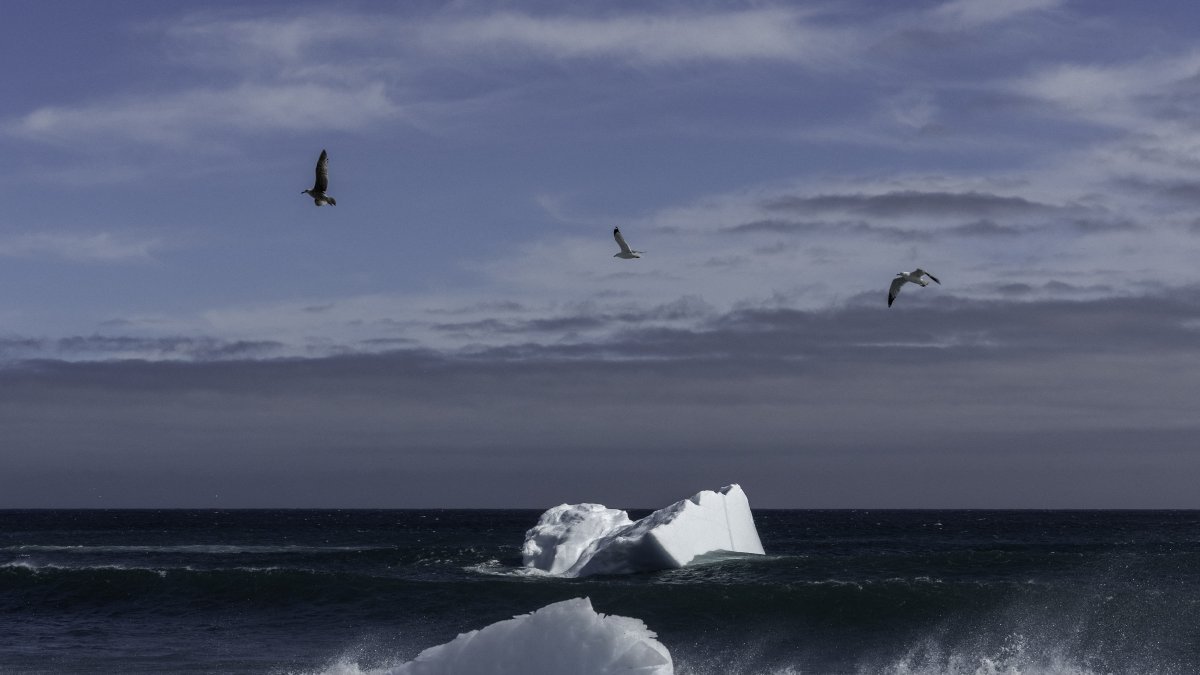
An iceberg floats in the waters of the Atlantic Ocean

A new study in Geophysical Research Letters appears to shed light on the mystery of the cooling zone in the North Atlantic, known as the "Cold Blob." According to the study, this cooling is not due to changes in the atmosphere, but rather to the weakening of the Atlantic Meridional Overturning Circulation (AMOC).
What is the “Cold Blob”?
Since the late 19th century, while the rest of the planet and its oceans have warmed steadily, a vast region south of Greenland and Iceland has experienced significant cooling, both at the surface and in the depths. This anomaly, which has dropped by nearly 1.8 degrees Fahrenheit since 1900, is the only oceanic region in the world that shows this trend contrary to global warming.
For years, scientists have debated two possible causes:
- Increased heat loss to the atmosphere due to changes in winds and clouds.
- A reduction in ocean heat transport to the region.
The study that resolves the debate
The team led by Stefan Rahmstorf of the Potsdam Institute for Climate Impact Research analyzed observational data on ocean heat content dating back to 1955, reanalyses of surface fluxes (ERA5, NCEP, and JRA-3Q) and climate models.
The main conclusion of the study:
The cooling of the "Cold Blob" cannot be explained by increased heat loss at the surface. In fact, the multi-decadal variability of heat content is dominated by changes in ocean heat transport.
This means that the AMOC, the great oceanic "conveyor belt" that carries warm water from the tropics northward, is delivering less heat to this region.
Why is this important?
Further weakening or collapse of the AMOC could lead to:
- Accelerated sea-level rise along the east coast of the United States.
- Much colder and more extreme winters in Europe.
- Severe disruptions to the monsoons in Africa and Asia.
- Drastic changes in global precipitation patterns.
Solid evidence
The study demonstrates that the cooling is not limited to the ocean surface, but occurs throughout the water column, from the surface to depths exceeding 3,280 feet. Furthermore, periods of reduced ocean heat transport coincide perfectly with the cooling phases of the "Cold Blob," while heat loss to the atmosphere acts primarily as a response rather than the main cause of the phenomenon.
Added to this is abundant independent evidence of the weakening of the AMOC, which includes paleoclimate data, salinity measurements, observations of the shift in the Gulf Stream, and various historical reconstructions.
A serious warning
The authors conclude that the "Cold Blob" is not just a surface phenomenon, but a deep loss of ocean heat caused mainly by a weakening of the AMOC. Although some uncertainties remain because of the limited long-term data, the observational evidence reinforces the view that this weakening is driven by global warming, especially by the increase in freshwater from Greenland’s melting ice. The researchers warn that this is a matter of major concern, given the existence of a tipping point in the AMOC.
LATEST