The man who stabbed Salman Rushdie has been found guilty of an 'act of terrorism' in federal court
Hadi Matar, who was already sentenced to 25 years in prison by a New York state court in May 2025 for this attempted murder of the author, now faces life in prison.
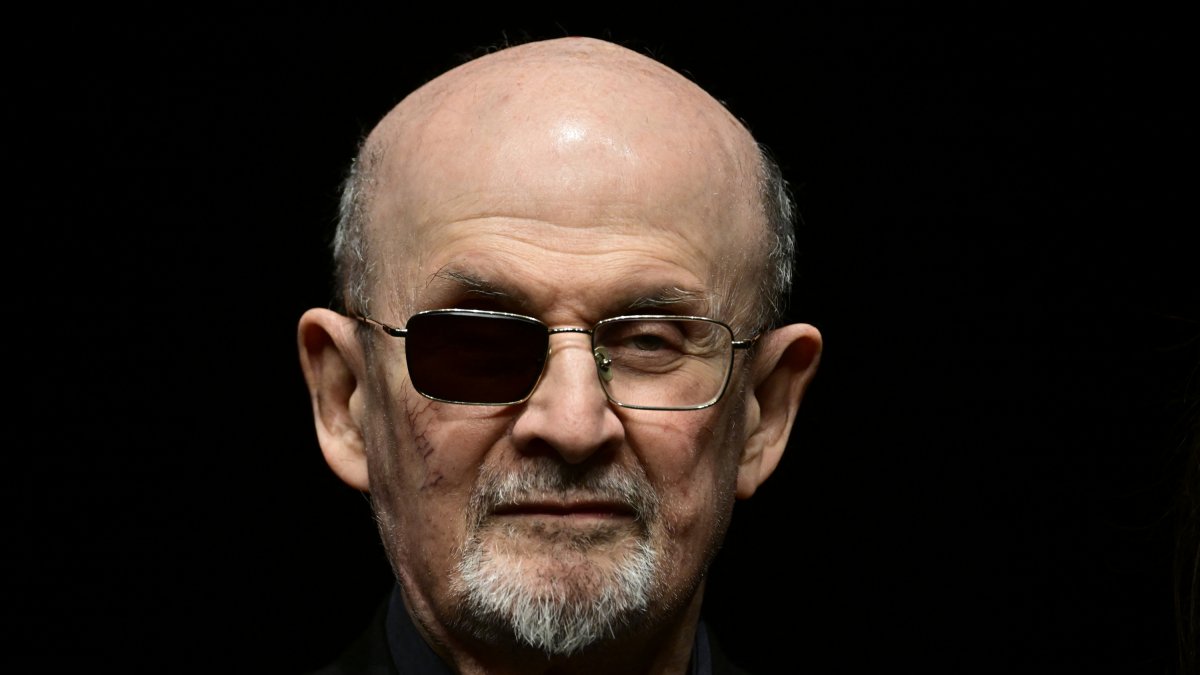
Salman Rushdie

Hadi Matar, the man who stabbed author Salman Rushdie in 2022 in the United States, was found guilty on Wednesday of committing "an act of terrorism" due to his sympathy toward Iran and the Lebanese Hezbollah, for which he faces life in prison.
Matar, who was already sentenced to 25 years in prison by a New York state court in May 2025 for this attempted murder of the 79-year-old author, will learn his sentence on November 3, the U.S. Department of Justice in a statement.
The 28-year-old man has now been convicted at the federal level for "having attempted to provide material support to Hezbollah, having committed an act of terrorism that transcends national borders and having provided material support to terrorists."
In Buffalo, New York, the jury reached its verdict after just two hours of deliberations, The New York Times reported, following a weeklong trial.
Khomeini's fatwa against Rushdie for "The Satanic Verses," the motive for the attack
According to the indictment, the attacker was motivated by the fatwa issued in 1989 by Ayatollah Ruhollah Khomeini, then leader of the Islamic Republic of Iran, against the author of The Satanic Verses, a text he considered blasphemous.
Prosecutors asserted that Matar conducted research and produced videos about this fatwa. Photos and material from Hezbollah were found at his home, including a fake driver's license in the name of a figure from that group.
"Mr. Matar spent more than a year immersing himself in Hezbollah's violent ideology and preparing to act in support of this fatwa," said U.S. Assistant Attorney General John A. Eisenberg, as quoted in the press release.
"He decided to align his values with the terrorist values of Iran's leaders," said U.S. Attorney Michael DiGiacomo.
The defense will appeal the sentence because Matar never acted on behalf of a terrorist group
According to the attacker's defense, he never acted on behalf of any terrorist organization, although he was motivated by anger toward the writer due to the allegedly blasphemous nature of his book. Matar's attorney, Nathaniel Barone II, announced that he will appeal, according to the New York Times.
In court, Salman Rushdie spoke for nearly an hour on Thursday about the attack he suffered before a conference on freedom of speech in Chautauqua, New York, on August 12, 2022, according to local media.
"The idiot who got the wrong idea about me"
When asked whether his assailant had attacked him to carry out the Iranian fatwa, the writer replied: "I have no certainty. I have my suspicions."
Born in India but a resident of the United Kingdom, Rushdie was forced to live in hiding under the protection of British police.
Although the fatwa was never officially revoked, Iran had indicated in 1998 that it would no longer seek to enforce it. As the threat subsided, Rushdie emerged from hiding, settled in New York, and obtained U.S. citizenship.
In 2024, he recounted the attack in Chautauqua in his book The Knife, in which he imagines lengthy conversations with Matar—whom he calls "the imbecile who got the wrong idea about me"—in an attempt to understand his actions.
"The book itself is about a knife, but it's also a bit of a knife in itself. I don't have any weapons or knives, so it's the tool I use," he explained on ABC. "It has become my way of controlling the narrative, so to speak."
LATEST