







Early return: four astronauts reach Earth after a medical problem on the Space Station
NASA avoided specifying the identity of the affected crew member or the nature of the health problem, but stressed that the astronaut "was and remains in stable condition" and that the early return was not in response to an immediate emergency.
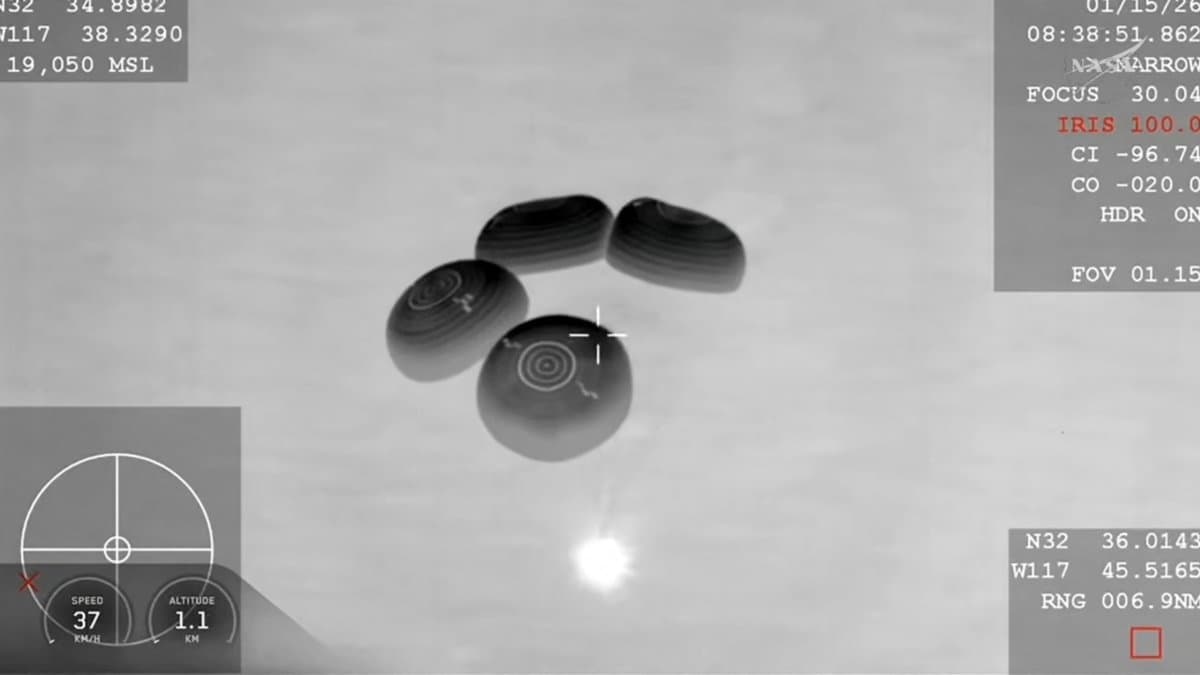

Four crew members of the International Space Station (ISS) successfully returned to Earth Thursday after a medical issue for one of them forced an early end to their mission, the U.S. space agency NASA reported.
SpaceX's Dragon capsule, carrying U.S. astronauts Mike Fincke and Zena Cardman, Russian cosmonaut Oleg Platonov and Japanese astronaut Kimiya Yui, splashed down safely in the Pacific Ocean off the coast of San Diego at 08:41 GMT, according to images broadcast live by NASA.
Welcome home, Crew-11! At 3:41am ET (0841 UTC), the @SpaceX Dragon spacecraft splashed down off the coast of San Diego, California. pic.twitter.com/8LFpdKwizc
The undocking of the ISS occurred Wednesday at 22:20 GMT, after nearly five months in orbit. The mission, dubbed Crew-11, was initially scheduled to last until mid-February.
NASA avoided specifying the identity of the affected crew member or the nature of the health problem, although it stressed that the astronaut "was and remains in stable condition" and that the early return was not in response to an immediate emergency. It is, however, the first medical evacuation performed from the ISS since the orbital complex began permanent operations in 2000.
"It was a deliberate decision to allow proper medical evaluations to be performed on Earth, where the full diagnostic capability exists," explained Rob Navias, a NASA spokesman. "It's the right decision, even if it has a bittersweet spot," he added according to the AFP story.
In a message broadcast on social networks, Mike Fincke assured that the crew was in good condition. "We are all fine. All aboard are stable, safe and well cared for," he wrote.
NASA's chief medical officer, James Polk, said the decision to move up the return was motivated by the risk involved in keeping a crewmember in orbit with an uncertain diagnosis. "The lingering doubt about exactly what the problem is led us to opt for the return," he said.
Welcome home! #Crew11 Roscosmos cosmonaut Oleg Platonov, left, @NASA_Astronauts Mike Fincke, Zena Cardman, and JAXA astronaut Kimiya Yui, right, are seen inside their @SpaceX Dragon spacecraft after splashing down off the coast of California. More photos: https://t.co/Z4Dn0TCIiI pic.twitter.com/zueuNTkKHn
Meanwhile, the ISS remains operational with three other occupants: U.S. astronaut Chris Williams and Russian cosmonauts Sergey Kud-Sverchkov and Sergey Mikayev, who arrived in November aboard a Soyuz spacecraft.
An area of active U.S.-Russian cooperation
The EEI is scheduled to be decommissioned after 2030 and its remains will disintegrate in a controlled manner in the atmosphere over a remote area of the Pacific known as Point Nemo, used as a spacecraft graveyard.
🛠 Do you think there is an error in this article?
Recommendations







LATEST