ANALYSIS
California's Hispanics, the surging economy that gives strength to the country
Increasingly populous and educated, the Hispanic-Californian community is gaining traction in the national economy. "Latinos will be California’s competitive edge for the remainder of the 21st Century," assert the authors of the 2025 California Latino GDP Report.

Taco stand in Los Angeles, Calif.

Hispanics in California contributed more than a trillion dollars annually of gross domestic product to the state and country. A contribution that is in addition to the one they have been making for 250 years, "driving" the state's economy, according to the researchers behind the 2025 California Latino GDP Report. And that will continue for years to come:
"Latinos will be California’s competitive edge for the remainder of the 21st Century."
So much so, according to researchers at the University of California and California Lutheran University, that the Golden State owes its position among the world's top five economies to the Hispanic-Californian community. Without it, it would fall to eighth place.
Taken as an independent state, Hispanic California also stands out in population growth. Nationally, the Hispanic population growth far outpaced that of non-Hispanics, with an eight-fold increase. In the Golden State, the gap is greater: 16.2% Hispanic population growth versus 1.9% non-Hispanic.
"Even more impressive," in the researchers' words, is the growth of the Hispanic-California labor force versus that of the rest of the population: 24.3% versus 1.6%.
"The importance of rapid Latino growth rates, and the intensity of economic activity which they represent, cannot be overstated," Matthew Fienup, an economist who co-authored the report, told UCLA Newsroom. "The vitality of the overall California economy greatly depends on the intensity of the economic activity of Latinos."
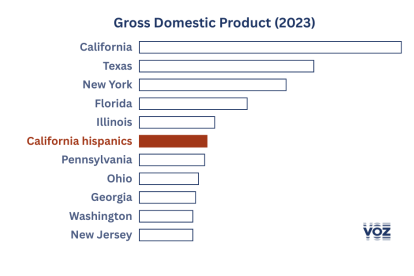
The GDP of Hispanics in California is the sixth largest in the country

Economy
Steady growth and a growing workforce: The keys behind the exceptional GDP numbers of latinos in the U.S.
Verónica Silveri Pazos
California's Hispanic profile
Hispanics who "overwhelmingly" enter the labor market are second- or third-generation Americans. Moreover, they are increasingly more educated: between 2010 and 2023, their "educational attainment" increased 3.4 times more than that of non-Hispanics.
"The state needs to maximize its investment in young Latinos’ health and education," Hayes-Bautista, a professor of medicine and co-author of the study, told UCLA Newsroom. "Anything that detracts from that investment detracts from California’s future."
More educated, more engaged in the labor market, the Hispanic-Californian community is also seeing an increase in income, which in turn redounds to greater clout as consumers.
"These children and grandchildren of immigrants are combining the extraordinary and selfless work ethic of their elders with rapid educational attainment to propel not just Latino GDP but overall GDP growth in California," the researchers say.


Society
The Hispanic powerhouse, increasingly conscious of its ‘size, power and influence’
Santiago Ospital
GDP by industry
Hispanic-California GDP has a greater impact on certain sectors than the state's overall GDP. For example, in construction: while it is only 3.9% of California's GDP, it is 7.2% of the state's Hispanic GDP. Which, according to the authors, makes it more "diversified": "In this way, Latinos provide a broad foundation of support for the state’s economy."
Another characteristic of the Hispanic worker is their preference for the private sector. Some 86.6% of Hispanic-Californians work in the private sector, compared to 13.4% in the public sector.
VOZ interviews Latino GDP
Access the full report
California Latino GDP 2025 by Santiago Adolfo Ospital
Santiago Adolfo Ospital.
LATEST