Trump’s political machine kicks into gear: $138 million for key races ahead of midterms
The president is pulling out all the stops to ensure Republicans retain their majority in both houses of Congress.
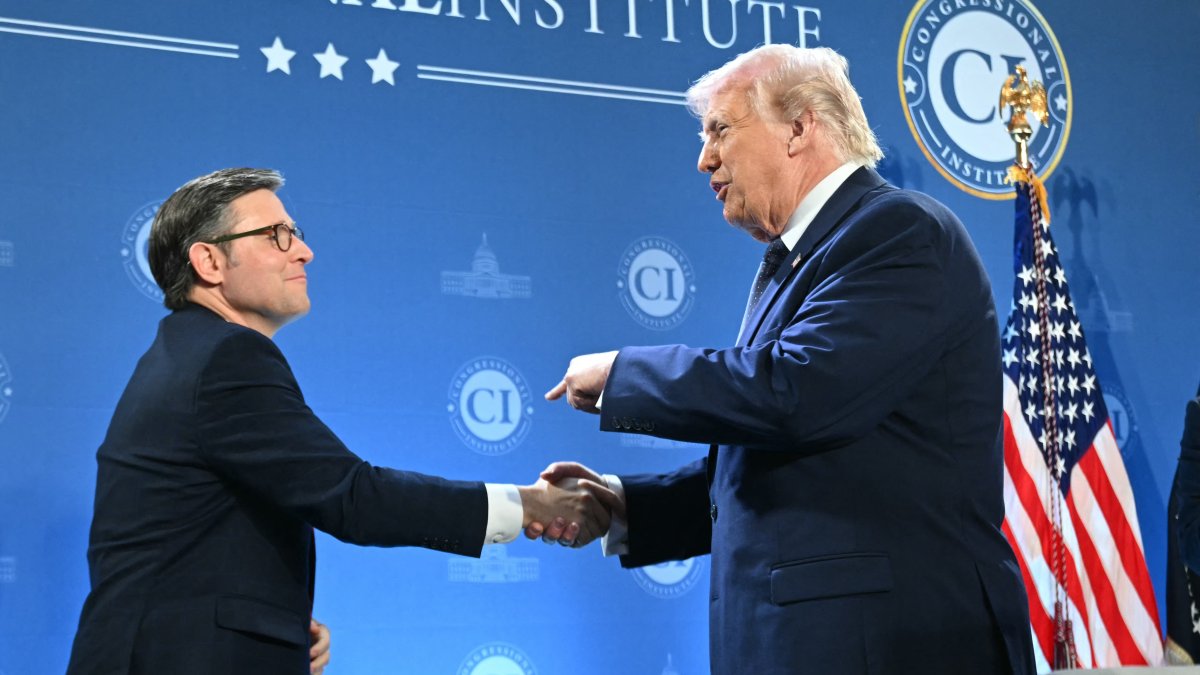
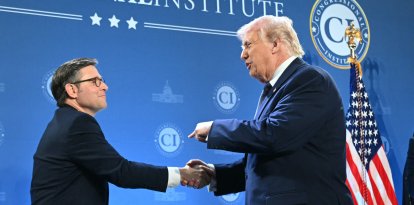
Donald Trump with Mike Johnson in Doral, Florida/ Saul Loeb

The political operation of Donald Trump has launched a financial offensive for the midterm elections. According to The New York Times, in the last few days alone, he has set aside nearly $138 million for advertising, direct mail and text messages to support Republican candidates in approximately 50 key races for the House of Representatives and the Senate.
The president is pulling out all the stops to ensure that Republicans retain their majority in both chambers of Congress. In addition to hosting the first Republican National Convention ahead of a midterm election — a key move to boost fundraising and raise the profiles of leading candidates — he announced that he will hold numerous events in key congressional districts and states.
Now, these efforts are being bolstered by a significant financial investment through MAGA Inc., the main independent spending committee associated with Trump. According to the aforementioned media outlet, MAGA Inc. and two other super PACs linked to Trump's political operation — No Going Back PAC Inc. and Safety and Affordability PAC Inc. — have collectively set aside nearly $138 million for advertising, direct mail and text messages to support Republican candidates.
To gauge the financial capacity of Trump's campaign, one need only look at MAGA Inc.'s coffers. The super PAC had $403.5 million in available cash as of the end of July, according to its latest report to the Federal Election Commission (FEC). In other words, the nearly $9 million in advertising the group has booked so far represents only a fraction of the resources at its disposal. It is expected to continue investing in key races leading up to November.
Trump's spending map
According to data from AdImpact, cited by the NYT, No Going Back has booked more than $95 million in advertising, while Safety and Affordability has another $27 million earmarked. MAGA Inc. has booked approximately $9 million.
The investment was heavily concentrated in a relatively small group of races. The Senate accounts for the largest individual bets, while in the House, the money is distributed among competitive districts across the country.

Politics
Voz News Debate: Midterm Elections—Who Will Win the Hispanic Vote: Democrats or Republicans?
Luis Francisco Orozco
Politics
Mitch McConnell returned to the Senate after 3 months away and made the Farm Bill a priority
Joaquín Núñez
In the Senate, the largest reserves are for the following races:
- Michigan: $18.2 million
- Ohio: $15.1 million
- Alaska: $11.3 million
- New Hampshire: $10.8 million
- Texas: $10.8 million
- North Carolina: $6.1 million
- Georgia: $2.2 million
- Montana: $1.9 million
- Iowa: $544,000
As for the top three spending targets, Michigan is seen as the Republicans' best opportunity to take a Senate seat away from the Democrats. Following Gary Peters' retirement, the Democrats nominated Abdul El-Sayed, who is associated with the party's most progressive wing, while the Republicans nominated former congressman Mike Rogers.
According to Republicans, El-Sayed's previous positions and statements, as well as his political ties to Hasan Piker, have made the Democrat one of the main targets of the Republican campaign. Piker, who campaigned alongside El-Sayed during the primaries, came under heavy criticism for saying in 2019 that the United States "deserved" 9/11, a statement he later retracted. El-Sayed has distanced himself from Piker's remarks.
In Ohio, Senator Jon Husted was appointed in 2025 by Governor Mike DeWine to replace JD Vance when he took office as vice president. The Republican will face off against Sherrod Brown, the former senator and the Democrats' "star recruit" for this race.
Brown represented Ohio in the Senate from 2007 to 2025. He lost his last reelection bid in 2024 to Republican Bernie Moreno. Now, he will seek to return to the Capitol amid the possibility of a "blue wave." The winner will serve out Vance's remaining term until January 2029.
Politics
Inside the GOP's case against Nellie Pou: A progressive Democrat in a Trump-won district
Joaquín Núñez

Politics
Marine, pastor, and former mayor: Republicans’ pick for key California House race
Joaquín Núñez
In third place is Alaska, which has become an unexpected headache for Republicans. In 2020, Dan Sullivan won reelection by 12 percentage points and did not expect a serious challenge this year, especially since Trump won the state by a 13-point margin in 2024.
However, the race became competitive after the Democrats managed to recruit Mary Peltola, who represented Alaska in the House from 2022 to 2025. She was the first Democrat to win the seat since 1972.
Added to this was a particularly unusual twist: another candidate named Dan Sullivan, Dan J. Sullivan, a retired teacher running as a Republican, advanced to the general election after finishing third in the primary. As a result, Senator Dan S. Sullivan will face off in November against Peltola and another candidate who shares virtually the same name.
The election will also be shaped by Alaska's electoral system known as "ranked-choice voting." Following an open primary in which all candidates compete on the same ballot, the four candidates with the most votes advance to the general election. There, voters rank the candidates in order of preference: if no candidate receives more than 50% of the first-choice votes, the candidate with the fewest votes is eliminated, and their votes are transferred to the second choice indicated on those ballots. The process is repeated until one candidate reaches a majority.
In a race featuring Mary Peltola, Dan Sullivan and another candidate named Dan Sullivan, this mechanism means that second and third preferences can play a significant role in the final outcome.
To regain control of the Senate, the Democrats will need to win at least four seats.
Another notable development is in New Hampshire, where Republicans managed to recruit former Senator John Sununu to run against Democrat Chris Pappas , and they are counting on his moderate profile, his track record and the weight of his last name to try to pull off an upset in that race.
In the House of Representatives, the largest campaign funds are concentrated in the following districts:
- NY-17: $8.8 million
- FL-25: $6.8 million
- MI-04: $5.3 million
- ME-02: $4.6 million
- TX-35: $3.6 million
- NJ-17: $3.3 million
- NC-01: $2.4 million
- OH-10: $2.2 million
- TX-15: $2 million
- NC-11: $2 million
The remaining funds are distributed among AZ-01 ($1.8 million), WA-03 ($1.8 million), MI-10 ($1.6 million), MI-07 ($1.6 million), FL-14 ($1.5 million), IA-01 ($1.1 million), PA-10 ($1.1 million) and CA-22 ($1 million).
LATEST