ANALYSIS
Another Democratic attempt to impeach Trump in the House fails—could they succeed if they win the midterms?
The latest vote, sponsored by Texas Democratic Rep. Al Green, was backed by a majority of his fellow party members, even though party leaders had instructed them to reject the motion.

Trump in Congress

The Democratic caucus once again attempted to initiate impeachment proceedings against President Trump. Despite knowing full well that the numbers weren't in their favor—and that they faced opposition from Democratic Party leaders in the House of Representatives—the motion by Rep. Al Green (D-Texas) served to demonstrate growing support for such an initiative, raising the key question: Will the Democrats be able to achieve this milestone if they win the upcoming midterms?
Green's motion, which sought to impeach Trump for his policies on immigration, was rejected by a vote of 232 to 147. This represents a notable increase in the number of Democratic lawmakers defying their leaders to show their desire to impeach Trump, even if it is merely a symbolic gesture and means going against the party. In June 2025, on a similar proposal—also sponsored by Green—128 Democratic lawmakers voted with Republicans to defeat it.
Trump: The only president to be impeached twice
The process for impeachment to succeed is not straightforward, in any case. During Trump's first term, the Republican survived two such attempts. In fact, he holds the dubious distinction of being the only president to be impeached twice during the same congressional session. Before him, Andrew Johnson in 1868 and Bill Clinton in 1998 faced impeachment proceedings. In all cases, the Senate defeated the effort.
The first impeachment Trump faced was in 2019, when he was accused by the Democrats (who held a majority in the House of Representatives at the time) of abuse of power after asking Ukraine to investigate a potential conflict of interest involving then-presidential candidate Joe Biden and his son Hunter regarding a possible conflict of interest in that country, and obstruction of justice.
The Senate: Until now an insurmountable hurdle to a president's impeachment
After the motion passed the House of Representatives—where a simple majority was all that was needed—the Senate defeated it by a vote of 52 against and 48 in favor. Then-Republican Sen. Mitt Romney caused a political earthquake by voting alongside the Democrats. However, for the impeachment to succeed, it was necessary to secure the support of two-thirds of the 100 senators in the Senate.
The second occasion was following his electoral defeat to Biden in 2020. On this occasion, Trump was accused of "inciting an insurrection" following the incidents at the Capitol on Jan. 6, 2021. In fact, had the impeachment attempt been successful, Trump would have been convicted while no longer in office. Once again, the Senate—this time by a vote of 57–43—acquitted him, as the required two-thirds majority was not reached.
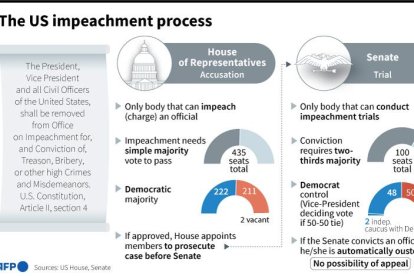
Impeachment process
Could the Democrats secure the necessary seats in November?
So, could the Democrats achieve what would be their No. 1 goal if they win the election? Let's look at the numbers.
Currently, Republicans hold a majority in the House of Representatives with 218 seats to the Democrats' 214. In addition, there is independent Kevin Kiley from California, who leans conservative. There are also two vacancies at this time that need to be filled to make up the full membership. In November, polls suggest that the Democratic Party has a strong chance of securing a majority.
However, as history has shown, the key lies in the Senate, where Democrats need at least 67 votes to secure Trump's removal from office. Currently, the breakdown is 53-47 in favor of the GOP. In the midterms, 35 seats will be up for grabs (33 regular seats and two special elections), most of which are currently held by conservatives.
Midterm predictions for the 35 seats up for grabs in the Senate
According to poll predictions, the Democrats are expected to have nine safe seats, plus one likely seat and two others where their candidates hold a slight lead. Added to these are another seven seats with uncertain outcomes (two currently held by Democrats and five by Republicans). The GOP is projected to start with 14 seats that are safe and two that are likely.
In other words, the Democratic caucus could win between 50 and 60 seats at most, making it very difficult—almost impossible—for their initiative to succeed, especially since several of Trump's main opponents within the GOP in the Senate lost their primaries.
LATEST