From the coalition that emerged to stop slavery to the White House: The Story of the Republican Party
March 20 marked another anniversary of the birth of the Republican Party. With 19 presidents, from Abraham Lincoln to Donald Trump, this is how the GOP was born.
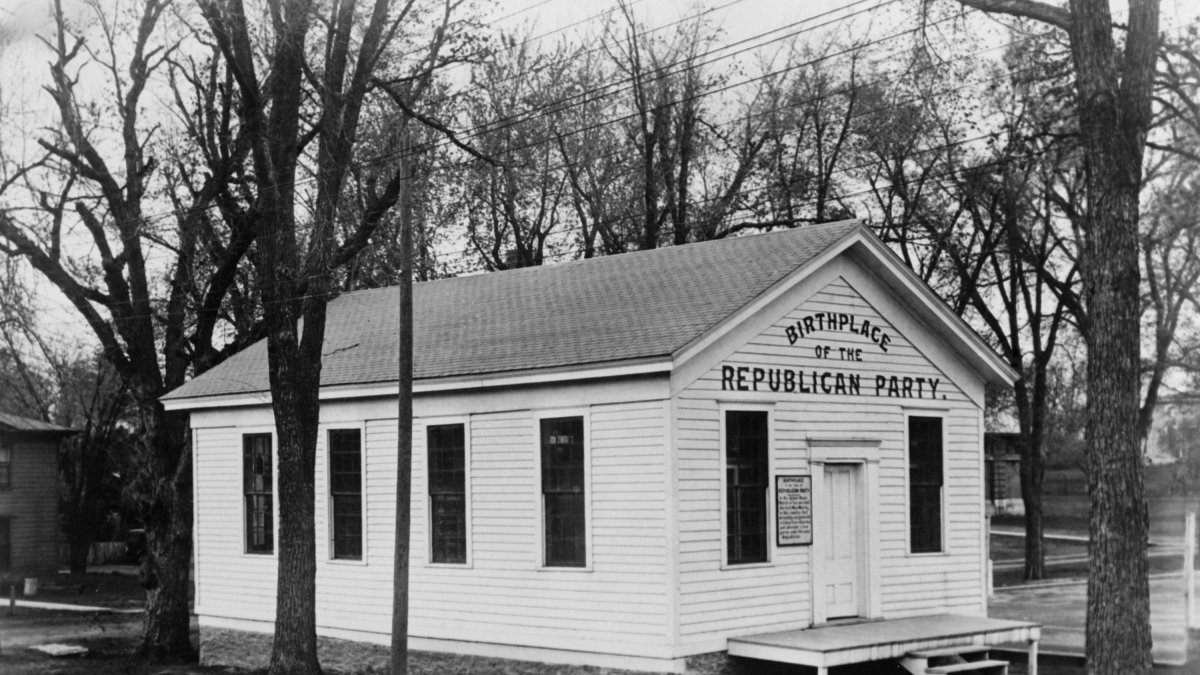
The school where the Republican Party began in Wisconsin.

March 20 marked the anniversary of another anniversary of the birth of the Republican Party. What began as a makeshift coalition to stop the expansion of slavery ended up cementing itself as one of the two major parties. In less than a decade, it would go from local meetings in the Midwest to winning the presidency with Abraham Lincoln, who would later transform the country.
Since its creation, the Republican Party has had 19 presidents, Lincoln being the first and Donald Trump the most recent. All were elected by the electoral college with the exception of Gerald Ford, who took office after Richard Nixon resigned in 1974.
While it may seem that American politics was always marked by what are now known as the two traditional parties, the struggle was not always Democrat vs. Republican. Since the first presidential election, which developed between 1788 and 1789, it took 72 years and fifteen presidents to find such a scenario.
The world before the Republican Party
The first system of the two great parties had as protagonists theFederalist Partyand the Democratic-Republican Party. The former is associated with the figure of Alexander Hamilton and the latter with that of Thomas Jefferson.
This changed from 1812 with the so-called "Era of Good Feelings", marked by a sense of victory and national unity after the end of thewar with the United Kingdom.
The Federalists were largely discredited after their opposition to the war, which made way for three consecutive Democratic-Republican victories.
However, this one-party system began to collapse due to internal differences. Tthe tipping point was the election of 1824, in which all four candidates vying for the Oval Office were from the Democratic-Republican Party. As none achieved a majority in the electoral college, the House of Representatives ended up electing the president.
Andrew Jackson obtained 99 electoral votes (to win he needed 131) and prevailed in the popular vote by a difference of eight percentage points. Despite this, the House ended up electing John Quincy Adams.

Politics
Marco Rubio or JD Vance? The question every Republican is asking, including Trump
Emmanuel Alejandro Rondón

This election led to the second major party system. On one side was the Democratic Party, led by Jackson himself, and on the other the Whig Party, composed of Jackson's opponents, including President Adams and Henry Clay.
The new party system premiered in 1829, the triumph of Jackson, who became the first Democratic president. While the Democratic Party favored a strong Executive Branch but a more limited federal government, the Whig supported a stronger Congress, with limits on presidentialism and industrial development based on infrastructure and tariffs.
The Kansas-Nebraska Act and the birth of the Republican Party
As early as the mid-19th century, another break emerged due to tension over slavery. The trigger? The Kansas- Nebraska Act of 1854.
The proposal was simple. Allow these two new territories to enter the union with the freedom to choose whether or not they were going to allow slavery. Under the banner of "popular sovereignty," it clashed directly with the CMissouri Compromise, signed in 1820. This federal law marked an imaginary dividing line in Missouri, located in the center of the country. According to this line, new territories joining the union and located to the north would be prohibited from slavery, while those south of the line could adopt this practice.
The legislation, which would end up being signed by President Franklin Pierce, fractured the two dominant parties and gave rise to a coalition of anti-slavery activists.
The point chosen for the meeting was Ripon, Wisconsin. In a small white school located at 1074 West Fond Du Lac Street. At that meeting, the creation of a new party was defined in the event that the aforementioned law was passed. Although the party was not formally founded there, it went down in history as the place where the idea of a Republican Party was born.
Since then, with a platform centered on opposition to the expansion of slavery into new territories, the Republican seal began to expand. First in Wisconsin and Michigan. Gradually, it incorporated former Whig members and anti-slavery Democrats.
The party would hold its first national convention not long after, which took place on February 22 in Philadelphia, Pennsylvania. The first Republican presidential nominee was John C. Fremont. The former California senator would lose those elections to James Buchanan, with former president Millard Fillmore, in third place.
Four years later the demise of the Whig would be confirmed and the Republican Party would have its first president, Abraham Lincoln. The Republicans would see the axis of their platform realized. First with the Emancipation Proclamation in 1863 and then with the total abolition of slavery that came in 1865 with the Thirteenth Amendment, already finished the Civil War.
LATEST