Following the Supreme Court's ruling, these are the three statutes left for Trump to impose tariffs
In a 6-3 ruling, the nation's highest court ruled that the president cannot impose tariffs under the International Emergency Economic Powers Act (IEEPA). Trump will therefore have to resort to alternative paths, some of which are even already in use.
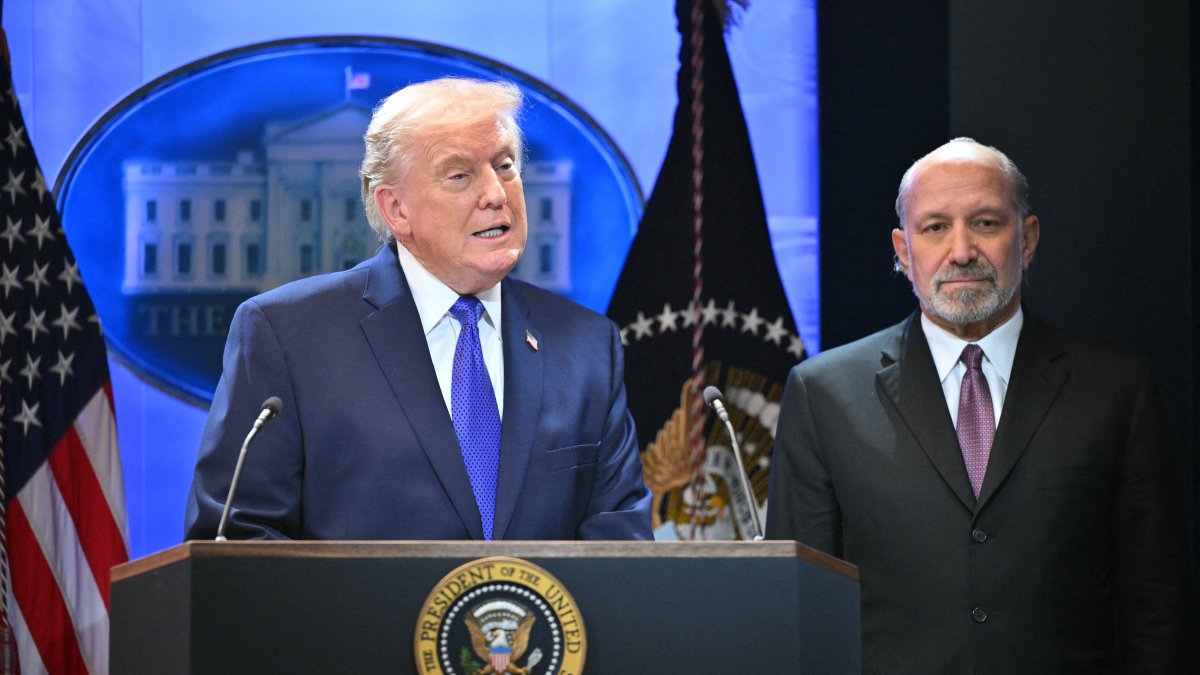
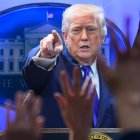
Donald Trump next to Howard Lutnick at the White House/ Mandel Ngan.

The Supreme Court struck down much of the tariffs imposed by Donald Trump. In a 6-3 ruling, the nation's highest court ruled that the president cannot impose tariffs under the International Emergency Economic Powers Act (IEEPA), arguing that it is a power constitutionally vested in Congress. However, Trump still has three paths to move forward with his flagship trade policy.
The ruling was released Friday morning, with Chief Justice John Roberts writing the majority opinion. He was joined by conservatives Neil Gorsuch and Amy Coney Barrett, as well as all of the more progressive justices—Elena Kagan, Sonia Sotomayor, and Ketanji Brown Jackson.
The dissenting opinion was written by Brett Kavanaugh, whom Clarence Thomas and Samuel Alito joined.
Until the Supreme Court ruling, Trump relied on a variety of laws for his trade policy, but primarily on IEEPA. Under this law, presidents can take numerous economic actions to address any unusual and extraordinary threat, originating wholly or substantially outside the United States, to the national security, foreign policy, or economy of the country.
Under this legislation, signed by Jimmy Carter in 1977, approximately 60% of the tariffs. The remainder, which will remain in effect, is mainly concentrated in three statutes that authorize the president to impose tariffs in certain extraordinary circumstances, without the need for congressional approval.
Trump will therefore have to rely on them to try to bring all or most of the tariffs that relied on IEEPA under the umbrella of the Trade Act of 1974 or Trade Expansion Act of 1962, that he already uses. In both cases, Congress did delegate its trade power to the President of the United States.
Section 301 of the Trade Act of 1974
This statute authorizes the president to impose tariffs to enforce U.S. rights under trade agreements or to counter foreign practices deemed unfair.
Specifically, the executive branch can activate it when a foreign country violates trade agreements or engages in practices deemed "unjustifiable," "unreasonable," or "discriminatory."
Trade Act of 1974 was in part a congressional response to what they considered to be a series of excesses by theNixon Administration, although it acted under the Trade with the Enemy Act of 1917. For example, the Republican president suspended the gold backing of the dollar and imposed a 10% tariff on all imports.

Politics
RNC files lawsuit to stop new Democratic-driven congressional map in Virginia
Luis Francisco Orozco
Politics
Republican Rep. Nicole Malliotakis asks the Supreme Court to halt redistricting in her district before the midterm elections
Luis Francisco Orozco
Section 232 of the Trade Expansion Act of 1962
In this case, the rule allows the president to impose tariffs on imports that threaten national security.
In this case, the procedure includes an investigation by the Department of Commerce. If it concludes that imports affect industrial capacity needed for defense or strategic sectors, the president can impose tariffs or quotas.
President Trump already used this statute during his first term, when he imposed tariffs and initiated investigations on aluminum, steel, automobiles, uranium, titanium, and transformers.
At that time, the Secretary of Commerce Wilbur Ross concluded the investigations and recommended to the Executive the imposition of tariffs on these products.
This statute, like the previous one, is currently used by the president to impose tariffs. Between them, they raised nearly $70 billion in fiscal year 2025.
Section 122 of the Trade Act of 1974
The latter statute was mentioned by Trump himself as a possibility three the unfavorable Supreme Court ruling.
Specifically, it authorizes the president to impose temporary tariffs of up to 15% or import quotas when there is a serious balance of payments problem or a significant drop in the dollar.
It allows for quick action for a maximum of 150 days without the need for a lengthy investigation, although it has not been activated by any president so far to impose tariffs.
The president must consult Congress before imposing restrictions, and if he wishes to extend them beyond the 150 days provided by law, he needs legislative authorization.
Unlike other trade tools, Section 122 does not require a showing of unfair practices or harm to a particular industry, as its background is macroeconomic.
LATEST