The war between the WSJ and Trump escalates: Murdoch's newspaper claims that the DOJ told Trump that his name appeared in the Epstein Files
The White House denied the report, and the outlet acknowledged that the context in which the president was mentioned is unclear. His mention in the files, along with the criticism over a lack of transparency, does not imply any criminal connection to Epstein.

Donald Trump and Pam Bondi in a file image

The war between The Wall Street Journal and President Donald Trump over the Jeffrey Epstein case continues to unfold. The latest episode once again featured the newspaper of tycoon Rupert Murdoch, which published an exclusive report revealing that, allegedly, the Justice Department informed Trump that his name appeared in the 'Epstein Files'.
According to the WSJ, when Attorney General Pam Bondi said publicly that she had discovered a mountain of files related to the Epstein case earlier this year, DOJ officials initiated a review and found that Trump's name appeared on several documents. In May, U.S. Attorney Bondi and Deputy Attorney General Todd Blanche held a meeting at the White House with the president, where he was briefed on the finding. He was also assured that other high-profile political figures were named in the files.
At that meeting, according to the unnamed officials quoted by the WSJ, a variety of routine topics were discussed, and Trump's appearance in the Epstein documents was not the main focus. It is not yet clear in what context the president was mentioned, and the mere fact of appearing or being named in the documents - as has happened in the past - does not necessarily imply having engaged in criminal or controversial conduct.

Politics
La demanda de Trump contra el WSJ y Rupert Murdoch toca a un juez designado por Obama
Santiago Ospital

The report details that prosecutors explained to Trump that the findings contained, for the most part, unverified rumors about dozens of people who in the past socialized or interacted with the financier, including the president himself.
According to a WSJ source, hundreds of names are contained within the files.
During the meeting, Bondi and Blanche explained that senior DOJ officials were not planning to declassify or release more files related to the case, especially since the material contained child pornography and personal information about the victims.
"Trump said at the meeting he would defer to the Justice Department’s decision to not release any further files," the WSJ reported.
Following the report, The New York Times joined the WSJ and published its own article on the meeting.

The White House questioned the veracity of both reports.
"This is another fake news story, just like the previous story by The Wall Street Journal," White House communications director Steven Cheung said.
Meanwhile, Bondi and Blanche sent a joint statement to the NYT..
"As part of our routine briefing, we made the president aware of the findings," they wrote. "Nothing in the files warranted further investigation or prosecution."
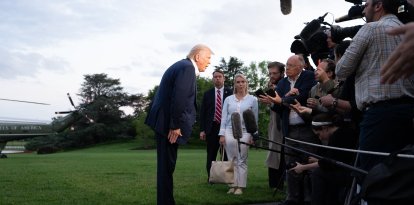
Following the release, a video resurfaced where the president claimed to the press that Bondi had not informed him that he appeared in the files during that meeting.
"No, no, she’s—she’s given us just a very quick briefing," Trump said when asked if his name was in the Epstein Files. At the time, he also praised the attorney general's work on the case.
Trump BUSTED Lying on Video: In a shocking reveal, Trump denied on July 15 that he was told his name appears in the Epstein files. The Wall Street Journal just revealed in that he was informed by the DOJ in May.
— Really American 🇺🇸 (@ReallyAmerican1) July 23, 2025
The coverup keeps getting worse for Trump!pic.twitter.com/3Ml8XjFrxV
Epstein case blows up in the face of the White House
For weeks now, the resurgence of the Epstein case has been a real headache for the Trump Administration. The main criticisms, coming especially from its base of voters and conservative activists, focus on the White House's lack of transparency regarding the case.
Activists and MAGA figures such as Michael Flynn, Laura Loomer or Congresswoman Marjorie Taylor Greene reacted critically after the Justice Department and the FBI released an official memo terminating the investigation into Jeffrey Epstein, arguing that the financier committed suicide in 2019 in his jail cell while awaiting trial for sex trafficking. The document, moreover, stated that there was no "client list", that there was no evidence to investigate uncharged third parties and that the rest of the material would not be disclosed because it contained child pornography and sensitive victim information, as the president had been informed in May.
The decision was immediately interpreted by much of the MAGA electoral base as a betrayal of the declassification commitment that Trump himself had promised during his election campaign, and generated direct accusations against prosecutor Bondi for having closed the review abruptly, months after she announced that on her desk she had key documents ready to be reviewed, including the alleged list of the child molester's clients.
Faced with strong public backlash, Trump first reacted against critics, claiming they were being manipulated by Democrats. Then, he accused part of his base of disloyalty. Eventually, the administration relented and partially took up the issue, allowing new demarches and communications with Epstein's ex-partner, Ghislaine Maxwell; and filing a motion to declassify the grand jury transcripts in the case.

In the interim, The Wall Street Journal recently published that Trump had signed an allegedly upsetting birthday letter included in an album prepared by Maxwell for Epstein in 2003, something the president adamantly denied. In response, Trump sued the WSJ, journalists at the paper, Murdoch, Dow Jones, and News Corp for $10 billion, accusing the newspaper of defamation and publishing false information.
The new information from the WSJ could now increase criticism against the White House, which is still trying to surf a wave of harsh questioning for its lack of transparency.
LATEST