Joe Biden did not personally oversee all of the pardons signed with autopen
After a debate over the various possible criteria, what the Democrat did approve were the standards that would be used to determine which convicts would qualify for a sentence reduction.

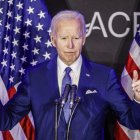
Biden giving a speech in Maryland/Allison Robbert.

Former President Joe Biden assured that he did not personally oversee all the pardons signed with autopen. He claimed that he decided to use the device because “we’re talking about a whole lot of people.”
The information was revealed by the Democrat during an interview in The New York Times. In that regard, both the former president and his aides indicated to the news outlet that Biden did not individually approve each name for the pardons that were applied to a large number of people.
Instead, after a debate over the various possible criteria, Biden approved the standards he wanted used to determine which convicts would qualify for a sentence reduction.
Instead, it was learned that President Biden noted during the interview that he discussed each of the highlighted cases with his advisers. As an example, he mentioned Gen. Milley.
"We know how vindictive Trump is and I’ve no doubt they would have gone after Mark for no good reason" Biden said. "The general, you know. So they may read off his name — what’d I want? I told them I wanted to make sure he had a pardon because I knew exactly what Trump would do — without any merit, I might add."
According to emails reviewed by NYT, President Biden made the key decisions on high-profile clemencies during two meetings. The first, on Jan. 18, involved Jeff Zients, Ed Siskel and adviser Bruce Reed. The second took place on the evening of Jan. 19, his last as president, and was attended by Siskel, Reed and three other close advisers Anthony Bernal, Steve Ricchetti and Annie Tomasini.
The e-mails also indicate that Biden included in that last meeting the preventive pardons for members of his family and that, in addition, he modified some of his criteria or positions during the process.
According to the information, the summary of the first meeting shows that President Biden had decided to grant a pardon to Don Siegelman, former Democratic governor of Alabama convicted of federal corruption in 2006. However, the summary of the second meeting indicated that Biden had reversed that decision.
In the interview with NYT, Biden explained that upon reflection he changed his mind, arguing that many people seek pardons and that Siegelman is no longer incarcerated or facing risk.
The same Jan. 19 summary also revealed that Biden decided, at the last minute, to grant a pardon to Ernest W. Cromartie II, a former Columbia, South Carolina councilman who in 2010 pleaded guilty to tax evasion and served a year in prison.
On that day, Biden had begun his day in South Carolina by attending a church service with Congressman James Clyburn, a close political ally. According to former aides, Clyburn later interceded on Cromartie's behalf, something Biden confirmed during the conversation..
“I agreed with Jim and I pardoned him,” he said.
Sources familiar with the matter indicated that at the Jan. 19 meeting, which took place in the Yellow Oval Room of the White House residence, Biden held his aides until nearly 10:00pm to discuss those decisions.
Biden's pardons
The rest of the clemency acts were signed by autopen, a device that replicates the president's signature automatically. Now, that procedure - legal but controversial - is at the center of a Justice Department review, amid growing questions about Biden's mental capacity in the final months of his tenure and the real control he exercised over key government decisions.
LATEST