The Supreme Court ruled in favor of biology, but ideology has not been defeated
On June 30, 2026, in two identical rulings, SCOTUS did what the International Olympic Committee, most sports federations, and a large portion of the Western political establishment had refused to do for years: acknowledge that there are two sexes, that this difference is relevant to athletic competition, and that a state has the right to legislate accordingly.
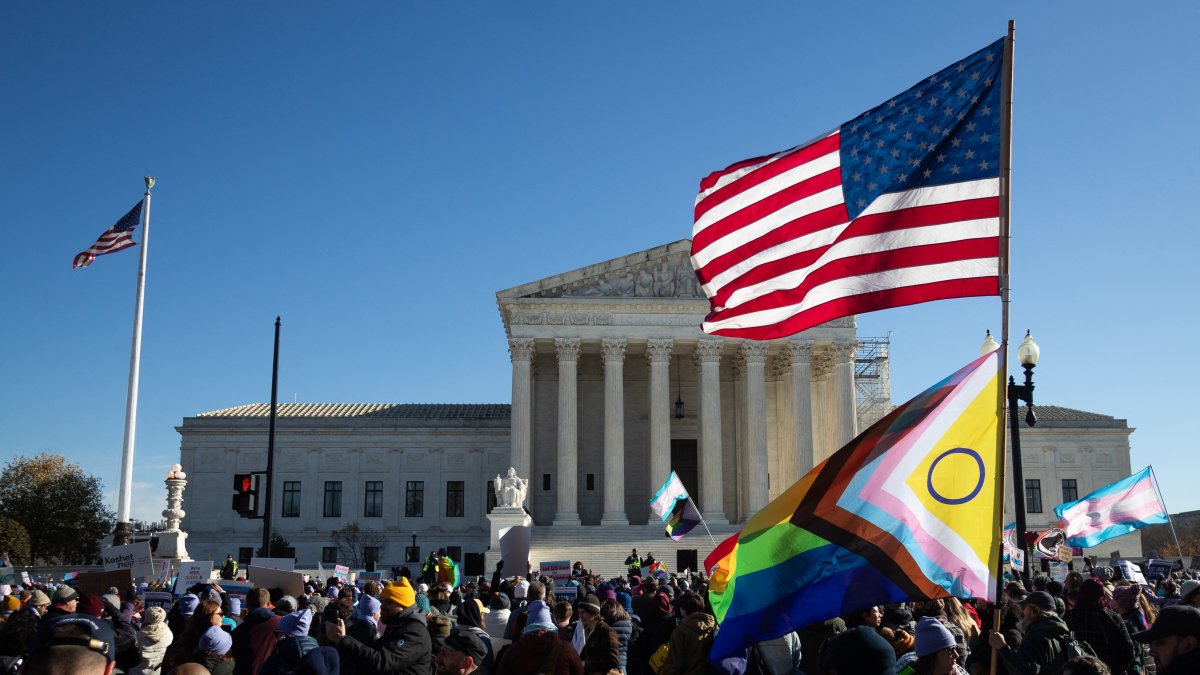
Protesta enfrente de SCOTUS del movimiento trans
On June 30, 2026, in two twin rulings, West Virginia v. B.P.J. and Little v. Hecox, the Supreme Court did what the International Olympic Committee, most sports federations and much of the Western political establishment had refused to do for years: acknowledge that there are two sexes, that this difference is relevant to athletic competition and that a state has the right to legislate accordingly.
All nine justices agreed that the laws of Idaho and West Virginia do not violate Title IX. But on the constitutional issue, whether those laws violate the Equal Protection Clause of the 14th Amendment, the Court was split 6-3: the conservative majority, led by Justice Brett Kavanaugh, held that sports teams separated by biological sex are a reasonable classification; Justice Sonia Sotomayor, dissenting alongside Elena Kagan and Ketanji Brown Jackson, accused the majority of “moving the goalposts” set by previous precedents and of resolving a sensitive issue without first exhausting the facts of the case. Kavanaugh, for his part, defended Title IX as one of the country's most transformative civil rights laws, noting that it spurred the growth of women’s sports, and argued that requiring courts to compare, on a case-by-case basis, the physical abilities of each transgender athlete against their competitors would be an impossible task.

You don’t have to be a legal expert to understand the magnitude of the ruling. For nearly a decade, saying out loud what the Supreme Court has just affirmed, that physical differences between the sexes are real and relevant in competitive sports, was reason enough to lose a job, be shamed on social media or outright accused of being “phobic.” This ruling is not a conceptual novelty. It is the long-overdue affirmation of something that athletes, coaches and families have been denouncing for years, while being treated as intolerant for doing so.
Take the case of Lia Thomas, the swimmer who competed in the men’s division until 2019 without standing out, and who, after her transition, broke records in the women’s division in 2021 and 2022. Then there’s Blaire Fleming, a volleyball player at San Jose State University, whose spikes led several rival teams to forfeit rather than expose their players to injury; her own teammates, led by captain Brooke Slusser had to file a Title IX complaint against their university just to be heard. There’s Payton McNabb, the North Carolina volleyball player who, in 2022, suffered a brain injury, partial paralysis and loss of peripheral vision after being hit in the head by a spike from a trans opponent, in a match where her own teammates were already aware of the situation but didn’t dare to raise the issue for fear of retaliation. And there’s the embarrassing episode at the 2024 Paris Olympics, where women’s boxing turned into a spectacle when Imane Khelif, disqualified a year earlier from the Women’s World Boxing Championships after a test revealed XY chromosomes, defeated Angela Carini in 46 seconds, while the International Olympic Committee chose to remain silent rather than risk an accusation of transphobia.

Sports
The International Boxing Association denounces the IOC for the Imane Khelif case
Alejandro Baños
Those 46 seconds sum up better than any speech what it meant to let ideological grandstanding replace sporting common sense: a committee founded, among other things, to honor a century of struggle by women like Alice Milliat ended up allowing an uneven match inside the ring, in the name of inclusion. I discuss all these cases and many others that never made it to court or the newspapers in greater detail in my book "The Wars You Lost While You Slept," where I reconstruct how gender ideology gradually gained institutional ground in sports, schools and healthcare long before politics and the judiciary dared to seriously address the issue.
The Supreme Court’s ruling does not reverse those medals or remedy those injuries. But it certifies, with the authority of the highest U.S. court, that those who pointed this out early on were right. However, it is important not to overstate the ruling's scope. The court was careful to define its scope, and the 21 states that currently allow transgender athletes to compete according to their “self-perception” may continue to do so. In other words, it has not been decided, not by a long shot, that gender ideology will cease to govern a significant portion of institutions. And in the rest of the West, the gap between what a court says and what happens in everyday life is even wider.
In the United Kingdom, Canada and Spain, the framework underpinning gender ideology continues to operate with remarkable inertia, almost indifferent to judicial setbacks. Therein lies, perhaps, the most unjust lesson of all: a ruling by the highest court is not enough if the bureaucracy simply decides to ignore it.
The most flagrant example is that of the United Kingdom itself. In April 2025, the British Supreme Court ruled, in the For Women Scotland case, that the terms “woman” and “sex” in the Equality Act refer to biological sex. More than a year later, gender-critical activists discovered, by tracking down internal documents, that the West London NHS Trust, which administers, among other facilities, the high-security psychiatric hospital Broadmoor, continued to allow its patients to use single-sex spaces based on their gender recognition certificate, not their biological sex, effectively ignoring what the country's highest court had already ruled.
Added to this is the conflict involving nurses at Darlington Hospital, who had to form their own union because the NHS did not guarantee them women-only changing rooms, and the June 2026 incident in Bournemouth, where a 47-year-old man was arrested for allegedly filming a mother and her daughter in an “inclusive” H&M fitting room, fitting rooms that the chain keeps coed despite the fact that weeks earlier, Education Minister Bridget Phillipson had finally published the Equality and Human Rights Commission’s 342-page code of practice, which instructs that men be excluded from such spaces. J.K. Rowling summed up the episode by noting that it was, once again, exactly what her critics had been warning would happen if mixed-gender changing rooms were maintained.
In Canada, institutional resistance is even more stark. While the United Kingdom, Denmark, Finland, Sweden and Norway scaled back their protocols for "gender-affirming care" following the Cass Review, the Canadian Paediatric Society has just appointed as its new president a physician who founded a childhood transition program and publicly described that review as unreliable.
Science has shifted sides in much of Western Europe; the Canadian medical establishment has not.
In Spain, the dispute even made its way into British high school study materials: a review book for the Spanish GCSE, the exam taken by tens of thousands of 15- and 16-year-old adolescents in the United Kingdom, published by Pearson, includes among its vocabulary examples the phrase “I follow/admire them because they fought for the rights of transgender people,” in a list where the rest of the examples are deliberately generic. The organization Sex Matters questioned why, out of dozens of possible phrases to teach a grammatical structure, the publisher chose that one in particular. Pearson responded that these are “examples, not required answers,” the same publisher that had previously been criticized for allowing gender-neutral pronouns in its language exams, following years of editorial collaboration with Stonewall.
But the most urgent danger is not just institutional; it is physical. In early 2026, a trans activist spent several days threatening an armed attack on girls-only schools in Merseyside, demanding that gender-critical women stop publicly questioning trans women; he was ultimately sentenced to prison. Media coverage, with a few exceptions, tended to downplay the explicit ideological motivation behind the threats.
“Trans Jihad”: “Kill your local Republican”
The most recent case occurred just two days after the Supreme Court’s ruling. Teha Delaruelle, a trans activist who had briefly collaborated with the congressional campaign of the socialist Democrat, also trans, Katrina deVille in Wisconsin, posted a series of videos in front of a chalkboard bearing the slogan "kill your local Republican," proposing to establish that slogan as "the moderate position" in the state and calling for what she termed a "trans jihad" against Trump’s base. In a subsequent post on Substack, he went further, describing the situation of trans people as “total extermination” that could only be countered by “destroying” the society that causes it.
Nor is it an isolated case: a group calling itself Bash Back is circulating a “direct action” guide urging people to identify “transphobic” targets and attack them until they cease their activities; the text itself admits that its methods will be, in most cases, illegal, and recommends that its members dispose of the tools used. The group has already claimed responsibility for attacks on a British minister’s office and on the headquarters of the Equality and Human Rights Commission. And when an organization like the Good Law Project accuses gender-critical groups of failing to publicly disclose the identities of their members, it deliberately omits the real reason behind the anonymity: it is not shame over their ideas, but a well-founded fear of the death threats received by women such as those who spearheaded the For Women Scotland case, or the activist Kellie-Jay Keen, who was assaulted in broad daylight on a New Zealand street for arguing that women’s spaces should remain for women.
The June 30 ruling does not settle anything. According to some analyses of the ruling itself, it also sets the stage for a new round of Title IX litigation in other contexts, not just sports, because the conservative majority went beyond what the defendant states themselves had requested by establishing that “sex” always means biological sex, a move that even the three justices who agreed with the final outcome considered an unnecessarily broad step. And behind each of those cases is a generation of girls, from Payton McNabb to the San Jose Spartans, who paid the price, both physically and in their athletic careers, for an ideology that no committee, no federation, and no government had the courage to stop in time. The Supreme Court, at last, did what it had to do. Now the rest of the West needs to understand that recognizing biology is, quite simply, justice.
LATEST