
Tradition: The great lesson left to us by the successful American Revolution
From a conservative perspective, it is clear that Latin America does not need—as some progressive politicians still propose—to reinvent itself.
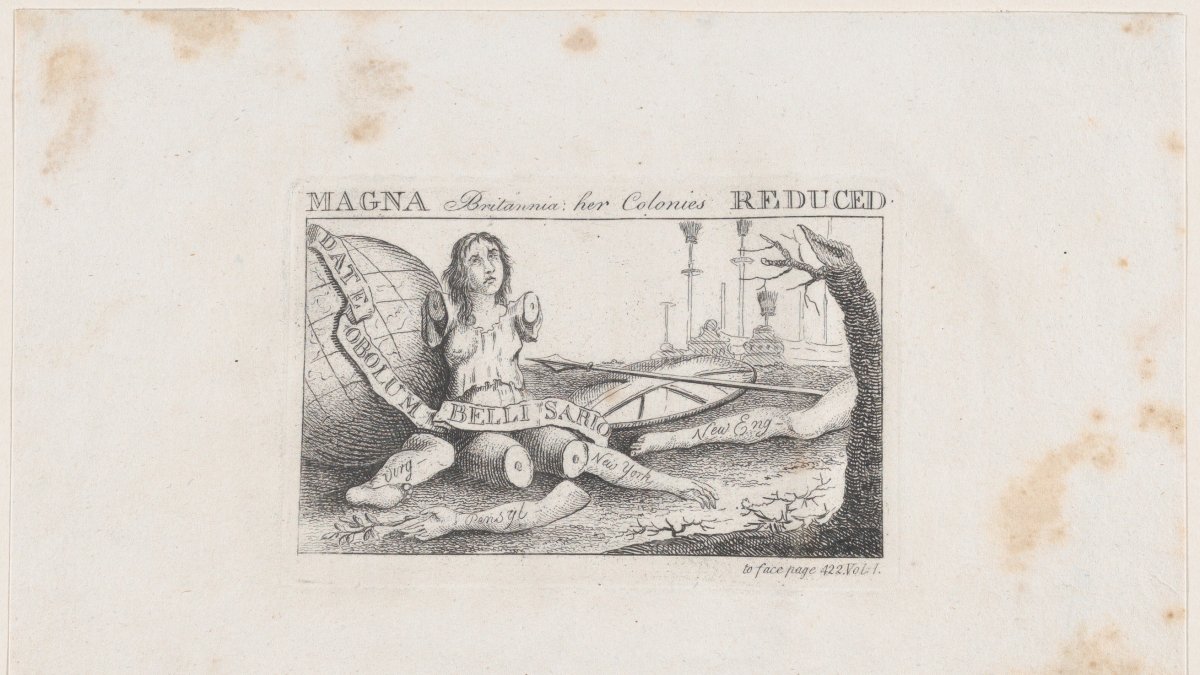
Engraving: Magna Britannia with its conquered colonies.
The American Revolution, very different from the French Revolution, offers profound lessons that take on greater significance in light of the evident success of the Founding Fathers’ project.
Unlike the French Revolution, the American Revolution bequeathed a structure that endures and makes the United States a beacon of hope for an increasingly decadent West—where, precisely, nations like France, which are extremely secularized, play a decisive role in that decadence.
To a large extent, the difference between the American Revolution and the French Revolution has to do with the preservation of tradition. This is the backbone of any conservative stance. And it is precisely the key to the success of the Founding Fathers’ project: freedom is born of inherited institutions.
But that is not the only difference between the American Revolution and the French Revolution. To a large extent, the spirit of rupture and progressivism also shaped the Latin American revolutions. As Carlos Rangel aptly explains in his essential work From the Noble Savage to the Noble Revolutionary, Latin America’s struggle for independence was fueled by a fierce anti-Spanish spirit.
As for the American Revolution, the colonists did not seek to create a “new man.” Instead, they insisted that the driving force behind their aspirations was the need to defend the traditional rights of the English themselves.
Edmund Burke, while praising the American Revolution—even as he remained critical—stated that U.S. independence defended an inherited order. As can be inferred from Burke, the American Revolution was, in many ways, a conservative revolution: it upheld common law; it respected private property; it protected the churches and local life; and it avoided destroying the social structure bequeathed by the British. There was no equivalent in the United States to the French Reign of Terror or to the “war to the death” declared by Bolívar against the Spaniards.
In From the Noble Savage to the Noble Revolutionary, Rangel argues that hostility toward Spanish tradition was decisive in sparking a spiral of chaos in the nascent Latin American nations that still plagues them today. Before independence, the countries of South America were Spain. They enjoyed their legacy, their history, their traditions, and their institutions. But the eagerness to build something new, breaking with the past, led to decades of instability for many of these young nations.
In that sense, if there is one thing we can learn from the American Revolution—beyond an appreciation for our countries of origin—it is the value of tradition and the importance of preserving what came before us so that we may pass it on to future generations.
From a conservative perspective, it is clear that Latin America does not need—as some progressive politicians still propose—to reinvent itself. Instead, it must reconcile itself with what has given it historical continuity: its legal tradition, the family, the church, civil associations, private property, and a rich political culture that teaches us to limit power rather than personalize it.
The great lesson of the American Revolution is not to make a revolution, but to understand that the most enduring transformations usually involve preserving and refining an inherited order, rather than betting on its complete replacement.
LATEST