Happy birthday, America
The United States was founded 250 years ago, not to replicate the political and social order of Europe, but precisely to be the opposite of Europe.
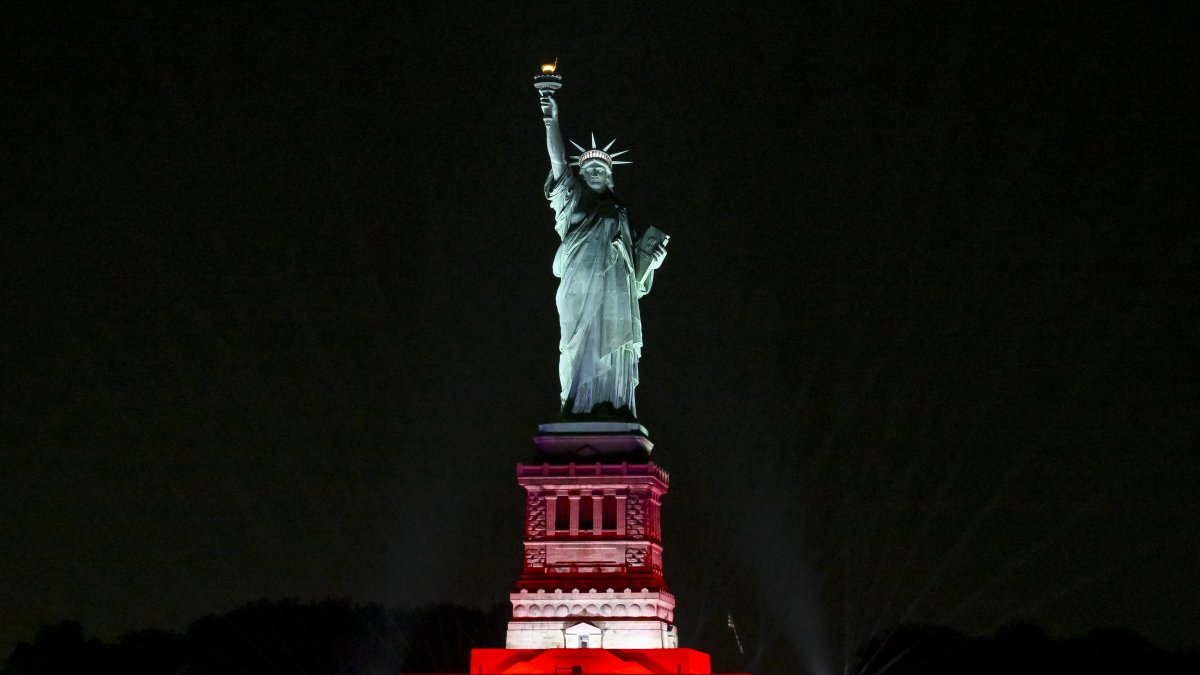
Statue of Liberty illuminated for a celebration (File photo)
I must begin by admitting that I cannot be impartial. My professional life and much of my personal life have been, or still are, linked to America. In the United States, I specialized in strategic and defense affairs in the 1980s; in the United States, I trained as a scuba diving instructor years later; and in the United States, I became a professional photographer a decade ago. I have quite a few friends in North America and I try to spend as much time there as I can when I’m not in Israel or Spain.
I don’t owe who I am to America, but the United States has allowed me to be everything I am. It offered me opportunities, and through hard work, sacrifice, and a great deal of determination, I was able to take advantage of them. And I am immensely grateful. I have to say it.
I have friends from Central Europe, those who lived behind the Iron Curtain and under the terror of communism, for whom “America” was just a brand of jeans; I have acquaintances, many refugees fleeing a death sentence in their home countries, for whom the United States has been their refuge; and I know of many for whom America has been the land where they could fulfill their professional ambitions and achieve, by the sweat of their brow as the saying goes, a better life for themselves and their families.
I suppose that, as a Spaniard and a staunch advocate of sovereignty, I should feel a certain degree of resentment toward the country that, at the height of its expansionist drive, put an end to much of Spain’s overseas dominion in the late 19th century; likewise, if I were on the left, I should criticize a country that cloaks itself in democratic values but made a pact with General Franco because of Spain’s contribution to the global policy of containing the USSR during the Cold War. But I am neither a leftist nor do I live clinging to the decrepitude of the Spanish empire.

On the contrary, I recognize the stabilizing role the U.S. has played for decades in Europe, providing security and allowing Europeans to develop the misnamed “welfare state,” subsidized in large part by American taxpayers; I admire the innovative role, especially in technology, that generation after generation of brilliant American minds have played; and I take great pleasure in seeing a country that does not shy away from its many contradictions but rather attempts to address and resolve them in a rational and pragmatic manner.
Perhaps because I know the country, I have never fallen for either idealized visions of a moral empire destined to do good in the world or the conspiracy theories that see America’s designs as the source of all the world’s evils.
The United States was founded 250 years ago not to replicate the political and social order of Europe, but precisely to not be Europe. And failing to understand this is leading EU leaders today to misunderstand the Donald Trump phenomenon.
Similarly, the America we have known over the past 80 years has not been the America seen during its first 170 years of existence. Its rise to global superpower status and its hegemonic role within the Western world have been episodes, if not fleeting, then at least a minority phase, in its history. Hence, too, the current confusion regarding the United States’ role in the world, the “America First” ideology and the transactional attitude of its 45th and 47th presidents.
But what has always existed is an American people proud of their flag, of the values of freedom it represented, of being able to live the American Dream, aware of their privileged place in the world, deeply moral, possibly excessive in their ambitions and willing to make sacrifices to achieve their goals, whether lofty or mundane. This is the America of the brave, of the daring who want to land on the Moon, or, now, to colonize Mars, or of those who fight against unjust discrimination. This is the America of Martin Luther King, Bob Dylan, Steve Jobs and Elon Musk. It is a nation where you can do anything that is not expressly prohibited and where, under the Constitution, the people determine the powers of the state, unlike in Europe, where the state determines the rights and duties of citizens.
But the America I have experienced and know is not without contradictions. In fact, I would go so far as to say that today’s America is in a state of cold civil war because, for far too long, the radical left has been eroding its self-confidence, has sought to erase its roots and has fostered an anti-American ideology whose goal is to subvert the economic system, diminish America’s international role and impose a societal structure based on tribes and group identity rather than on the national concept of the common good. The “offended ones” are the most visible byproduct of that social revolution they wanted to bring to America.
Trump, as a bulwark against this profound transformation, is also something that is not understood in a morally decadent Europe, devoted to political correctness and held captive by an establishment that embraces the left because it makes itself look more popular. It is that age-old adage of “everything for the people but without the people” that they want to revive in Brussels and in many European capitals. And it is the American rejection of this assault on real democracy that is feared.
On this 250th anniversary, a time capsule has been buried, intended to be opened another 250 years from now, in July 2276. I don’t know what Americans will be like at that time. What I do know is that there won’t be any Europeans like those of today who can do the same, because the native-born will have been replaced by immigrants from Africa and, along with them, the rejection of the liberal values of our civilization.

Opinion
Tradition: The great lesson left to us by the successful American Revolution
Orlando Avendaño
The United States and the American people know something that we Europeans have preferred to forget: “Freedom is not free,” as can be read on the Korean War Memorial in Washington, D.C. Or, in the words of Benjamin Franklin, when asked by Elizabeth Willing Powell after the Philadelphia Convention September 1787, “What do we have in the end, Doctor, a republic or a monarchy?” He replied: "A republic, if you are able to preserve it.”
The United States and Europe once shared a common civilization… until now. Europe does not seem to know how, or want, to defend it. Trump’s America is determined to do so for its own sake and future.
I want to trust that, despite their many enemies, the American people and their leaders will know how to preserve their civilization until its 500th anniversary. They have what it takes to achieve this and avoid the worst temptations that might prevent it.
That is why I have come to D.C. to celebrate this first 250th anniversary. Because the success of the free and prosperous Europe we want depends on America’s success.
Happy birthday, America!
LATEST