Pax Silicia: The importance of the initiative and Taiwan as its cornerstone
This initiative is, ultimately, a commitment to preserving the preeminence of the free world, starting with Taiwan’s territorial integrity as the cornerstone of the system.
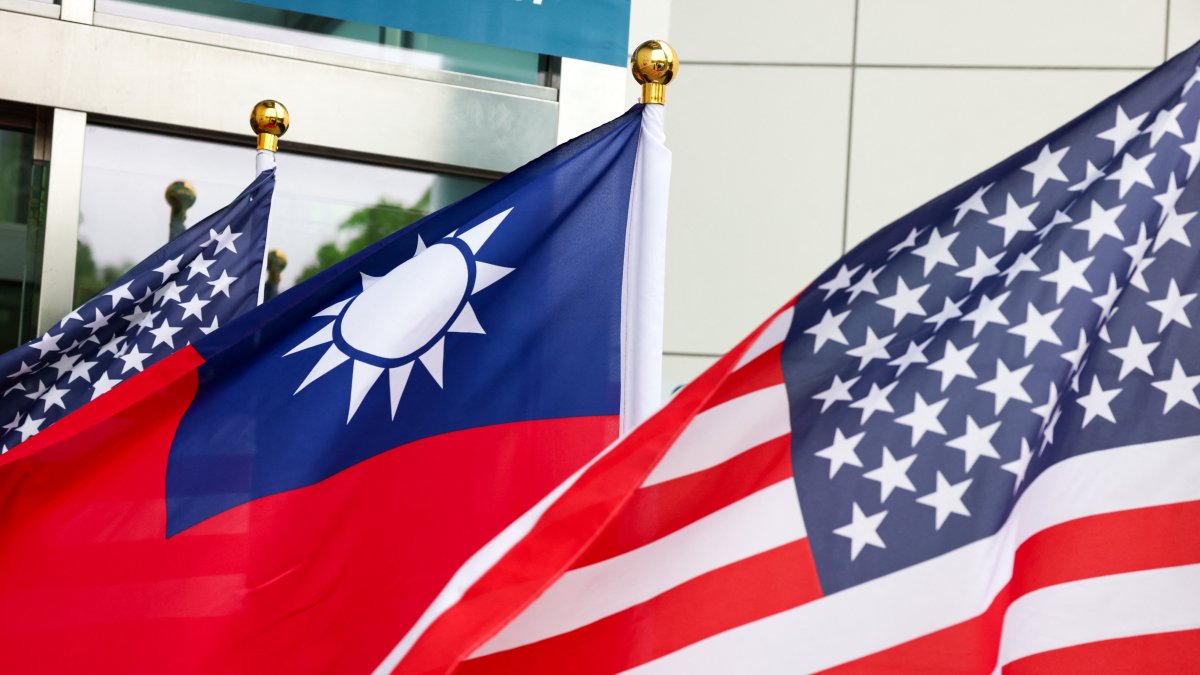
Flags of Taiwan and the United States / I-Hwa Cheng
This week, Argentina joined the Pax Silica, a flagship initiative of the U.S. Department of State regarding artificial intelligence (AI) and supply chain security. Although the news went almost unnoticed on the public agenda, there is no doubt that this decision is one of the most significant of the current administration’s foreign policy moves.
The Pax Silica, established by the State Department’s Under Secretary for Economic Affairs Jacob Helberg, and which refers to silicon, a mineral used in the manufacture of chips and semiconductors, is a strategic initiative aimed at “build a new economic security consensus among allies and trusted partners to advance secure, prosperous and innovative supply chains spanning critical minerals, energy inputs, advanced manufacturing, semiconductors, AI and technology infrastructure.”
As stated in the Declaration of Pax Silica: “If the 20th century ran on oil and steel, the 21st century runs on computing power and the minerals that make it possible. This historic declaration establishes a new consensus on economic security to ensure that aligned partners build the artificial intelligence ecosystem of the future, from energy and critical minerals to high-tech manufacturing and AI models.”
Currently, the initiative has 23 signatories, including Argentina, Australia, Chile, the European Union, Germany, India, Israel, Japan, the Netherlands, Qatar, South Korea, Singapore and the United Kingdom. In addition, it has one non-signatory member: Taiwan. The government of President Lai Ching-te endorsed the initiative’s principles through the joint statement on the Pax Silica Declaration and Economic Security Cooperation between the United States and Taiwan.
And it is precisely Taiwan that is the most important factor in the system.
The industry leader is TSMC (Taiwan Semiconductor Manufacturing Company), which operates as a co-designer and strategic partner to major Western companies such as Nvidia, AMD and Apple, among others.
In other words, Taiwan is an irreplaceable player in the global technology production chain. And this situation, in turn, positions it as the main focus of current geopolitical competition.
Taiwan’s vast production capacity is what drives the global system’s dependence on the island, a dependence that is further amplified by the development of artificial intelligence and its need for highly complex chips. And this dependence becomes critical when the People’s Republic of China enters the equation. If the Chinese Communist Party (CPC), driven by its expansionist ambitions, were to encroach on Taiwan’s freedom and autonomy, whether through military action or a blockade of the island, it would control nearly the entire global semiconductor market. Thus, China would position itself as the leading technological power.
For this reason, the Pax Silica represents the United States’ response to this threat in its geopolitical dispute with China. What the Trump administration is building is an international alliance of states committed to cooperation on economic and national security “centered on the strategic links in the global technology supply chain, including, among others, software applications and platforms, foundational frontier models, information connectivity and network infrastructure, computing and semiconductors, advanced manufacturing, transportation logistics, mineral refining and processing, and energy.”
This initiative is, ultimately, a commitment to preserving the preeminence of the free world, starting with Taiwan’s territorial integrity as the cornerstone of the system. It is a commitment by the members of this network, who defend democracy, the free-market economy, and the rule of law, to ensure the security of technology supply chains.
The author is the executive director of the FREE Foundation.
LATEST