The New York Times' war on American history
Why the country’s most influential newspaper has made the denigration of the founding narrative a sustained editorial policy.
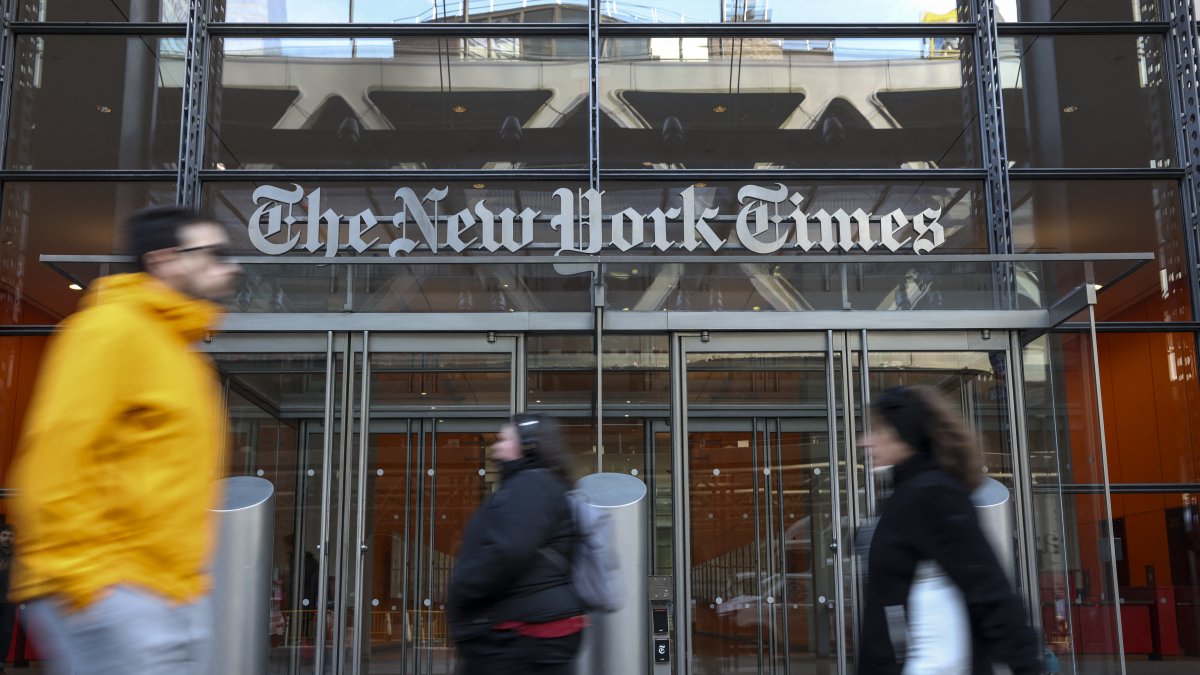
People walking past The New York Times' newsroom in New York
To celebrate the 250th anniversary of the Declaration of Independence, The New York Times Magazine published an ambitious animated feature on the American Revolution. Its thesis flaunts a revisionist perspective: “land, not taxes, was the first grievance” that pitted the colonies against Great Britain. The events of 1776 are portrayed there less as a struggle for self-government than as an enterprise by settlers eager for land, driven by an “anti-Native sentiment.” On the country’s birthday, its most influential newspaper chose to describe its pioneers as land grabbers.
This is a consistent narrative that The New York Times has maintained for years: a persistent animosity toward the country’s origins, the rewriting of its founding in terms of original sin, and the replacement of the narrative of freedom with that of dispossession.
It is worth highlighting the facts that the anniversary narrative overlooks. The Times’ account begins in 1763, with the Royal Proclamation that limited westward expansion, and from there it deduces that independence was, at its core, a struggle over Indigenous land. The Washington Free Beacon was among the first media outlets to sound the alarm over this attempt to reduce the Revolution to a land grab, which incidentally contradicts key facts, such as the fact that most of the key figures had no need for new land, whereas Washington, Jefferson and the Lees already owned thousands. The driving force that the Declaration puts forward is not land but the principle that governments derive their power from the consent of the governed and the rejection of being ruled by a distant Parliament in which they were not represented.
And those principles had a long lineage. When, as an elderly man, he was asked where he had drawn the ideas for the Declaration from, Thomas Jefferson replied without hesitation in a letter from 1825: he had not sought to “find out new principles, or new arguments, never before thought of,” but rather to give voice to “the American mind,” nourished by “the elementary books of public right, as Aristotle, Cicero, Locke, Sidney.” The mention of John Locke is no coincidence: it is from the Second Treatise on Civil Government that the conviction underpinning the Declaration comes, that all men are born free and equal, that all legitimate power rests on the consent of the governed, and that a people has the right to alter or abolish a government that turns against their rights. That is why John Adams, already retired, was able to write in 1818 that the true Revolution had taken place before the first shot was fired: it was “in the minds and hearts of the people.” Not on a map of lands to be divided, but in an idea.
But we’ve seen all this revisionism from the NYT before. Seven years earlier, the same newspaper had attempted the same maneuver, this time with a name that became famous.

Politics
Gold coin featuring President Trump's image approved for nation's 250th anniversary
Williams Perdomo
In August 2019, it launched the 1619 Project, led by Nikole Hannah-Jones. The premise was in the name: to take as the true starting point of the nation not the Declaration of 1776 but the arrival of the first enslaved Africans in the colony of Virginia in 1619. The gesture was deliberate and acknowledged in the introductory text itself, which called for "reimagining" American history by viewing 1619 as the true birth of the country. The aim was not to nuance the founding narrative but to supplant it.
The project grew into a cultural machine: a special issue of the magazine, a Sunday supplement with the Smithsonian, a podcast, a book, a children's book, an Emmy-winning series on Hulu and, most brazenly, a school curriculum distributed by the Pulitzer Center to thousands of classrooms across the country. Hannah-Jones received the Pulitzer Prize for Commentary in 2020. The 1619 Project was not an article; it was a curriculum designed to indoctrinate children in guilt and woke theories of decolonization.
The problem is that its central thesis did not stand up to scrutiny by historians themselves. The most explosive claim in Hannah-Jones’s essay was that one of the main reasons the colonists sought independence was to protect slavery. In December 2019, five historians signed an open letter in The New York Times itself, calling for corrections and warning against what they called a displacement of historical understanding by ideology.
The objection was neither minor nor partisan. Wilentz, a historian at Princeton, pointed out that in 1776 there was no perceptible British threat to slavery, given that the British abolitionist movement was practically nonexistent at that time; thus, the idea of a revolution carried out to “save” slavery lacked any empirical basis. Gordon Wood was even more emphatic in stating that he did not know a single colonist who said they wanted independence in order to keep their slaves.
The magazine’s response was revealing. The editor, Jake Silverstein, defended the project and refused to correct it. It was not until March 2020, after one of the historians consulted, Leslie Harris, revealed that she had warned the team about that error and that they had ignored her, that the newspaper introduced an almost imperceptible “clarification,” and the phrase changed from “the colonists” to “some of the colonists.” Later, without an editorial note, the site quietly removed the phrase describing 1619 as “our true founding.” When critics noticed this, they were accused of acting in bad faith.
The project was as misleading as it was divisive, even within the left itself. The World Socialist Web Site denounced it as a fabrication that replaces class conflict with racial conflict. James Oakes himself, a signatory of the original letter, published an essay in 2021 in the magazine Catalyst arguing that the project had misrepresented both the history of the slave economy and that of the antislavery movement that fought against it.

Decolonial theory makes a grand entrance
There is a single methodology linking the 1619 Project and the 250th-anniversary cartoon. What unites both projects is the intellectual framework that the NYT has normalized: the logic of decolonial interpretation applied to mass communication. Like any critical theory, the Marxist and dialectical framework of these attempts seeks to frame all historical events within the binary system of oppressors and oppressed so characteristic of woke ideology. For this reason, the narrative seeks to present the birth of the nation not as a drive toward freedom and self-government, but as a structure of domination whose official narrative exists primarily to cover up dispossession. Viewed through this lens, enlightenment ideas such as the consent of the governed, natural rights and representation cease to be principles and become pretexts in the service of the “oppressors.”
The rhetorical maneuver is always the same: to seek an unacknowledged material interest behind every hero. If the Founding Fathers speak of freedom, it is hypocrisy; if they act out of self-interest, it is evidence of guilt. No fact can refute a thesis that interprets both virtue and vice as confirmation of guilt.
And this is not merely an academic dispute. The 1619 Project did not remain confined to the Sunday magazine; it made its way into classrooms as part of the curriculum, and the anniversary piece is presented as an animated video, designed to take root easily and early on. The target is always the same: the general public, and above all a generation that is being conditioned to view the birth of its country as the scene of a crime. No new evidence necessitates this shift; it is a framing decision, repeated until it becomes routine.
Because there is a huge difference between discussing history and undermining its very core. The former is the standard work of historians; the latter is shifting the focus until the freedom of 1776 is turned into a grievance and the nation into little more than its original sin. This isn’t journalism that gets a single fact wrong; it’s a narrative constructed issue after issue, to make the reader ultimately distrust the country.
That is why it would be a mistake to view these pieces as a handful of isolated excesses. What looms behind the 1619 Project and the anniversary project is the same symbolic and cultural system, rehearsed in newsrooms and perfected in academia, which targets the very roots of the nation: its moral, philosophical and political foundations. Tinkering with the founding myth is never an innocent act. The origin story is what gives a people its unity and self-belief; eroding it does not correct history; it dismantles it. And a country taught to be ashamed of its foundations ends up doubting everything it has built upon them as well.
And it is worth remembering what was built. From the ideas of a handful of men arose the freest and most prosperous society history has ever known. It can be criticized; what cannot be done, without paying a price, is to teach it to renounce the very idea that made it possible. That is, at its core, the true agenda lurking behind so many front pages: not to better recount the past but to undermine a nation's confidence in its own future.
LATEST