Miami feels the Hispanic power: The real estate boom redefining the city
Peggy Olin, CEO of OneWorld Properties, explained that "historically, much of the demand came directly from Latin America, but today we are seeing a generation of Hispanic buyers who are already fully integrated into the U.S. economy."

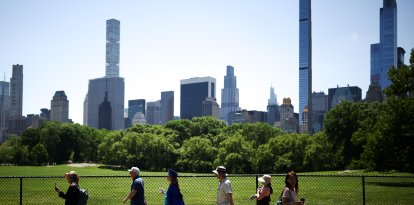
Porsche Design Tower (C) in Miami.

Hispanic power is felt in Miami. A study revealed that the city's real estate market is solidifying its position as the top destination for international buyers in the country, driven by Hispanic capital and a growing community already settled in the country.
According to the “MIAMI Realtor International Buyer Profile,” in 2025, foreign buyers accounted for 15% of residential volume in South Florida, a figure seven times the national average.
In total, they invested $4.4 billion in properties, up from $3.1 billion the year before, confirming Miami as the nation's number one market for international sales.
This growth is no longer solely dependent on money coming in from Hispanic America. In a conversation with VOZ, Peggy Olin, CEO of OneWorld Properties, explained that "historically, much of the demand came directly from Latin America, but today we are seeing a generation of Hispanic buyers who are already fully integrated into the U.S. economy and who see Miami as a natural place to invest or settle."
This is, she said, a profile with access to financing, economic stability and strong cultural roots. "For them, Miami is not only a real estate investment, it is also a place where they feel at home."
Even so, the international flow continues to be decisive. In fact, almost 49% of new construction, preconstruction and condo conversion sales in the region are by foreign buyers, mostly Latinos.

Latin America leads investment
The regional leadership is clear. Colombia (15%) and Argentina (12%) lead the ranking of international buyers, followed by Mexico and Brazil (7%), and Venezuela, Peru and Chile (5% each). Colombia and Argentina account for more than a quarter of all international transactions.
This pattern confirms the direct relationship between political context and investment decision. "For many buyers coming from economies with high political or financial volatility, purchasing a property in Miami is a very clear way to protect their wealth," explained Olin.
She added: "More than just an investment, it's a diversification strategy."
Investment, shelter and family planning
The motivation of international buyers goes beyond immediate returns. Ninety-three percent buy homes for security, affordability and location, while up to 75% maintain their primary residence outside the U.S., reinforcing the global nature of the market.
In addition, cash payment remains dominant: more than 50% of international transactions are in cash. As Olin explains, "they prefer to have the asset paid for, with no debt, and in a strong currency such as the dollar."
This interest is reflected in concrete developments. Projects such as Domus Brickell Center, where 79% of buyers are international, or Shoma Bay and JEM Private Residences, show strong Hispanic demand—especially from countries such as Colombia, Mexico, Argentina or Brazil—attracted by central locations and rental potential.
Impact on the city and the Hispanic community
The effect of this capital goes beyond the real estate sector. Juan Carlos Tassara, founding partner of North Development, points out that "the international investor that arrives today, especially from Latin America, is sophisticated, with a greater capacity to pay and a vision for the future."
He added that "it attracts more services, more quality jobs, better infrastructure and a city that continues to grow in value for all who live there."
In that sense, he argued that "the local Hispanic community benefits from that ecosystem," he says, in a market where "Latin American capital and the local Hispanic community are mutually empowering."

Society
From the kitchen to the American dream: 'Tamale Act' opens doors to entrepreneurs in Colorado
Diane Hernández
The demographic engine of the future
With more than 60 million Hispanics in the United States, the weight of this community will continue to grow. "It already is and it will only continue to grow," Tassara assures.
Moreover, he said, the generational handover is already underway. "In 2025, Hispanics added about 441,000 new homeowners, representing more than the total growth of the U.S. housing market."
For the expert, this is, in addition, a young population, with a median age of 31 years. More than half of Hispanic buyers are first-time buyers.
Second generation and cultural identity
In that decision, culture remains key. For Hispanic buyers, Miami represents the possibility of investing in a market they understand culturally, where they can operate in their language. But it's not just an emotional issue. "Cultural affinity is the first step, but it's the fundamentals of the market that make the decision," said Tassara.
A resilient and expanding market
The combination of factors—international capital, internal migration within the country and growth of the Hispanic community—has made Miami a particularly strong market. As Olin sums up, "that mix of profiles is what makes the Miami market so dynamic and resilient."
LATEST