Analysis: In contrast to the Fed's predictions, inflation remains stable with a slight deceleration in costs
Despite the implementation of protectionist policies (such as the tariffs imposed by President Donald Trump), goods prices have fallen and overall inflation has moderated, while the government has collected tariff revenue at record levels.

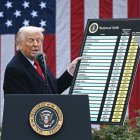
Donald Trump fastens tariff schedule during Liberation Day (File)

Inflation data for July this year reveal that consumer price pressures have not increased as anticipated as a consequence to the tariffs imposed by the Trump administration.
According to the government report released Friday, inflation was flat, with a slight slowdown in costs, defying warnings from Federal Reserve Chairman Jerome Powell about the inflationary impact of these trade measures. Despite the implementation of protectionist policies (such as the tariffs imposed by President Donald Trump), goods prices have fallen and overall inflation has moderated, while the U.S. government has collected tariff revenues in record levels, as anticipated by Trump.


The personal consumption expenditures price index (PCE), the Fed's preferred gauge, rose 2.6% year-over-year in July, matching economists' forecasts and remaining at the same pace as in June.
Month-to-month, prices rose by 0.2%, in line with expectations and down from the 0.3% recorded the previous month. If this rate were to hold over the next twelve months, annual inflation would fall to 2.4%, moving closer to the Fed's 2% target.
Core prices, or "core PCE," which exclude volatile food and energy, rose 2.9% y/y and 0.3% m/m, also meeting Wall Street predictions.
These benign figures have reassured economic authorities, indicating that inflationary pressures remain manageable. However, services continue to be the main driver of increases, up 3.6% year-on-year, while goods were up only 0.5% over the same period.
The monthly breakdown
In the monthly breakdown, goods prices fell 0.1% in July, driven by a 1.1% decline in energy costs and a 0.1% drop in durable goods.
The annual breakdown
Annually, energy prices were down 2.7%, durable goods were up a modest 1.1%, and non-durable goods were up only 0.2%. These trends in categories of goods (particularly susceptible to tariffs) contrast with previous Fed warnings.
Despite the fact that the U.S. has collected hundreds of billions of dollars in tariffs since the Trump Administration's trade policies went into effect, consumer prices in durable and non-durable goods have shown minimal increases.
The data, for now, contradict Powell
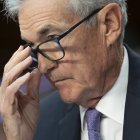
These data contradict Powell's repeated statements about the impact of tariffs. In April 2025, the Fed chairman stated: "Tariffs are highly likely to generate at least a temporary rise in inflation." He further warned that "inflationary effects could also be more persistent" and described the tariff increases as "significantly higher than expected."
However, numbers from the Bureau of Economic Analysis show that U.S. consumers have continued to spend despite the pressures.
What Americans are spending on
Personal consumption expenditures rose 0.5% in July, driven by purchases of vehicles, financial services and housing costs.
Personal income also grew by 0.4%, mainly due to increases in wages and salaries in the private sector, including contributions to social benefits.
After adjusting for taxes and inflation, real disposable income rose 0.2%, giving modest additional purchasing power to households.
Interest rates
Inflation data will be key in the Federal Reserve's interest rate deliberations as the central bank seeks to balance a return to its 2% target with sustaining economic growth.
The economic impact of Trump's tariffs
President Donald Trump promoted tariffs as a powerful tool to protect domestic industry, reduce trade deficits and pressure partners such as China, Mexico and the European Union.
With announcements in April of across-the-board tariffs of 10% and up to 145% on Chinese products, based on trade deficits, the stated goal is to encourage local manufacturing and generate tax revenues, which has indeed happened: the government has collected hundreds of billions of dollars, reaching historic records.
However, the implementation of these tariffs generated global uncertainty, with retaliation from other countries and fears of a trade war that would raise consumer prices.

In that regard, Powell and the Fed repeatedly warned that such measures could cause temporary or persistent inflation, by increasing the costs of imports and supply chains.
Trump, for his part, downplayed these risks, arguing that tariffs would enrich the U.S. without significantly impacting prices.
In summary, the July data show that, so far, tariffs have not boosted inflation, as Powell predicted, with goods prices falling and overall moderation.
With this data, the Fed is preparing to lower interest rates
LATEST