ANALYSIS.
Trump's tariffs go into effect: 'Billions of dollars are flowing into the US'
The president stresses that his economic policy is allowing the country to balance the trade balance, although he warns that "a radical left-wing court that wants to see our country fail" could derail the benefits he expects with this measure.

Donald Trump fastens list of tariffs during Liberation Day.

Donald Trump was chortling just before midnight, when “billions of dollars” were set to start flowing into the U.S. with the implementation of his now-infamous reciprocal tariffs. In fact, he didn’t even wait until exactly 12:00 a.m. to start celebrating on Truth Social, hailing the incoming cascade of money into the country thanks to his negotiations—and sanctions—with much of the world.
No more laughing for the "countries that have taken advantage of the U.S. for years"
In his first publication on his social network, the president again insisted that one of his star initiatives, in addition to filling the country's coffers, will balance the balance of trade with respect to "countries that have taken advantage of the United States of America for many years, laughing all the time."
The Republican tycoon also did not miss the opportunity to throw a dig at those who are proving to be his true and most effective opponents: the courts with judges appointed by previous Democratic presidents: "THE ONLY THING THAT CAN STOP THE GREATNESS OF THE UNITED STATES WOULD BE A RADICAL LEFTIST COURT THAT WANTS TO SEE OUR COUNTRY FAIL!"
Tariffs of between 15% and 41% on countries with which the U.S. has a trade deficit
After midnight, Washington maintains the universal minimum of 10% imposed in April on countries to which the United States exports more than it imports, i.e. with which it has trade surplus. Countries with which the country has a trade deficit, however, face surcharges of between 15% and 41%.
In reality, the majority will pay 15%, as is the case with the European Union, Japan, South Korea, Costa Rica, Bolivia, Ecuador and Venezuela, among others. Nicaragua, 18%. The situation of India stands out, which immediately faces a 25% from this Thursday, to which an additional 25% would have to be added, which will start to be effective in three weeks due to "the continued purchase of Russian oil."

Brazil, the hardest hit by the "witch hunt" against Bolsonaro
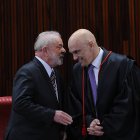
However, the doubtful honor of being the most punished by the new tariffs is Brazil. The Carioca country, despite having a trade relationship with the US in which it imports more than it exports, was the first to face the new rates, 24 hours before the rest. Moreover, its penalty for the "witch hunt" by Lula da Silva's government and Supreme Court judge Alexandre de Moraes against Jair Bolsonaro has also been much higher than for the rest: a 50% surcharge.
Mexico and Canada try to shield themselves with the North American Free Trade Agreement
Mexico has bought time with a 90-day extension to negotiate an agreement and in the meantime pays 25%, except on goods protected by the North American Free Trade Agreement (T-MEC), of which it is a party with the United States and Canada.
This agreement also protects many goods from Canada, hit since a few days ago with 35% supplementary levies.
The new customs tariffs reach 41% in the case of Syria. Switzerland, which is on its heels with 39%, tried until the last minute to lower the percentage. In vain.
Semiconductors, chips and medicines, next on the list
Pharmaceuticals are also in the Republican tycoon's crosshairs: "Initially we're going to place a small tariff on pharmaceuticals, but in a year, year and a half, at the most, it will go up to 150% and then 250% because we want pharmaceuticals to be manufactured in our country," Trump told CNBC this week.
Aug. 12, new key date: end of tariff truce with China
August 12 is another date marked in red on the calendars of global economic players. On that day the tariff truce expires between the world's two major powers which, despite ongoing negotiations, have not yet reached any agreement to extend it or seal a definitive trade pact.
LATEST