Venezuela: UN warns that repressive apparatus remains intact
The Independent International Fact-Finding Mission documented arbitrary detentions, torture and links between the "colectivos" and state structures. The opposition leader warned that the reduction in repression does not mean that the structures that made it possible have disappeared.
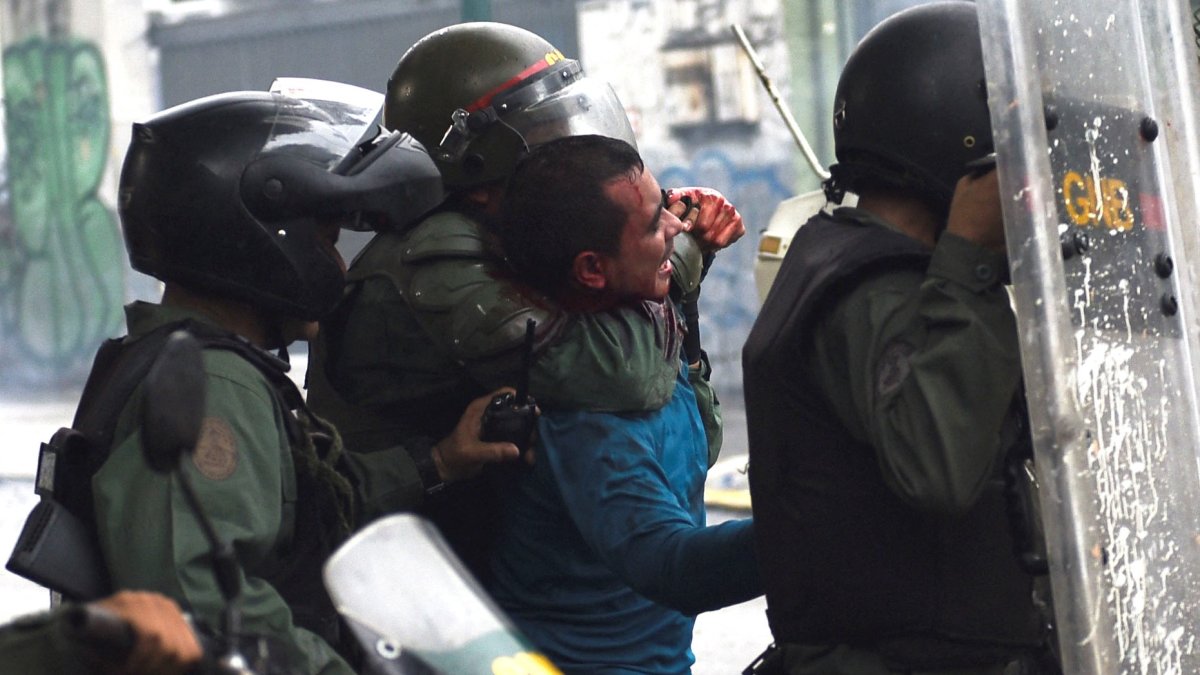
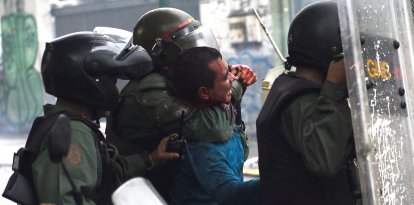
Repression in Venezuela by Maduro's police forces

The United Nations Independent International Fact-Finding Mission on Venezuela warned that, despite limited improvements in the area of human rights, the state institutions responsible for repression and serious human rights violations and crimes against humanity remain intact.
In its Sept. 16 report, the agency noted that the changes observed have not been accompanied by the institutional reforms necessary to ensure a sustained improvement in the situation.
The mission examined the events of the past year and presented conclusions regarding the human rights violations that continue to occur. It also included an analysis of the "colectivos" and their ties to the Venezuelan government.
After reviewing the document, Venezuelan opposition leader Edmundo González Urrutia stated that its content is serious and must be analyzed based on a fundamental premise: "Human rights are not a concession, nor can they depend on political circumstances."
In a statement released after reading the report, the opposition leader argued that the reduction in certain forms of repression does not mean that the structures that made them possible have disappeared.
Arbitrary arrests and torture continue in Venezuela
The mission observed a significant decrease in long-term detentions and associated enforced disappearances following the U.S. military attack on Jan. 3, 2026, and the capture of Nicolás Maduro. It also noted that the authorities released hundreds of people detained for political reasons and allowed somewhat greater leeway for protests, public gatherings and civil society participation.
However, the mission documented that the legal, institutional and security structures used to repress dissent remain in place. Numerous laws used to criminalize dissent remain in effect, while intelligence services and security forces retain essentially the same structures, policies and practices.
The mission also noted that journalists and other civil society actors continue to face obstacles in their daily work. Between Sept. 1, 2025, and July 29, 2026, civil society organizations recorded at least 214 politically motivated arbitrary detentions. Ninety-four percent of these occurred before the end of 2025.
After Jan. 3, the mission identified a recurring pattern of short-term arbitrary arrests intended to intimidate opposition activists, journalists and other civil society actors.
Although releases significantly reduced the number of political prisoners, nongovernmental organizations estimate that between 379 and 500 people remained in detention. The lack of official, transparent and verifiable information makes it impossible to determine precisely who has been released, where those who remain in detention are located, and what their legal status is.
González Urrutia highlighted this point, noting that "hundreds of Venezuelans continue to be arbitrarily deprived of their liberty." He also warned that cases of enforced disappearances, torture and ill-treatment continue to be documented.
U.N. documents new cases of torture
The mission continued to document patterns of torture and ill-treatment against individuals detained for political reasons.
At the maximum-security El Rodeo I prison, it documented practices such as forced intubation and prolonged confinement in a sealed underground cistern known as the "time machine."
At Fuerte Guaicaipuro, a military facility, it investigated the confinement of individuals in cells resembling pits dug below ground level, exposure to the cold, deprivation of food and other degrading practices.
The agency investigated 64 new cases of torture after Jan. 3, a figure that, according to the report, indicates that these practices remain widespread.
The mission also warned that hundreds of people remain exposed to deplorable detention conditions, with severely restricted access to safe drinking water, adequate food, medication and medical care.
It also concluded that several cases of deaths in custody of detainees held for political reasons were linked to a lack of access to adequate medical care and to ill-treatment.
In his response, González Urrutia described the mission's conclusion regarding the persistence of an institutionalized culture of torture, sustained by tolerance and impunity, as particularly serious.
The "colectivos" and their ties to the state
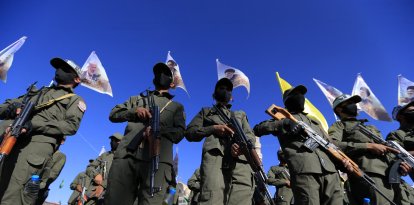
One section of the report is devoted to the colectivos, pro-government armed civilian groups that, according to the mission, constitute a central component of the state's repressive apparatus and of a broader system of local governance and social control.
The mission found evidence of long-standing relationships that include political backing, direct and indirect funding, logistical and material support, operational coordination and institutional protection.
It also had reasonable grounds to believe that the government regularly supplied the "colectivos" with firearms, ammunition, motorcycles, cell phones and radio equipment.
The investigation found that these groups have carried out surveillance and intelligence functions, located individuals wanted by security agencies, and participated in the violent repression of demonstrations and the selective persecution of actual or perceived opponents.
The mission determined that, when the "colectivos" exercise public authority functions conferred by Venezuelan law or act under the instructions, direction or control of state bodies, their actions may be attributed to the state.
González Urrutia calls for truth, remembrance and justice
However, he cautioned that a distinction must be made between the time needed for democratic transformation and the ability of a repressive structure to reinvent itself.
"What this report shows is precisely the persistence of structures that change their forms without altering their substance," he said.
González Urrutia also called for the U.N. Fact-Finding Mission's work to continue and highlighted the importance of preserving the testimonies collected, the documented violations and the established responsibilities.
LATEST