Trump threatens EU with tariffs over new alliance with Canada, Carney fires back
The U.S. president warned of heavy tariffs and even restrictions on trade with the European Union if he interprets the proposal to make Canada the bloc's first "associate member" as a "hostile act." Brussels assured that the initiative "is not against anyone else."
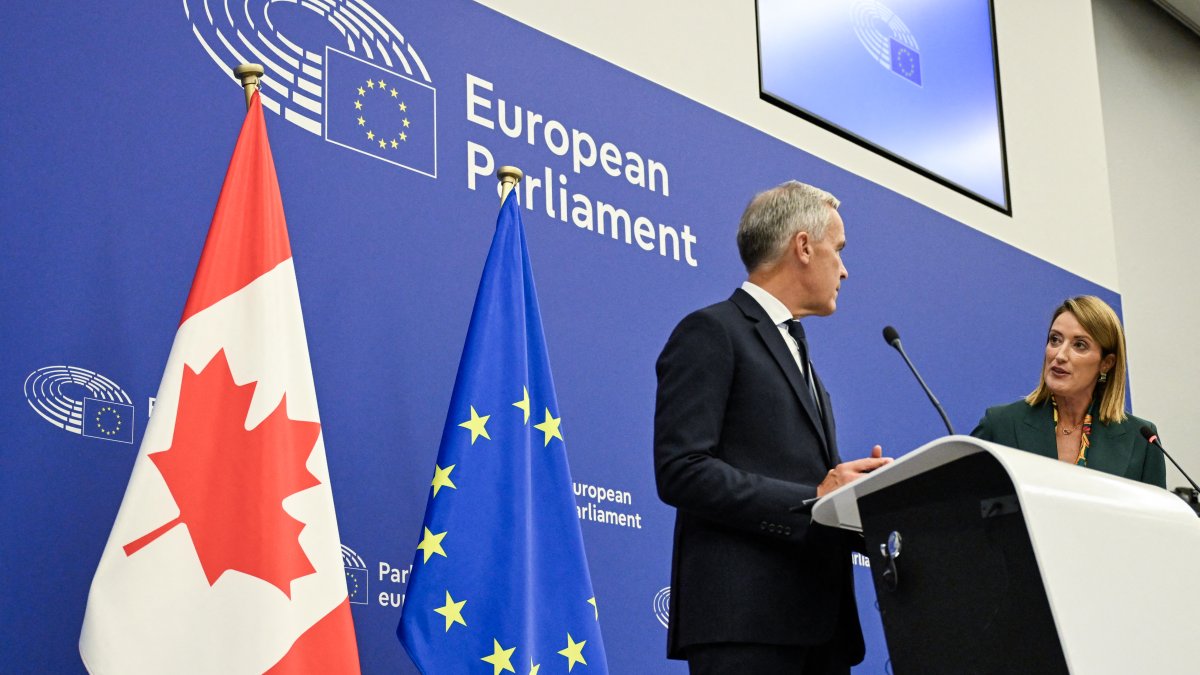
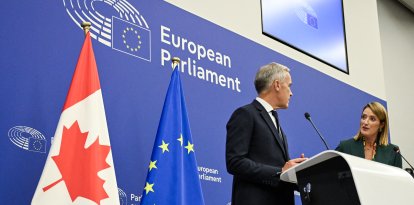
Canadian Prime Minister Mark Carney and European Parliament President Roberta Metsola

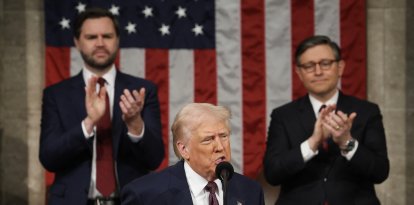
President Donald Trump threatened to impose heavy tariffs on the European Union and even restrict trade with the bloc after Brussels proposed making Canada its first "associate member."
The proposal was presented on Wednesday by European Commission President Ursula von der Leyen during her State of the Union address to the European Parliament, which was attended by Canadian Prime Minister Mark Carney as a guest.
Trump reacted hours later from North Carolina and called the initiative "ridiculous." The president noted that Washington's response would depend on how he interpreted the agreement's intentions.
"If they do that, if I think it’s at all a hostile act, I will put very serious tariffs or stop trading with Europe on many things," Trump warned. He later clarified that if the proposal stems from "good intention," he would have no objections, but he asserted that any contrary motivation could trigger severe trade retaliation.
The warning opens a new front in Washington's already complex trade relations with its traditional allies and comes as Canada seeks to reduce its heavy dependence on the U.S. market.

Politics
Trump threatens EU with tariffs following record fine against Google: 'The EU will pay a very big price'
Carlos Dominguez
Brussels responds to Trump
The European Commission denied on Thursday that the rapprochement with Ottawa is intended to harm the United States.
"The proposed strengthening of our partnership with Canada is not against anyone else," said Olof Gill, the European Commission's trade spokesperson, following the U.S. president's threats.
Von der Leyen herself had argued the day before that the initiative seeks to expand a relationship that has so far been based primarily on trade and to move it toward an "alliance for the future."
The Commission president proposed deepening bilateral cooperation in areas such as defense, artificial intelligence, energy, critical minerals, cybersecurity, advanced manufacturing, and the Arctic.
"I would like to work with you on opening the door for Canada to be the first associate member of the E.U.," von der Leyen told Carney in Strasbourg.
The rapprochement also envisages greater coordination on security. Von der Leyen proposed that Canada participate, alongside countries such as the United Kingdom and Norway, in a future European Security Council.

World
Von der Leyen proposes that Canada become the European Union's first 'associate member'
Diane Hernández
Carney replied: "No one is going to dictate" whom we can partner with
"Canadians are united that nobody is going to tell us what language to speak. ... No one is going to dictate our culture, or with whom we can strike agreements," Carney told reporters at the European Parliament, according to AFP.
Carney welcomed the European proposal and advocated for a broader strategic alliance with the bloc in trade, defense, artificial intelligence, energy and critical minerals.
During his speech in Strasbourg, the Canadian leader presented the rapprochement with Europe as part of a strategy to strengthen Canada's sovereignty and economic capacity in an international landscape marked by growing trade and geopolitical tensions.
Ottawa has also set a goal of doubling its trade with countries other than the United States over the next decade, while seeking to diversify an economy that still sends about 70% of its exports to the U.S. market.
Can Canada really become an "associate member" of the E.U.?
For now, the concept is primarily a political proposal.
The European Union treaties do not formally establish an "associate member" category, so the rights, obligations or institutions to which Canada might have access have not yet been defined.
A similar formula was previously proposed by Germany for Ukraine and included, among other possibilities, participation in European meetings and summits without having the same voting rights as member states.
European diplomats consulted by Reuters have also pointed out that Canada's conventional accession to the E.U. faces significant legal and geographical obstacles. The details of a strengthened relationship will have to be negotiated between Brussels, Ottawa and the member states.
Canada and the E.U., however, already have a substantial economic relationship. Both have been provisionally implementing the Comprehensive Economic and Trade Agreement (CETA) since 2017 and have recently expanded their cooperation on defense.
Talks could move forward during the Canada-E.U. summit scheduled for late October in Montreal, where the parties are expected to begin defining the actual scope of this new "alliance for the future."
LATEST