Iranian regime's state television cuts short interview with chief negotiator in talks with Washington
According to the parliamentary media center, the deleted segments included sensitive topics such as inspections by the International Atomic Energy Agency (IAEA), Iranian assets frozen abroad and a $300,000 million reconstruction loan.

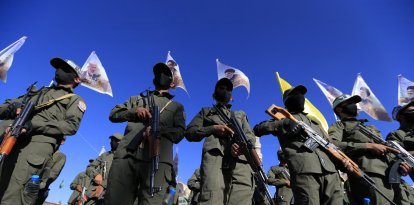
A banner featuring Mojtaba Khamenei during a demonstration

The Iranian regime’s state television (IRIB) abruptly cut off the broadcast Tuesday of an interview with Mohammad Bagher Ghalibaf, speaker of Parliament and Iran’s chief negotiator in talks with Washington, prompting strong criticism from his team.

According to AFP, in a statement issued Wednesday, Parliament’s media center reported that the interview had been provided to IRIB more than two hours in advance but was cut off midway through the broadcast. “Although the discussion was recorded, IRIB officials did not coordinate with us regarding their decision not to air part of the content,” they lamented.
The state-run television network defended its decision, arguing that the interview was divided into two parts and that the second part would air Wednesday night.
Sensitive topics censored
According to the parliamentary media center, the deleted segments included sensitive topics such as inspections by the International Atomic Energy Agency (IAEA), Iranian assets frozen abroad and a $300,000 million reconstruction loan.
The interruption has caused unease even among conservative and hardline sectors of the regime, which had already been harshly criticizing the agreement reached between Tehran and the Trump administration to end the regional conflict.
Ghalibaf defends the results
During the interrupted interview, Ghalibaf defended the agreement’s achievements. According to AFP, the official stated that the memorandum allowed Iran to sell its oil after the lifting of the U.S. blockade in the Strait of Hormuz.
“From the day the blockade was lifted until today, we have exported more than 40 million barrels of oil,” he noted. In contrast, he said that during the 50 to 60 days prior, “we really couldn’t export a single barrel.”
Strong criticism of the agreement with the U.S.
Critics argue that Iran hastily reopened the Strait of Hormuz, allowing oil to flow once again, without securing any concrete benefits in exchange for the memorandum of understanding signed with Washington.
LATEST