'Everything collapsed': Hardest-hit Venezuela region calls for help after earthquakes
Two consecutive earthquakes with magnitudes of 7.2 and 7.5 struck Venezuela on Wednesday night, killing at least 188 people and injuring nearly 1,500, with an unknown number of people missing in the rubble in various parts of the country.
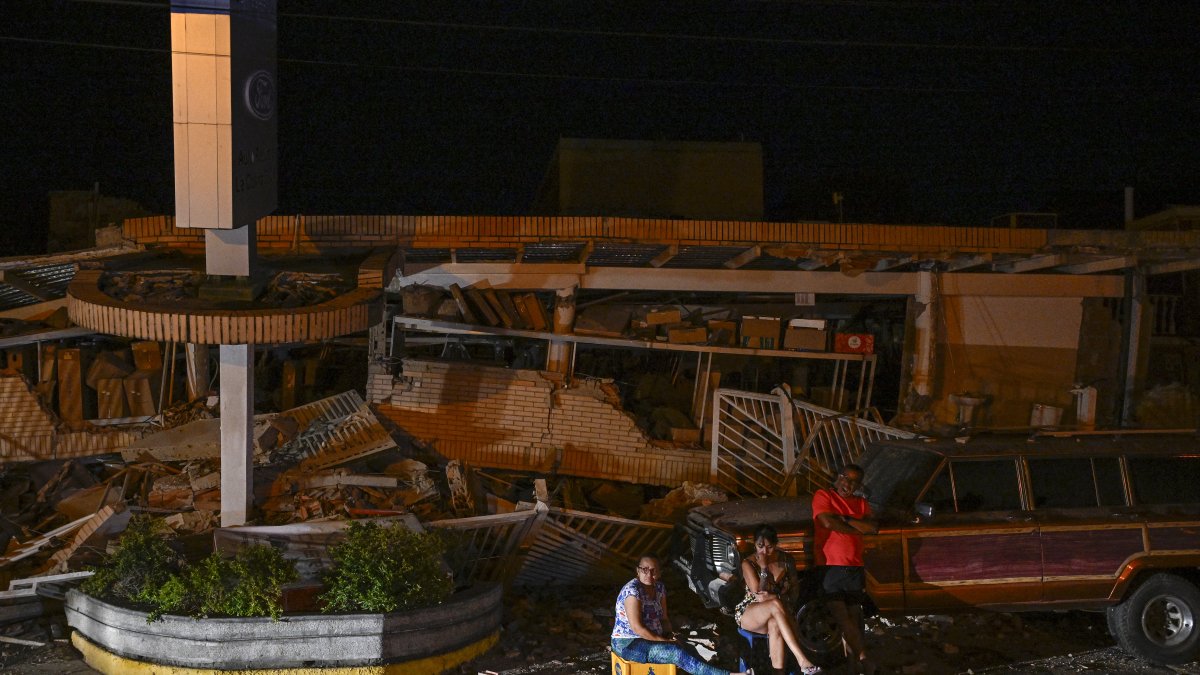
Image of the earthquake in Venezuela

"It was terrible. Everything, everything, collapsed," laments Yilsmaris Blanco as she gazes in horror at the devastation in Catia La Mar, one of the cities hit hardest by the double earthquake that leveled dozens of buildings in the Venezuelan state of La Guaira.
"We thank God because (...) we’re alive, but there are people right now suffering because their relatives are trapped under the rubble, crushed beneath it and they can’t get them out," the 39-year-old woman told AFP.
Two consecutive earthquakes with magnitudes of 7.2 and 7.5 struck Venezuela on Wednesday night, killing at least 188 people and injuring nearly 1,500, with an unknown number of people missing in the rubble across the country.
In the north, facing the Caribbean, La Guaira, 40 minutes from Caracas and home to Maiquetía International Airport, was the hardest-hit region. The interim government declared it a “disaster zone.”
“We have nothing, right now we have nothing, not even the strength, nor the courage to go in there. Just imagine,” says Larry Rojas, 49, one of the thousands of residents affected in an area of Catia La Mar with nearly 200 residential towers.
Some of those buildings are barely standing, with large cracks and gaping holes in the walls visible from the outside, as an AFP team observed during a tour of the area.
Dozens of others, however, collapsed completely and were reduced to rubble.
Much of the area is without electricity, and dozens of residents are spending the night on the street. In the darkness, they fear there may be more aftershocks after the more than 20 they have already felt.
“There are survivors down there,” warns Lisbeth Vasquez, another resident who managed to escape with her family from one of the collapsed buildings.
World
Venezuela: The 7.5-magnitude earthquake in a seismic doublet is the strongest since 1900
Carlos Dominguez
"What's needed is help"
In the middle of the night, dozens of rescue workers were doing their best amid the rubble, while authorities closely monitored citizens trying on their own to find their loved ones by shouting their names.
AFP journalists witnessed family members recovering the bodies of a man and a woman and placing them in the trunk of a pickup truck.
They also saw how a well-known pharmacy in Catia La Mar had its glass doors shattered and its shelves emptied, though authorities were unable to confirm whether looting had occurred in the wake of the emergency.
“What we need is help, especially technical teams, the teams in Caracas who know which tools to use and can come here to La Guaira to help. Let them come,” pleads José Pacheco, head of operations for the United Rescue Group of Venezuela, his breath coming in gasps.
“You can see the structures as they are, like this one here, which has completely collapsed, and what we need is help,” adds the 52-year-old rescuer, as he counts some 14 damaged buildings around him.
Pacheco, with three decades of experience, says he had “never” seen “anything like this.”
"It shook harder"
Antonio Bermúdez, a 45-year-old resident of La Guaira, was in his living room when the tremor “suddenly” began.
“I started moving; I sought shelter under a column. I was between my bedroom and the shower. It was shaking harder and harder,” he recalls.
“I held onto the wall, I held onto the wall, I held onto the wall, and the building started to collapse,” he explains, sitting against a wall on the street, while trying to position a leg he cannot move after a “slab” fell on him as he tried to escape from the rubble.
Help in the darkness
“We don’t have any water either; we’re dying of thirst. We’re taking shelter inside the structure and are afraid it might collapse too,” adds Larry Rojas.
“We really need someone to help us, send in heavy equipment. That’s what we need to get into the collapsed buildings,” he pleads.
LATEST