The EU is accelerating the development of the digital euro to reduce its dependence on tech and financial giants
The ECB first unveiled this initiative in 2020, arguing that Europe lacks its own solution capable of competing with international payment platforms dominated by U.S. companies.
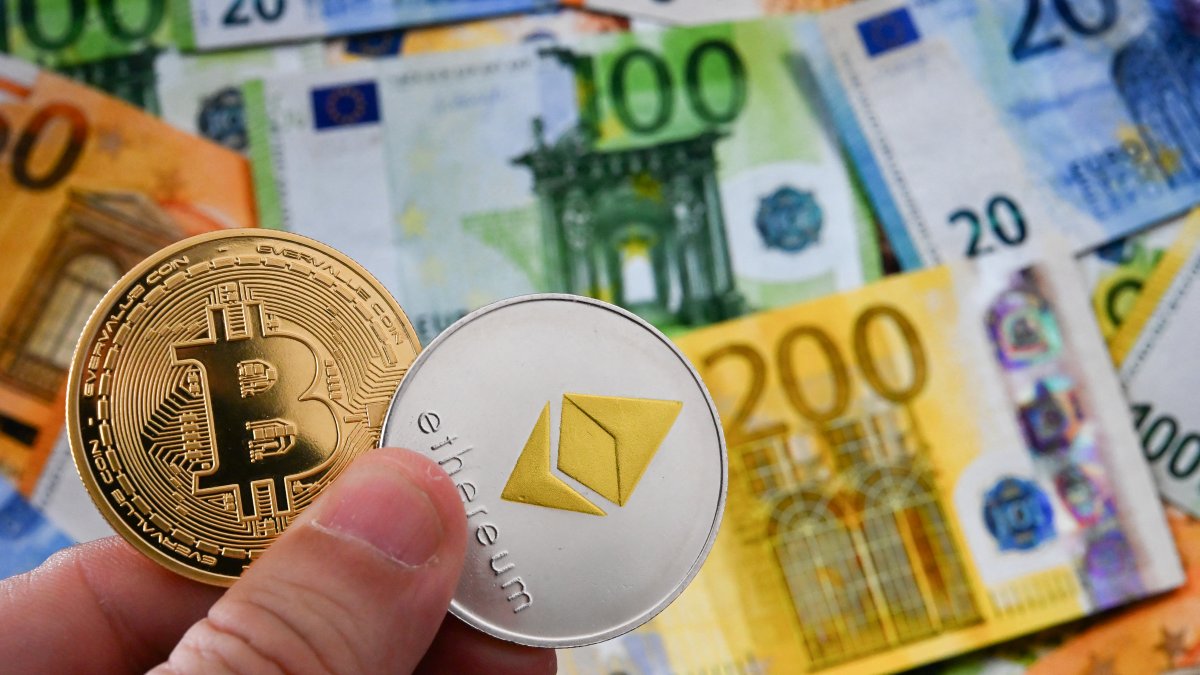
Illustration of Bitcoin and Ethereum coins next to various euro banknotes (File photo)

The European Union took another step toward creating the digital euro, an initiative aimed at strengthening the bloc’s financial sovereignty and reducing its dependence on payment systems controlled by U.S. companies such as Visa, Mastercard, Apple Pay and Google Pay.
On Tuesday, the European Parliament’s Committee on Economic Affairs approved the legislative framework that will allow progress on the project spearheaded by the European Central Bank (ECB), bringing Europe closer to the creation of an official digital currency that could be available to citizens as early as 2029.
The measure is part of a broader strategy by Brussels to strengthen European technological and financial autonomy in an international context marked by growing geopolitical tensions and concerns about dependence on critical infrastructure controlled from outside the continent.
Another step toward European financial sovereignty
The parliamentary committee’s approval represents a significant step forward, although the proposal must still pass through further legislative stages. The European Parliament plans to ratify the decision next month, though MEPs could still request a vote in plenary session.
Subsequently, negotiations will begin between the Parliament, the European Commission and the member states to define the final legal framework that will enable the launch of the digital euro.
The ECB first presented this initiative in 2020, arguing that Europe lacks its own solution capable of competing with international payment platforms dominated by U.S. companies.
What exactly is the digital euro?
Unlike cryptocurrencies or traditional bank deposits, the digital euro would be an electronic form of money issued directly by the European Central Bank.
Users would not store these funds in their regular bank accounts, but rather in a digital wallet specifically designed to handle this new digital version of the European currency.
Its value would be identical to that of physical cash, maintaining a one-to-one parity with the conventional euro.
The goal is to offer citizens a public, European alternative for making payments both in physical stores and online.

How will it work?
According to the ECB’s plans, any citizen could open a digital euro wallet through a bank, an authorized institution, or even public agencies such as post offices.
Users could transfer money from their traditional bank accounts or deposit cash to convert it into digital euros.
Payments could be made using:
- Physical cards
- Mobile apps
- Smartphones
- Platforms integrated into banking apps
In addition, the system would include an offline payment mode, designed to offer privacy levels comparable to those of cash.
The ECB insists that the digital euro will not replace cash or current payment methods, but will coexist with them.
"Cash will continue to be available, and citizens will be able to continue using existing private systems," explained Alessandro Giovannini, an advisor to the ECB’s digital euro program, according to AFP.
The goal: Reduce dependence on the United States
European institutions consider that payment systems are critical infrastructure and, therefore, tools of economic and political power.
French MEP Gilles Boyer stated that payment systems “are not neutral,” but rather instruments that can be used to exert geopolitical influence.
Brussels has cited as a recent example the sanctions imposed by Washington in 2025 against judges of the International Criminal Court. Some of the affected judges reported restrictions on their access to certain financial services, which, according to European officials, highlighted the existing dependence on infrastructure controlled by U.S. companies.
Currently, nearly two-thirds of card payments made in the eurozone are processed by non-European companies, primarily Visa and Mastercard. Furthermore, 13 of the 21 countries that use the euro lack their own national card payment system for everyday transactions.
For European authorities, the digital euro would make it possible to build a pan-European alternative and strengthen the bloc’s economic autonomy.
Planned timeline
If negotiations proceed as planned and the regulations are approved before the end of this year, the ECB plans to launch a pilot program in mid-2027.
This period would be used to test the system's functionality, evaluate technical aspects and prepare banks, merchants and users. Full implementation could take place in 2029.
The ECB believes this timeline is necessary to ensure an orderly transition and avoid operational problems in the European financial system.

Banks: The main critics
The initiative does not have the unanimous support of the financial sector.
European banks have expressed concern about the high costs of technological adaptation that the rollout of the digital euro will require.
The European Banking Federation estimates that the process could cost around 18,000 million euros, while the ECB puts the figure between 4,000 and 5,800 million. Banks also fear that a portion of bank deposits will shift to the new digital wallets, reducing a key source of funding for the financial system.
However, the ECB dismisses these fears and maintains that the planned design will include limits and control mechanisms to prevent massive deposit outflows, even in crisis scenarios.
Another concern for the sector is potential competition from private European initiatives such as Wero, the pan-European payment system backed by several banks across the continent.
A debate that goes beyond technology
Beyond financial innovation, the debate over the digital euro reflects a strategic issue for Europe: To what extent should the continent rely on foreign platforms to manage activities as essential as payments?
For Brussels, the answer lies in developing its own infrastructure to ensure autonomy, security and decision-making capacity.
Tuesday’s parliamentary approval brings the European Union closer to that goal and makes the digital euro one of the most ambitious economic projects of the coming decade.
LATEST