Open conflict in Mexico: Security forces kill ‘El Mencho,’ leader of Jalisco New Generation Cartel, triggering wave of violence in the west
Nemesio Oseguera Cervantes was considered the most powerful drug trafficker in the country. The United States was offering up to $15 million for information leading to his capture.
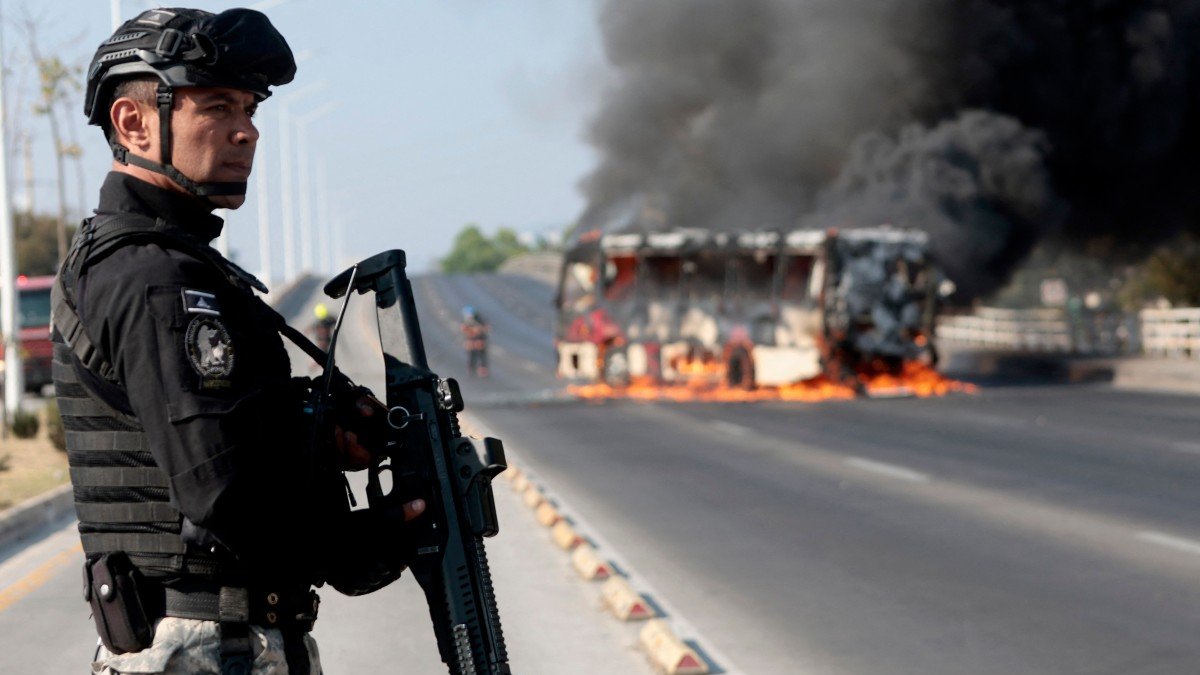
Mexican law enforcement forces near burning bus on Feb. 22

The Mexican government confirmed Sunday that special forces of the Army and the National Guard shot down dangerous drug trafficker Nemesio Oseguera Cervantes, aka “El Mencho,” leader of the Jalisco New Generation Cartel (CJNG), during an operation in the municipality of Tapalpa, in the state of Jalisco, with the support of the U.S. intelligence apparatus.
Although the Mexican Ministry of National Defense explained that the initial objective of the operation was to capture him, the drug lord ultimately died of wounds suffered during the confrontation while he was being airlifted to Mexico City.
According to various reports, the operation was planned by the central military intelligence unit and executed with the support of the Air Force and the National Guard's Special Immediate Reaction Force. According to official information, seven members of the CJNG were killed—four at the scene and three during the transfer—including Oseguera. Two more people were arrested and three military personnel were wounded during the operation.
According to Fox News, the Mexican military operation that killed the leader of the Jalisco New Generation Cartel received “strong support” from the U.S. military, although it was carried out entirely by Mexican forces. Citing a U.S. Department of Defense official speaking on background, the network reported that the Joint Interagency Task Force–Counter Cartel (JIATF-CC), which regularly works with Mexican forces through U.S. Northern Command, played a supporting role; however, the source emphasized that “this was a Mexican military operation, so the success is theirs.”

Chaos and violence in Mexico in retaliation
The CJNG's reaction was practically immediate. In the early afternoon, after the killing of “El Mencho,” the criminal group began to set up coordinated blockades on strategic highways and streets in Jalisco. The Mexican press, such as El Universal, reported that cargo vehicles and private cars were set on fire in various intersections to impede traffic and hinder the mobilization of federal forces.
In the Guadalajara metropolitan area, vehicle fires were also reported on main streets, reported El País. The state government activated Code Red and asked the population to remain in their homes. Public transportation was preventively suspended, on-site classes were cancelled for Monday and massive gatherings and sporting events were postponed.
One of the most sensitive and affected areas was Puerto Vallarta, a key tourist destination on the Mexican Pacific coast and considered one of the historical strongholds of the CJNG. Videos posted on social media during the day showed plumes of smoke on roads near the urban area. Although federal authorities and the Grupo Aeroportuario del Pacífico reported that Guadalajara International Airport was operating normally and under the protection of the National Guard and the Sedena, in Puerto Vallarta there were disturbances on access routes near the airport and several videos on social media showed evacuations at the airport, as well as in some hospitals.

Several international airlines, including Air Canada and United Airlines, temporarily cancelled flights to this destination due to the situation on the surrounding highways, although no incidents were reported inside the terminals.
Narco-blockades in western Mexico
The blockades extended beyond Jalisco. Mexican authorities confirmed incidents in Guanajuato, Michoacán, Nayarit, Aguascalientes and Tamaulipas. In Michoacán, a fire was reported in a heavy vehicle that blocked a state road. In other states, security tables were set up due to the risk of violence spreading.
In Colima, the National Port System Administration reported the temporary suspension of operations at the Manzanillo port customs as a preventive measure, although other port activities continued as usual.
So far, authorities have not confirmed civilian casualties derived from the narco-blockades and fires registered during Sunday. Official statements indicated that the violence was limited to the burning of vehicles and obstruction of roads, with no verified reports of civilian deaths related to the CJNG's reaction.
U.S. and Canada issue security alerts
The embassies of United States and Canada issued a security alert for their citizens in Jalisco—including Guadalajara, Puerto Vallarta and Chapala—as well as in Tamaulipas, Michoacán, Guerrero and Nuevo León. The advisory recommended taking shelter until further notice, avoiding areas of police activity and minimizing travel in the face of blockades and criminal activity.
🚨 ÚLTIMA HORA | La Embajada de Estados Unidos en México emite una alerta de emergencia para todos aquellos que se encuentren en los estados de Jalisco, Tamaulipas, Michoacán, Guerrero y Nuevo León pic.twitter.com/8w6MrgNzul
— VOZ (@VozMediaUSA) February 22, 2026
Canadians in #Mexico: Violence and roadblocks are occurring in #Jalisco State. A shelter-in-place order is in effect in Puerto Vallarta. If you’re in Jalisco State, keep a low profile and follow advice of local authorities. More info:https://t.co/wVdAxQDbsG pic.twitter.com/EsGgrk57Eh
— Travel.gc.ca (@TravelGoC) February 22, 2026
From Washington, Deputy Secretary of State Christopher Landau publicly congratulated the Mexican forces for the operation. Secretary of State Marco Rubio also expressed appreciation to Mexico for the action against the CJNG leader, highlighting bilateral security cooperation.
Oseguera, considered by Mexican and U.S. authorities to be one of the most influential drug traffickers in recent years, had built up the CJNG to be an organization with a presence in multiple states and paramilitary capacity. His death represents one of the most significant blows against organized crime in recent years.
At nightfall on Sunday, federal forces maintained deployments on highways in the west and center of the country to reestablish traffic and prevent new blockades, while state authorities continued to call on the population to avoid unnecessary travel in the face of the imminent danger and the wave of violence sweeping several states in the country.
LATEST