Venezuela's judiciary orders 379 releases after amnesty law enacted
Despite the releases, human rights organizations and relatives of detainees have expressed doubts about the real scope of the law.
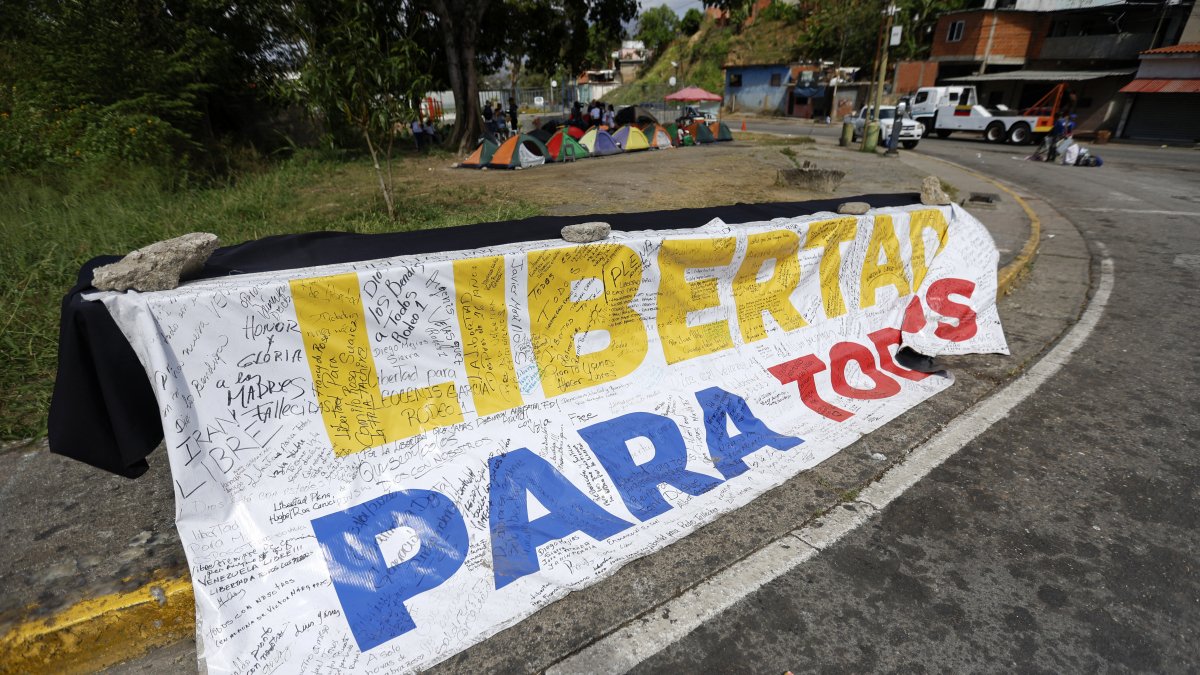
A banner reading "Freedom for all" is displayed in front of El Rodeo I prison in Guatire.

Venezuela's judiciary, controlled by the ruling party, ordered the release of 379 political prisoners Friday night, a day after the enactment of a new amnesty law approved unanimously by the National Assembly and signed by the interim President Delcy Rodriguez, official sources overseeing the process reported.
The announcement was made by Chavista Jorge Arreaza, who heads the legislative commission that drafted the law and is overseeing its implementation. In a television interview, Arreaza said the Public Ministry filed the necessary requests with the competent courts for the 379 amnestied individuals to be released between Friday night and Saturday morning.
">🚨 Jorge Arreaza informa que el Ministerio Público solicitó al Tribunal Supremo otorgar medidas de amnistía para:
— Juan Pablo González 🇻🇪 (@Juanegron) February 21, 2026
• 371 en Caracas
• 5 en Barinas
• 2 en Portuguesa
• 1 en Monagas
Total: 379 personas que deben ser excarceladas y amnistiadas, a más tardar mañana. pic.twitter.com/P5kRGWg6gY
Arreaza stressed that these releases follow the entry into force of the law, which was approved Thursday night by consensus in the ruling party-dominated Parliament following the overthrow of Nicolás Maduro.
Official reactions
Hours before the announcement, Delcy Rodriguez defended the amnesty law, calling it an important step towards the construction of "a more democratic, just and free Venezuela." However, the dictator failed to point out the flaws and broad exclusions of this legislative project.

World
The regime of Delcy Rodríguez approves an incomplete amnesty law with broad exclusions
Luis Francisco Orozco
Despite the releases, human rights organizations and relatives of detainees have expressed doubts about the real scope of the law. The director of Foro Penal, Alfredo Romero, has pointed out that the amnesty does not apply automatically, but requires individual processing before courts, a point that has generated criticism and delays.
Relatives of prisoners have set up vigils in front of prisons such as Zona 7 in Caracas, demanding concrete results after weeks of waiting. Many have emphasized that they need "deeds, not words," given the perception that the process is advancing slowly.
Context and criticisms
Human rights groups have warned that, although the law promises broad amnesties for politically motivated crimes, it excludes individuals accused of serious crimes such as corruption or human rights violations, and requires appearance in court, which may limit its effectiveness.
In addition, recent reports indicate that, despite previous releases since the beginning of January, hundreds of people are still being detained for political reasons.
LATEST