Iran: Plucking the Daisy
The media speak of drums of war. Analysts no longer debate whether there will be a strike, but when—and how far it will go.
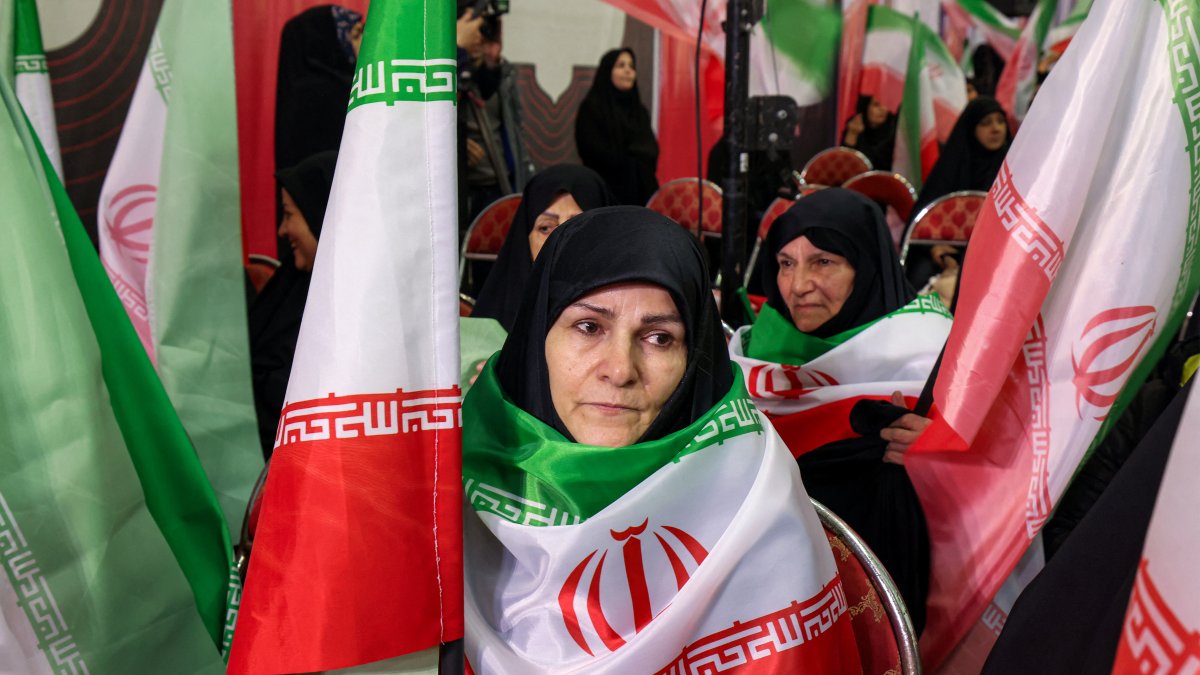
Women with Iranian flags mourn for the victims of terrorism killed in protests in Iran.
President Donald Trump has set a clear deadline: either Iran presents an acceptable proposal for an agreement with the United States, or it will face the consequences. At the same time, Washington is assembling in the region more than enough military force to strike the ayatollahs’ regime decisively. The media speak of drums of war. Analysts no longer debate whether there will be a strike, but when—and how far it will go.
And yet, one question remains: will there really be one?
When speaking about the future, it is worth recalling Yogi Berra’s famous line: “It’s tough to make predictions, especially about the future.”
There are things we do know. In Trump’s own words: “Iran has never won a war, but it has never lost a negotiation.” Its diplomatic playbook has long relied on deception and delay.
We also know that Supreme Leader Ali Khamenei operates within an informational bubble that led him to miscalculate Israel last year. It would not be surprising if he were to misjudge Trump this year as well. The leadership of the Revolutionary Guard may have a more realistic assessment of the balance of power, but they share the regime’s ideological DNA: Islamist, revolutionary, and expansionist. Exporting the Islamic Revolution is not a side project—it is the foundation of the regime’s legitimacy. Hence Hezbollah, Hamas, the Houthis, and the militias in Syria and Iraq. Hence the obsession with Israel. Hence the constant chant of “Death to America.”
These structural realities place hard limits on what Tehran can accept in any negotiation. The nuclear program may be the formal focus of talks, but the real issues extend far beyond uranium enrichment: ballistic missiles, regional proxy networks, and the regime’s broader expansionist ambitions.
Moreover, Iran’s nuclear infrastructure was severely degraded during last June’s conflict with Israel and subsequent U.S. strikes. What Tehran can offer today has more to do with future ambitions than with immediate capabilities. That makes the non-nuclear components of the negotiation all the more consequential.
Domestically, brutal repression has not fully extinguished dissent. The country faces a deep economic crisis and worsening water shortages. The regime can repress—but it cannot resolve. Protests will persist, and images will continue to reach the outside world despite attempts to censor the internet.
JNS
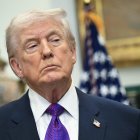
Iran has ‘10, 15 days, pretty much maximum’ to reach deal, Trump says
JNS (Jewish News Syndicate)
And what do we know about Washington?
Trump prioritizes negotiation, but he does not see negotiation and military action as mutually exclusive. He demonstrated that last June. He has demonstrated it elsewhere. His strategic instinct is consistent: minimum investment, maximum return. With Iran significantly weakened, a calibrated use of force could reshape the strategic balance—not only for the Iranian people, but for the broader Middle East.
Many within the MAGA movement—and many in Europe—portray Trump as a committed isolationist. Yet his national security strategy suggests something different: preserving American global primacy without necessarily acting as the world’s permanent sheriff. Iran is not merely a regional issue. It is a piece on the global chessboard in competition with China—and, by extension, Russia. This is less about securing access to Iranian oil than about denying it to America’s rivals.
Meanwhile, the U.S. military buildup in and around the region appears to be more than symbolic deterrence. It carries the capability to execute limited or high-intensity operations should that decision be made. It strengthens Washington’s negotiating position—but it also keeps the option of decisive action fully available.
In Israel, where I was visiting earlier this week, the prevailing view was that negotiations are unlikely to succeed given the regime’s structural rigidity. An attack, if it comes, was thought to be weeks away rather than days. Yet following the latest round of talks in Geneva, speculation about imminent action intensified once again. A month ago, when a U.S. strike was widely expected, airlines suspended flights to Israel. This time they have not. That may mean something—or nothing at all.

As Donald Rumsfeld once put it: “there are things we know we know, there are other things we known we don´t know, and there are things we don´t know we don´t know”. At this moment, the unknowns outweigh the certainties.
Still, one can imagine an alternative scenario. What if, whether through military action or internal implosion, the ayatollahs’ regime were to collapse? What if Iran ceased defining itself through anti-Americanism and revolutionary export? The strategic landscape of the Middle East would shift dramatically. A level of regional stability long considered unattainable could emerge far sooner than expected.
Is it possible? Yes.
Is it probable? Perhaps.
Is it imminent? No one truly knows.
For now, Washington continues plucking the daisy.
LATEST