Colombia: Two terrorist attacks leave at least 18 dead and more than 60 injured
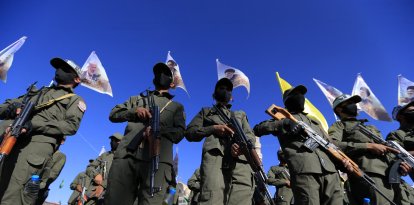
Authorities attributed the attacks to two FARC dissident groups. "We are facing an international mafia, with armed gangs here," said President Petro, whose government is evaluating declaring the groups suspected in the attacks and the Clan del Golfo terrorist organizations.
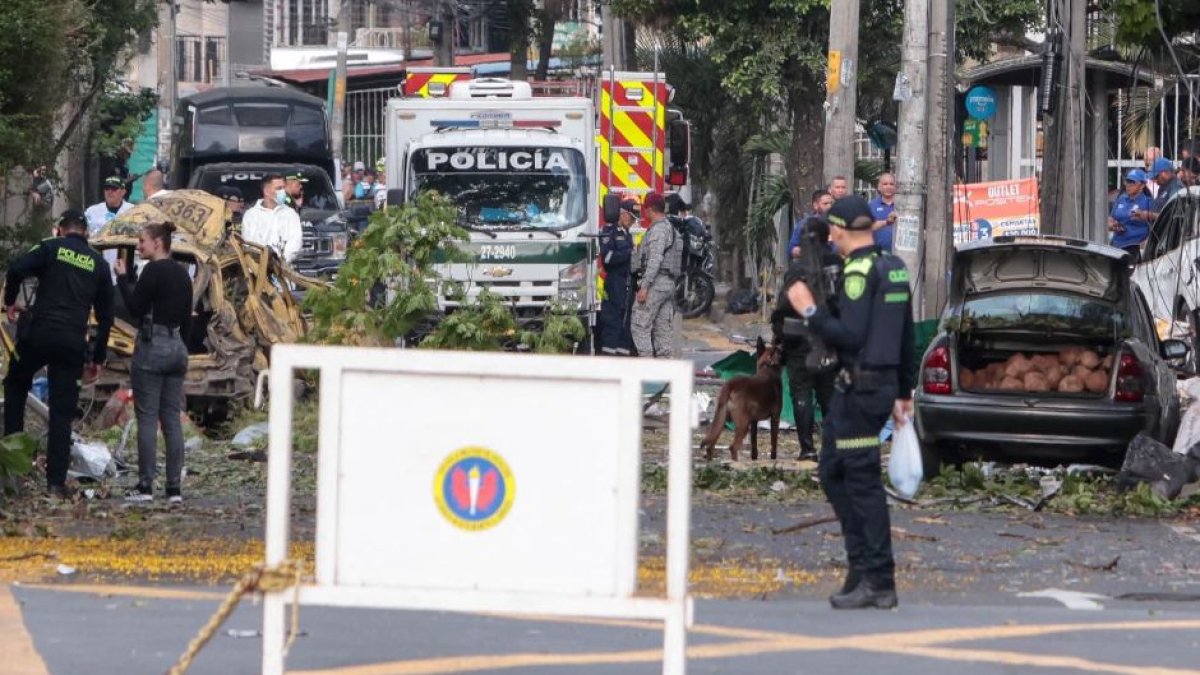
The area where a bomb exploded in Cali
Colombia again experienced a day of extreme violence on Thursday, when two attacks in different regions of the country left at least 18 people dead and more than 60 wounded. The events occurred amid an upsurge in the activities of armed groups disputing territorial control and drug trafficking routes.
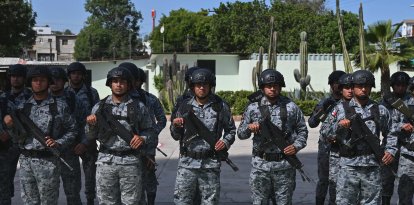
In the last hours, the Government reinforced military operations in the affected regions.
Car bomb in Cali
In Cali, Colombia's third-largest city, a truck loaded with explosives detonated near the Marco Fidel Suarez Military Aviation School. The attack left 6 people dead and more than 60 injured, according to authorities.
The event revives security concerns in the region, just weeks after bomb attacks in June that left seven dead and more than 50 injured.

Politics
The DEA accused the Maduro regime of collaborating with the FARC and ELN to traffic drugs to the US
Williams Perdomo
Police helicopter shot down in Antioquia
Hours later, in the municipality of Amalfi, in Antioquia, a police helicopter was shot down while supporting manual eradication of coca crops. The attack left 12 police officers dead and 3 others wounded.
According to preliminary investigations, the aircraft was hit by a drone loaded with explosives. The 36th Front of the FARC dissidents and the Clan del Golfo, the most powerful criminal organization in the country, operate in this area of northwestern Colombia.
Government targets FARC dissidents
No armed group has so far claimed responsibility for the attack in Cali. Authorities first pointed to Revolutionary Armed Forces of Colombia (FARC) dissidents, the National Liberation Army (ELN) and the Gulf Clan, all with a strong presence in various regions, as possible perpetrators. However, they later managed to refine the accusation to include two FARC dissident groups.
President Gustavo Petro published images of one of the alleged perpetrators of the bomb attack in Cali, assuring that he had been "captured by the community at the scene."
"He is alias Sebastián and belongs to the EMC structures, led by [Iván Jacob Idrobo] alias Marlon, subordinate to the Junta del Narcotráfico," he said, thus referring to one of the guerrilla splinter groups of the FARC after the peace process, known as Estado Mayor Central.
"This cowardly attack against civilians is a desperate reaction to the loss of control of drug trafficking in Valle del Cauca, Cauca and Nariño, where the security forces have neutralized a large part of this threat and are advancing in the irreversible recovery of the territory for legality," said the Minister of Defense, Pedro Sanchez.
The other attack was allegedly carried out by a rebel faction called Structure 36 (E36), linked to the cartel led by Alexander Díaz Mendoza, alias Calarcá.
Both groups, born in opposition to the peace agreement signed in 2016 by the FARC leadership, are at loggerheads with each other, according to AFP.
World
Cartel of the Suns, ELN, Hezbollah and Iran alliance revealed on Colombia-Venezuela border
Leandro Fleischer
President Petro announces extraordinary response
Faced with the wave of violence in the southwest of the country, the Colombian government is considering declaring the Clan del Golfo and the main dissidents of the FARC as "terrorist organizations." The objective of this measure would be to intensify the persecution against these groups, which combine violent actions with the control of illegal economies.
In addition, among the options under evaluation is the activation of the state of internal commotion. This constitutional figure grants exceptional powers to the president to govern using decrees with force of law.
What does the state of internal commotion imply?
Although it does not allow the suspension of human rights or fundamental freedoms, it concentrates broad power in the Executive and the Armed Forces to face security emergencies such as the current one.
United States reiterates its support for Colombia's security forces
The U.S. chargé d'affaires in Colombia, John McNamara, issued a statement lamenting the "tragic death" of the uniformed men in Amalfi.
"I extend my deepest condolences to their families and all my sympathy to the wounded and their loved ones at this difficult time," he said. "From our Embassy, we pay tribute to their bravery and service to the country, and we reiterate our firm support to the Colombian Public Force in their fight for security, legality and peace. Their sacrifice will not be forgotten."
LATEST