Trump hails NATO military spending increase, insists on Iran nuclear disarmament
Opening the plenary session with the 32 leaders, Mark Rutte praised the Republican president's influence as he threatens to roll back Washington's protection of Europe since World War II.

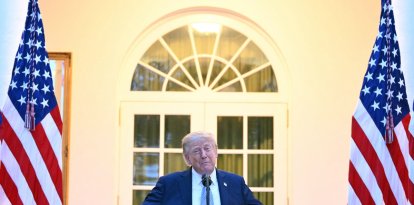
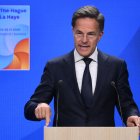
President Donald Trump at the NATO Summit, The Hague.

President Donald Trump said Wednesday at the summit in The Hague that the increase in military spending that NATO will approve under his initiative is a "big win for everyone."
The NATO meeting is set to seal a historic increase in its military spending, to 5% of each national GDP of its 32 member countries, beyond the reluctance expressed by Spain, which wants to limit itself to 2.1%.
"It's a great victory for everyone. I think we'll all be more equal before long, and that's the way it should be," said the U.S. leader, whose country is the Alliance's largest contributor, with 62% of total spending last year.
"I've been asking for an increase to 5% for several years, and they're going to increase to 5%. I think that will be great news," Trump added referring to the rest of the nations, and backed by NATO Secretary General Mark Rutte.
Rutte: "Dear Donald, you have made change possible."
Opening the plenary session with the 32 leaders, Rutte praised Trump's influence, which threatens to reduce the protection Washington has provided Europe since World War II. "Dear Donald, you have made change possible," he said.
"We will make historic and transformational decisions to make our people safer, through a stronger, fairer and more lethal NATO," the secretary-general also noted.
Although the increase is very ambitious, and will involve a major rearmament in a continent marked in recent years by the Russian invasion of Ukraine, the countries have committed to assume the new ceiling dedicated to defense.
The consensus until now was on a floor of 2% of GDP, a threshold that last year only 22 of the 32 member states reached.
World
NATO chief denies Sánchez: 'Spain is not exempt from spending 5% of its GDP on defense'
Diane Hernández
Spain's refusal
The Spanish Prime Minister, Pedro Sánchez, assured days ago that he negotiated with Rutte a flexibility on its military spending levels, so that the country would increase it only up to 2.1% of its GDP.
According to the head of the Spanish Executive, that level of spending is sufficient for his country to meet the necessary contribution of capabilities to the alliance, and 5% would be "disproportionate" and "unreasonable."
The NATO secretary himself denied an "agreement" with Spain, as Sanchez had speculated, and Trump also criticized the Spanish position on Tuesday. He claimed it is "unfair" to the rest of the alliance and represents a "problem."
Even Rutte said he is "not concerned" with the possibility of Spain derailing the course of the summit. The secretary has insisted since the start of the week that the agreement of around 5% does not include an exception clause, and that the alliance countries will all be committed to the spending increase.

Although Belgium and Slovakia expressed themselves in similar terms to Spain, several leaders were at pains to allay concerns on Wednesday. They said there would be unity at the end of the working meeting.
The 5% target, by 2035, is the sum of two components: 3.5% military spending in the strict sense (arms purchases, salaries), and 1.5% investment in areas such as cybersecurity, infrastructure and border protection, of both civilian and military utility.
Iran's nuclear disarmament: "They are not going to build bombs for a long time"
Adding to the Israeli military campaign launched on June 13, the Republican president decided on Sunday to attack three key Iranian nuclear facilities: Natanz, Fordo - located deep under a mountain - and Isfahan.
His goal, like Israel's, was to disrupt Iran's nuclear program, which Western powers suspect, despite Tehran's denial, is aimed at achieving an atomic bomb.
"I think they were totally destroyed," the tycoon declared from The Hague, where he is attending a NATO summit. "They're not going to build bombs for a long time," he stressed, adding that Iran's nuclear program was set back "decades."
Trump likewise estimated from The Hague that the uneasy truce between Iran and Israel was "working very well."
The Hague summit should also address continued support for Ukraine, and Ukrainian President Volodimyr Zelensky should meet with Trump to arrange a bilateral meeting.
LATEST