Ukraine's surprise attack on Russian bombers erodes Putin's ability to project global power
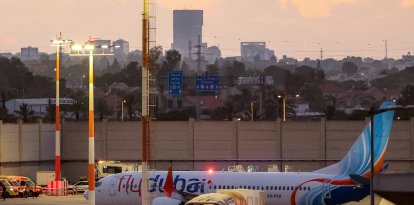
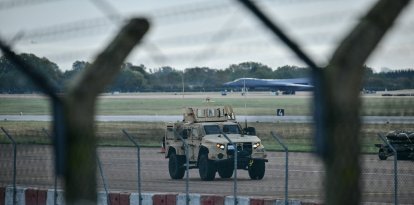
Ukrainian drones hit airbases more than 3,000 km from Kyiv, in the middle of Russian territory, destroying part of Moscow's strategic bomber fleet and leaving serious geopolitical implications in their wake.

Vladimir Putin with Russian soldiers

Last weekend Ukraine surprised the Kremlin by launching one of the most audacious, surprising, and destructive attacks since the start of the war by striking, via drones, several Russian air bases in the middle of enemy territory.
According to the Wall Street Journal, the Ukrainian offensive not only penetrated the Russian interior but also succeeded in damaging or destroying a significant portion of the Tupolev bombers that Vladimir Putin employs for both long-range strikes and his nuclear deterrence strategy. That is, his global power projection.
The targets were primarily Tu-95 and Tu-22 bombers, key aircraft in Russia's air arsenal that are periodically used to bomb Ukrainian cities.
According to Kyiv, more than 40 Russian aircraft, including nuclear bombers, were damaged, but intelligence analysts from independent sources confirmed a more cautious figure: at least 14 ships affected through satellite imagery.

World
Ucrania no avisó a la Casa Blanca de su ataque sorpresa contra bombarderos nucleares rusos
Emmanuel Alejandro Rondón
But, beyond the destruction of the bombers, the most significant impact, as the WSJ explains, is that Russia no longer manufactures these models, and, therefore, the recovery of these military assets will not be in the short term.
Their loss, according to experts cited by the newspaper, represents structural and collateral damage to Russia's ability to project military power beyond its borders, including against rivals such as the United States.
A change of balance in the war
The surprise attack, authorized directly by Ukrainian President Volodymyr Zelensky, as confirmed by intelligence chief Vasyl Maliuk, had the primary objective of neutralizing Russian air power from its very source, at least partially.
Moreover, it has also dealt a media and even internal blow to the Kremlin, as how the attack was carried out has ignited alarm in the military high command.
"The enemy bombed our country from these planes almost every night, and today I actually felt that ‘payback is inevitable," Maliuk said.
The surprise attack, planned for more than a year, occurred simultaneously at four bases - including those at Olenya, Belaya, and Ivanovo - and hit facilities 3,000 kilometers from Kyiv, a distance the Kremlin mistakenly thought was armored.
Ultimately, the Ukrainian attack exposed serious internal security flaws in the Kremlin and is likely to sharpen paranoia within Putin's inner circle of power.

World
Russia steps up attacks against Ukraine with 90 drones and two ballistic missiles
Agustina Blanco
The heart of Russia's nuclear triad was hit
The Russian bombers that hit Ukraine are part of, no more and no less, Russia's nuclear triad, along with land-based missiles and submarines.
Their damage, reads the WSJ, complicates the Kremlin's ability to maintain its deterrent posture vis-à-vis its enemies in the midst of peace negotiations.
While its main rival, the United States, keeps in operation B-52 bombers designed in 1949 through constant improvements and upgrades, Moscow, at least according to experts, has not yet shown its ability to replace its Tupolevs with new models with equivalent range and payload.
Kyiv, moreover, managed to prove to Washington that it still has the firepower and independence to fight a war that seemed stalled and, at times, lost, completely changing the narrative with a fierce and unprecedented attack that forced Moscow to reposition its strategic assets and reinforce defenses in areas that it considered absolutely safe and proved their vulnerability.
LATEST