







Impressive discovery on Mars: solid core similar to Earth's identified
Unlike previous studies that suggested it was completely liquid, the new results indicate that Mars' inner core would have solidified over time, a process that may still be ongoing.
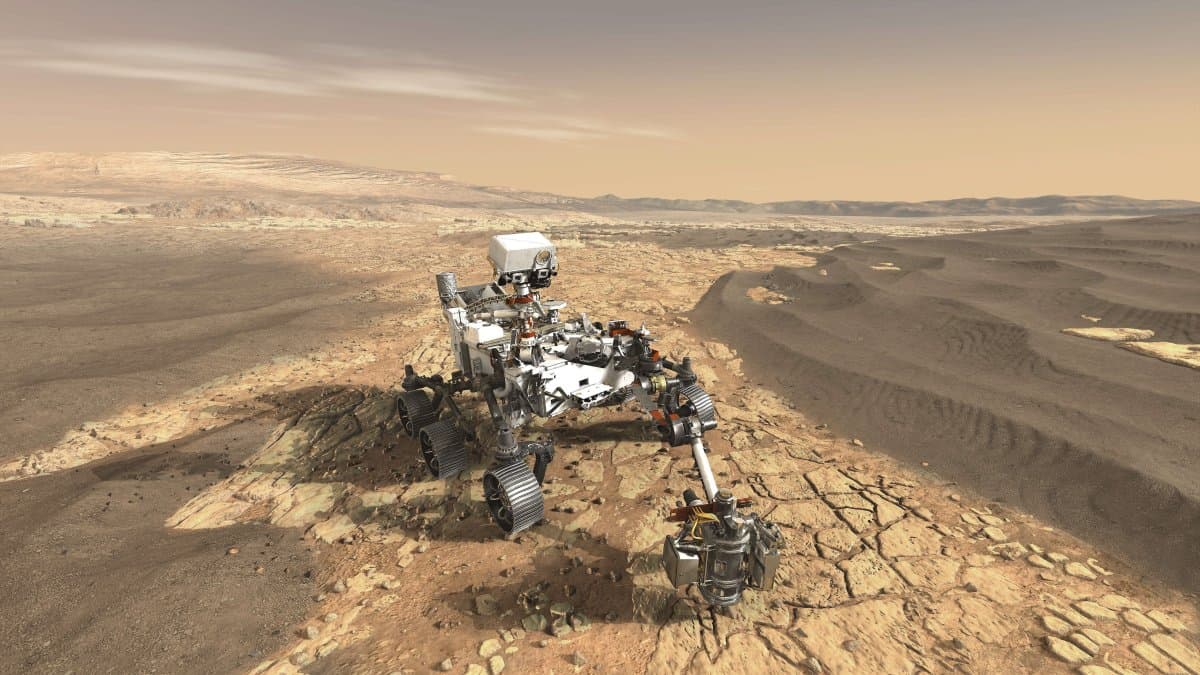

A team of scientists led by Chinese researchers has discovered that Mars’ innermost core is solid, a feature that makes it similar to Earth’s core. This finding, based on data collected by NASA’s InSight probe, was published in the journal Nature and provides new insights into the red planet’s internal structure.
The InSight probe, which operated on a plain near the Martian equator from 2018 until its deactivation in 2022, recorded more than 1,300 earthquakes on Mars, known as marsquakes. The study focused on 23 low-intensity quakes, with epicenters located between 1,200 and 2,360 kilometers from the probe. These data allowed researchers to determine that Mars’ inner core—likely composed of iron and nickel, along with lighter elements such as oxygen—extends from the planet’s center to about 613 kilometers in radius. Surrounding this solid core is a layer of molten metal that forms a liquid outer core, which could extend up to 1,100 miles (1,800 kilometers) from the center.
Unlike previous studies that suggested a completely liquid core, the new results indicate that Mars’ inner core has solidified over time, a process that may still be ongoing. According to the scientists, led by Daoyuan Sun of the University of Science and Technology of China, it is unclear whether the liquid outer core contains solid fragments or an intermediate layer between the two states. This discovery suggests that the ratio of Mars’ solid core to the planet’s size is similar to that of Earth’s core, although this could be coincidental.

Questions remain to be answered
The study, reported by the Associated Press, also highlights that Mars’ lack of a magnetic field could be related to the slow solidification of its inner core. However, experts such as Nicholas Schmerr of the University of Maryland, who was not involved in the research, note that there are still unanswered questions about the exact composition and formation of the Martian core.
The deactivation of InSight limits the ability to obtain new seismic data, underscoring the need for future missions equipped with seismometer arrays to further our understanding of Mars’ internal structure and magnetic history.
Elon Musk envisions Starship mega-rocket mission to Mars in late 2026
“Starship will leave for Mars late next year, with Optimus on board. If those landings go well, landings with humans could start in 2029, although 2031 is the most likely date,” Musk posted on X.
🛠 Do you think there is an error in this article?
Recommendations






LATEST