Iran announces an agreement with Oman to manage the Strait of Hormuz while awaiting Trump's response; attacks continue against ships attempting to pass through it
Washington has always made it clear that the free passage of ships through that area is a red line in negotiations with Tehran.
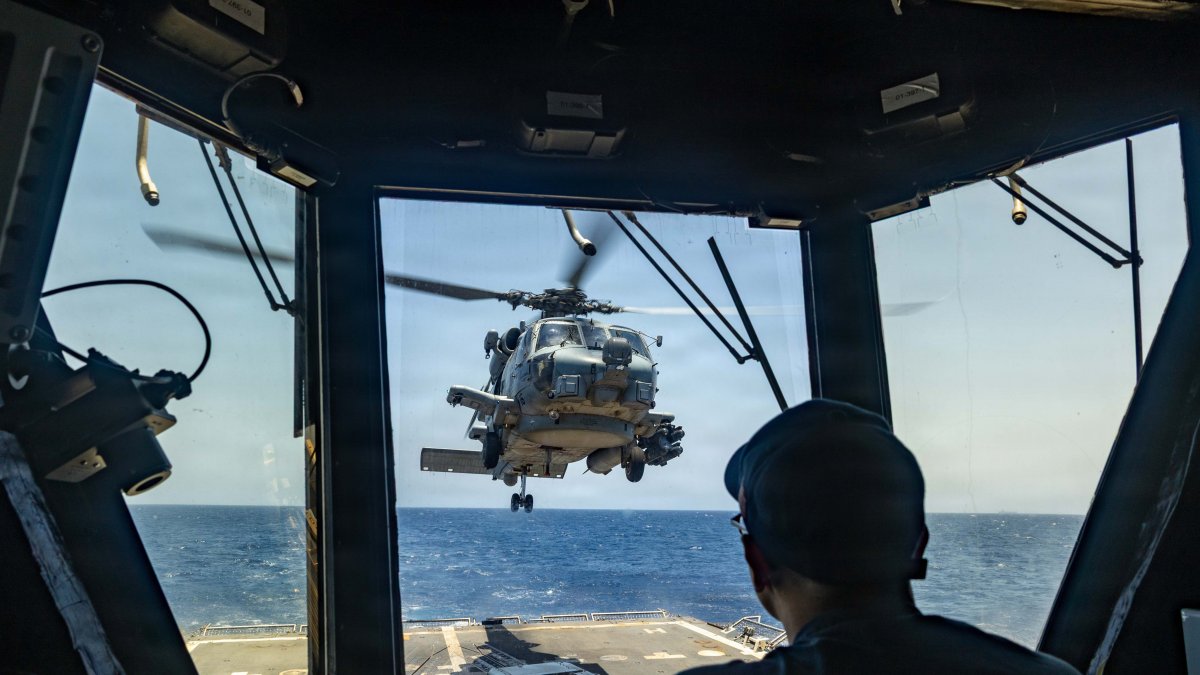
A helicopter takes off from the USS Rafael Peralta (DDG 115) in the Strait of Hormuz

Iran reported on Wednesday that it had reached an agreement with the Sultanate of Oman regarding a new transit route for ships in the Strait of Hormuz, which both countries border and which is at the center of tensions with the United States. However, attacks on ships attempting to pass through the strait have continued during the negotiations.
In any case, the possible reopening of this key maritime route for the transit of hydrocarbons—which has been blocked by Tehran—is in Washington's hands. For the time being, the U.S. is maintaining its blockade of Iranian ports, awaiting the outcome of the negotiations announced by Trump to resolve the situation.
"The geographical coordinates of the route envisaged by both parties have been agreed upon," said Iranian Foreign Ministry spokesman Esmail Baqai, as quoted by the state news agency IRNA. He specified that Iran and Oman were working on a "joint statement," provided that "third parties do not hinder the process."
The Strait: Iran's "nuclear weapon"
Since hostilities with the United States resumed in early July, Tehran has once again blocked this strategic strait, through which one-fifth of the world's hydrocarbon trade used to pass before the war.
Donald Trump has stated on several occasions that Tehran wishes to reach an agreement to reopen this route to shipping, but the Ayatollahs have denied this and claim that, on the contrary, it will reach an agreement with its neighbor across the strait, Oman.
Vance warns that ending the conflict is "complicated" by "crazy radicals" in Iran
The vice president and leader of the U.S. negotiating team in this conflict, JD Vance, acknowledged Wednesday on Fox News that negotiations with Iran had been uneven, and that the Trump administration had experienced both progress and setbacks in its efforts to reach an agreement.
"It's going to be complicated and it will take time to achieve," he acknowledged. Vance attributed these difficulties to divisions within the Iranian leadership, in which some officials wanted an end to the conflict, while some "crazy radicals" wanted it to continue. "First of all, Iranians are extremely difficult people. Second, their system is fragmented," Vance said.
Attacks on ships continue
According to Baqai, talks with Muscat are progressing, but even if an agreement were reached, that would not mean the passage is risk-free, since "the factors that make the Strait of Hormuz unsafe continue to exist on the part of the United States."
He mentioned the naval blockade imposed by Washington in retaliation for Tehran's closure of the strait, and "other aggressive and threatening actions against Iran and its interests."
Trump stated on Tuesday that the strait would reopen "very soon" or, otherwise, Iran would suffer a "very severe" blow, and that an agreement could be reached by Thursday. But Tehran denied that any talks had taken place with Washington.
U.S. rejects Iran's proposal to charge a toll for crossing
Iran does not want to return to the pre-war situation and, for the time being, only authorizes a route along its coastline. It is considering charging service fees, a possibility rejected by the United States and other countries and one that violates international maritime law.
The launch of an Omani route in June had sparked Tehran's anger, leading to a series of attacks on vessels. The British maritime agency UKMTO reported Thursday that the crew of an oil tanker reported hearing explosions while transiting the Strait of Hormuz.
Meanwhile, the Iranian-backed Houthi rebels in Yemen announced on Wednesday that they had attacked two Saudi crude oil tankers in the Red Sea and in the Gulf of Aden, as part of the blockade they had announced against the kingdom's fleet.
On another front of the conflict, the Israeli army said that two of its soldiers were killed in combat in southern Lebanon, where it is facing off against the pro-Iranian terrorist group Hezbollah.
LATEST