Today's solar eclipse crosses the sky: What time will it be, and which states will have the best view?
This Wednesday's total solar eclipse will cross parts of Europe and the North Atlantic, while in the United States it will be visible as a partial eclipse. Alaska and the Northeast will have some of the best viewing conditions in the country.
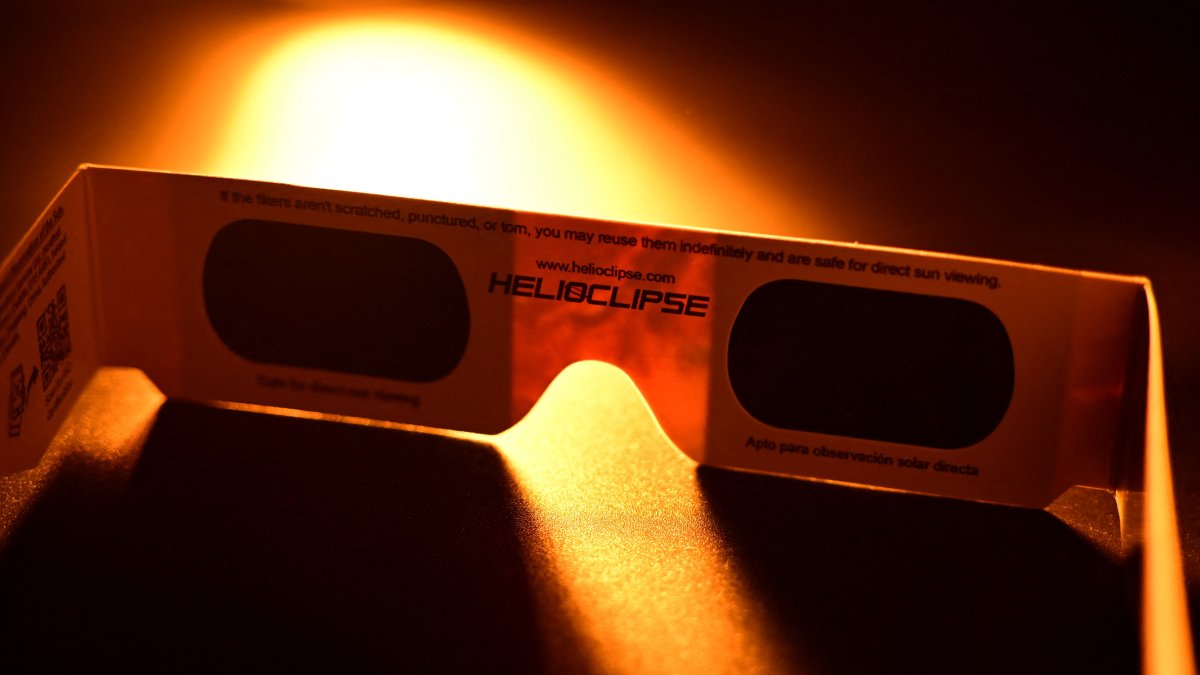
Special glasses for viewing the solar eclipse (File photo)

A new astronomical spectacle will take place this Wednesday, August 12, 2026, when the Moon passes between the Earth and the Sun, causing a total solar eclipse visible from certain regions of the Northern Hemisphere.
The path of totality—the area where the Moon will completely cover the Sun's disk—will pass through Greenland, Iceland, northern Russia, the Atlantic Ocean, Spain, and a small area in northwestern Portugal, according to NASA.
In the United States, however, the eclipse will not be total. Some regions will be able to observe a partial eclipse, primarily Alaska and the northern and northeastern parts of the continental United States. From those areas, the Moon will appear to cover a small portion of the Sun's disk, creating the effect of a "bite" out of the Sun.
Where will the eclipse be visible in the United States?
NASA notes that the partial eclipse will be visible from parts of the northern United States, from Alaska to North Carolina. The extent of the eclipse will vary considerably depending on location.
Alaska will have one of the best views. In Fairbanks, for example, approximately 37% of the Sun's disk will be covered at the peak of the eclipse. In Anchorage, coverage will reach 28%, while in Juneau it will be around 17%.
It will also be visible in the northeastern part of the country. Bangor, Maine, will have a maximum coverage of approximately 24%, and Portland, Maine, 19%.
Further south and west, the phenomenon will be much less pronounced: Boston will have about 16% coverage; New York, 9%; Philadelphia, 7%; Washington, D.C., 4%; and Detroit, just 3%, according to estimates published by NASA.
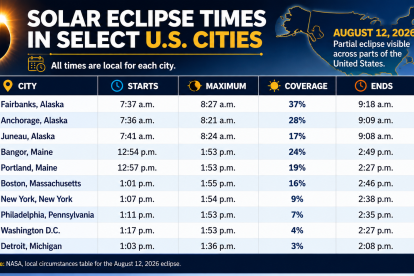
Eclipse times in some U.S. cities
What will the eclipse look like from the United States?
Unlike those in the path of totality in Europe or Greenland, no observer in the United States will experience the momentary darkness characteristic of a total eclipse.
In the United States, the Moon will only block part of the Sun. NASA describes the visual effect as a small "bite" out of the Sun's disk, especially in areas farther from the path of totality.
The difference will be significant between different cities. While more than a third of the Sun will be obscured from Fairbanks, only about one-tenth will be obscured from New York, and approximately 4% from Washington, D.C.
The eclipse will begin in the morning in Alaska. In the northern part of the continental United States, it will occur mainly around noon and in the early afternoon.
What is a solar eclipse, and why does it occur?
A solar eclipse occurs when the Moon passes between the Sun and Earth and casts its shadow onto our planet. This phenomenon can only occur during the new moon phase.
The Moon's shadow has two main regions.
The umbra is the darkest and narrowest zone. Places within it experience a total eclipse, because the Moon completely covers the Sun.
The penumbra, which is much wider, is the region where the Moon blocks only part of the Sun. It is precisely within this zone that the regions of the United States where the phenomenon can be observed this Wednesday will be located.
NASA estimates that the lunar shadow producing totality on the Earth's surface is about 300 miles (480 kilometers) wide, which explains why a total eclipse can only be seen from a relatively narrow band across the planet.
What is the difference between a total eclipse and a partial eclipse?
In a partial eclipse, the Sun, Moon, and Earth are not aligned in such a way that the solar disk is completely obscured from the observer's perspective. Part of the Sun remains visible throughout the event.
That is exactly what will happen in the United States on August 12: regardless of the percentage of coverage, the Sun will never be completely obscured.
How long will the total eclipse last?
In regions of the world located within the path of totality, the phase during which the Sun will be completely obscured will be relatively brief.
For most observers within that path, totality will last less than two minutes. Near the center of the path, in certain areas of Greenland, Russia, or the North Atlantic, it may exceed two minutes, though it will remain under two and a half minutes, according to NASA.
The United States lies outside this path.
How to view the eclipse safely
This point is especially important in the U.S. because the eclipse there will be only partial.
NASA warns that you should never look directly at the Sun during a partial eclipse without specialized eye protection. Conventional sunglasses, no matter how dark they are, do not provide sufficient protection.
To view the eclipse directly, you must use eclipse glasses or solar viewers specifically designed for this purpose, which must comply with the international standard ISO 12312-2.
You should also avoid looking directly at the Sun through telescopes, cameras, or binoculars without solar filters designed to be placed in front of these devices. The concentrated sunlight can cause serious eye injuries.
A safe alternative is to use indirect methods, such as a pinhole projector, which allows you to project the image of the eclipsed Sun onto another surface without looking at it directly.

Technology
Artemis II astronauts become the humans who have traveled farthest from Earth
Williams Perdomo
Where will the total eclipse be visible on August 12?
In Spain, one of the world's prime viewing locations for this eclipse, totality will occur shortly before sunset. In some cities, the Sun will even set while it is still partially eclipsed.
For the United States, therefore, Wednesday's event will be considerably less dramatic: Alaska and the Northeast will have the best views, while in cities like New York, Philadelphia, and Washington, D.C., only a small portion of the Sun's disk will be covered by the Moon.
LATEST