Iran's most dangerous secret has a Texas accent: Where is Monica Witt, the spy hunter who switched sides?
U.S. authorities allege that the former military counterintelligence agent betrayed her country by providing classified information to the Iranian government and collaborating with operations targeting former American colleagues and intelligence agents.
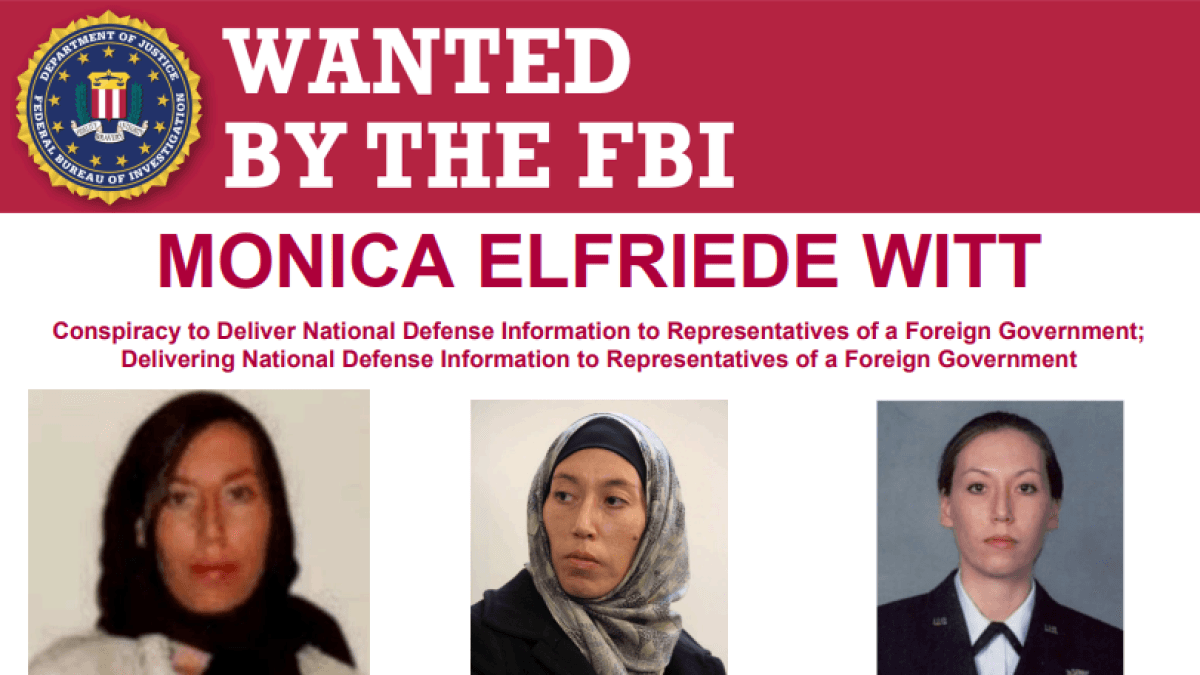

The Federal Bureau of Investigation (FBI) announced a reward of $200,000 for information leading to the capture and prosecution of Monica Elfriede Witt, a former U.S. Air Force member accused of defecting to Iran and handing over sensitive intelligence information.
U.S. authorities allege that Witt, a former military counterintelligence agent, betrayed his country by providing classified information to the Iranian government and collaborating with operations targeting former American colleagues and intelligence agents.
According to the FBI, the case remains active and, more than a decade after her alleged defection, authorities believe she continues to be linked to activities related to the Iranian regime.
The trajectory of an intelligence specialist
Monica Elfriede Witt was born April 8, 1979, in El Paso, Texas. She entered the U.S. Air Force in December 1997 and was assigned to Offutt Air Force Base, where she began her career as an intelligence specialist focusing on Persian-Farsi language.
She later went on to serve as a special agent with the Air Force Office of Special Investigations (AFOSI), an agency charged with identifying and neutralizing criminal, terrorist and intelligence threats affecting the Air Force and the U.S. government.
During her military career, she received several decorations, including the Air Medal, an award given for outstanding acts of merit or heroism.
Witt left the military in May 2008 with the rank of technical sergeant.
After leaving military service, she worked as a contractor and consultant on Middle East and Iranian issues. She served for companies such as Booz Allen Hamilton and Chenega Federal Systems, where she was involved in counterintelligence operations and regional affairs analysis.
Her experience included cultural and linguistic expertise in Iran, in addition to work in countries such as Iraq, Qatar, Jordan, Turkey, the United Arab Emirates and Tajikistan.
She also did academic work: she obtained studies at University of Maryland and George Washington University, and published articles on international politics.
Trip to Iran and accusations of espionage
The U.S. investigation contends that a tipping point occurred in 2012, when Witt traveled to Iran to participate in a conference that was critical of the United States and U.S. foreign policy.
According to the indictment filed in 2019, during that period, Iranian officials began to establish ties with her and subsequently offered her logistical support, housing and technological equipment.
Authorities claim that Witt returned to Iran in 2013 and ended up defecting. Since then, she allegedly worked for the Iranian government by sharing classified information and assisting with intelligence operations.
The Justice Department asserted that Witt had access to high-level information, including secret and top-secret data related to intelligence and counterintelligence operations, as well as identities of U.S. covert agents.
The indictment alleges that she turned over information on highly classified programs and data that would have put U.S. intelligence officials at risk.
Collaboration in operations against former colleagues
According to the investigation, she produced profiles and reports on U.S. officials and former colleagues, information that was allegedly used for surveillance campaigns, cyber operations and digital attacks.
In the same court filing, four Iranian nationals were indicted for crimes related to conspiracy, computer intrusion and identity theft.
The prosecution alleges that these individuals attempted to target U.S. officials who, at some point, had worked or maintained contact with Witt.
A continuing search
More than seven years after the formal indictment filed in 2019, the FBI claims it is still trying to locate the former agent.
Daniel Wierzbicki, head of FBI Counterintelligence and Cybersecurity in Washington, affirmed recently that the agency has not abandoned the case.
Authorities believe that the current context in Iran could open up new possibilities for obtaining information about her location and reiterate that any relevant information could lead to her capture.
Monica Witt's case continues to be considered by the country as one of the most sensitive espionage and defection episodes in recent years, due to the level of access she had to strategic national security information.
🛠 Do you think there is an error in this article?
Recommendations







LATEST