The tentacles of the Singham Network or how Raúl Castro's international defense was articulated
The Justice Department indicts the former Cuban leader for the downing of planes in 1996; organizations and figures linked to the so-called "Singham Network" react by denouncing an alleged escalation against Havana.
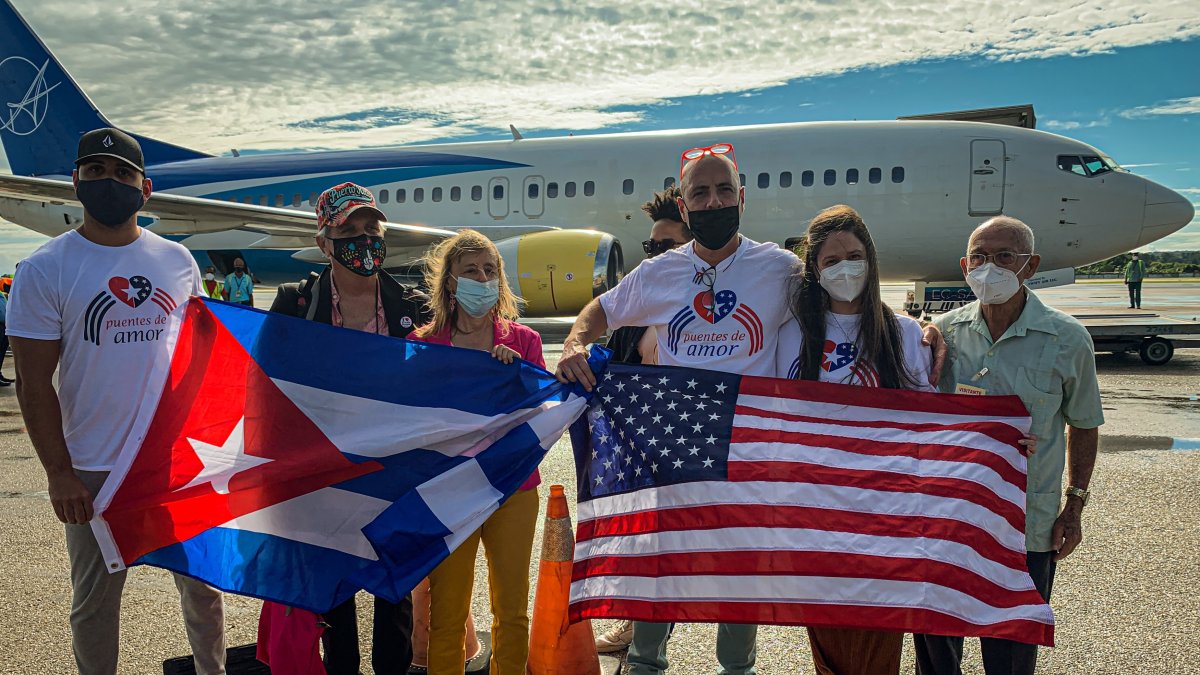
Members of the NGOs Puentes de Amor, Foro del Pueblo and CODEPINK in Cuba (Archive).

An indictment filed by the Department of Justice against former Cuban President Raul Castro triggered a swift international political and ideological response. Various organizations, media and activists linked to the so-called 'Singham Network'—a network of political and media groups associated with the communist businessman Neville Roy Singham—mobilized to reject Washington's decision and defend both Castro and the historical legitimacy of the Cuban political system that keeps the island in misery.
The reaction not only revolved around the figure of Raúl Castro. It also opened a new chapter in a broader dispute: the confrontation between the policy of U.S. oppression toward Cuba and an international network of movements that consider the island a symbol of anti-imperialist resistance.
The information was originally published in an article by Just the News.
The indictment that reopened a 30-year-old wound
The Department of US Justice announced charges against Raúl Modesto Castro Ruz related to the February 1996 shoot-down of two aircraft belonging to the humanitarian organization Brothers to the Rescue (Brothers to the Rescue).
According to the indictment, Cuban MiGs destroyed the aircraft while they were over international waters near Cuba. The attack left four dead: three U.S. citizens and one permanent resident. Prosecutors contend that the aircraft were flying away from Cuban territory and did not receive prior warnings before being attacked.
Raul Castro, who gave the order to fire, faces charges that include:
- Conspiracy to murder U.S. citizens.
- Destruction of aircraft.
- Four homicide charges linked to the incident.
The U.S. administration described the move as part of a renewed policy of pressure against the Cuban regime.
Acting Attorney General Todd Blanche stated, "The United States and President Trump do not and will not forget their citizens."
The Singham Network enters the scene
The response was immediate.
Several organizations pointed out by Just the News as members or close to the so-called 'Singham Network' rejected the accusation and described it as a political operation aimed at justifying future actions against Cuba.
Among the groups mentioned:
- Code Pink.
- Party for Socialism and Liberation.
- The People's Forum.
- Tricontinental: Institute for Social Research.
- International Peoples' Assembly.
The network is associated by the U.S. media with Marxist businessman Neville Roy Singham, although the various groups maintain independent structures and activities. At the time the network was also accused of being a propaganda arm funded by the Communist Party of China (CCP).
Code Pink: "They are not looking for justice, they are looking for a pretext"
The far-left organization Code Pink called the accusation a political operation. In publications spread on social networks it argued:
"They are not seeking justice for a downed plane. The Trump administration is inventing a pretext for military intervention."
The same argued that Cuba had a sovereign right to defend its airspace and asserted that the accusations are part of a historical strategy of U.S. pressure. The Justice Department, however, maintains the exact opposite: that the aircraft were outside Cuban airspace and flying over international waters.
Code Pink also published on Instagram a message in favor of Castro, shared also by the group's co-founder, Medea Benjamin, and by the National Network on Cuba, whose member organizations include Code Pink, as well as the Communist Party USA, the Democratic Socialists of America and the Socialist Workers Party.
The group ,allegedly pacifist, has for many years and in many ways praised communist Cuba, without mentioning the crises that for decades have faced the Cuban people, who today live in extreme poverty.
The Party for Socialism and Liberation defends Cuban performance
The Party for Socialism and Liberation issued a statement denouncing the accusation as a "provocation."
Its affiliated media outlet, Liberation News, argued that Cuba acted under principles of international law and cited Article 51 of the United Nations Charter, relating to the right of defense of sovereign states.
The central argument: Cuba would have acted within its powers to respond to incursions deemed illegal.
Again, the position contradicts the U.S. narrative, which states that the shoot down occurred outside Cuban sovereign territory.
Manolo De Los Santos and explicit support for Raul Castro
One of the most visible faces of the response was Manolo De Los Santos, executive director of the Popular Forum, a researcher for Tricontinental and listed in the tax records of the Justice and Education Fund linked to Singham.
The leader described Castro as "an incredibly brave and revolutionary hero. And he also took the opportunity to praise the late, historic Cuban dictator Fidel Castro.
He also accused Washington of acting hypocritically by questioning Cuban actions while, he said, the United States carries out lethal operations in different regions.
De Los Santos has been a leading figure in international campaigns of solidarity with Cuba and recently participated in official meetings with the Cuban dictator.
Trips to Havana and high-level meetings
In March of this year, leaders of groups linked to the Singham Network traveled to Cuba and participated in meetings with Cuban dictator Miguel Diaz-Canel.
According to official Cuban publications, the meetings focused on international cooperation, political solidarity and joint actions in the face of what they described as "media and ideological warfare."
Subsequently, several organizations promoted solidarity trips and economic support campaigns aimed at energy and hospital projects on the island.
The geopolitical dimension: China appears in the debate
The research also connects some network actors with academic institutions and spaces linked to the Chinese political ecosystem.
Vijay Prashad, director of Tricontinental: Institute for Social Research, whose advisory board is chaired by Singham, also came out in defense after the accusation against Raul Castro.
Prashad, who criticized the accusation, wrote: "Cuba is not a threat to the world. The United States is a threat to the world."
Just the News also maintains that Prashad maintains academic links with organisms related to Chinese Communist Party structures, something presented by the media as a relevant element to understand the international connections of the network.
What is at stake
The indictment against Raul Castro could become a historic episode for multiple reasons:
- It is one of the most significant legal actions against a central figure of the Cuban Revolution.
- It revives the 1996 case, one of the major diplomatic crises between Washington and Havana.
- Exposes an international network of political organizations mobilized in defense of the Cuban model.
The open question now is whether these pressure campaigns—from Washington or from its detractors—will change the political balance around the island or only deepen a confrontation that has been going on for more than half a century.
LATEST