Scott Adams, creator of 'Dilbert' and enemy of the woke left, dead at 68
Adams, who endorsed Trump before his 2016 election victory, rose to fame in the 1990s with his satire of white-collar office life.
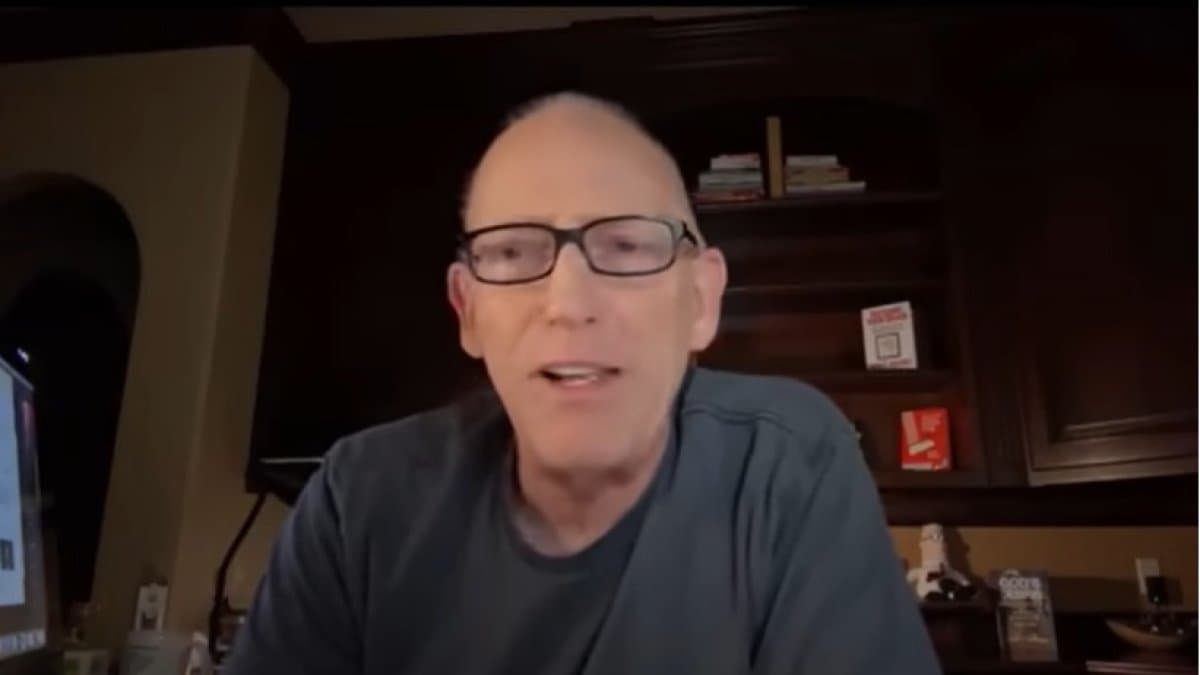

Scott Adams, the cartoonist famous for his comic strip “Dilbert,” died at 68, his ex-wife said Tuesday.
Adams, who rose to fame in the 1990s with his satire of white-collar office life, had been receiving palliative care at his home in northern California after being diagnosed with prostate cancer.
His ex-wife, Shelly Miles, announced his passing in an emotional message streamed live on Adams' YouTube channel, “Real Coffee with Scott Adams.”
President Trump paid tribute to Adams by calling him a "great influencer" in a post on his Truth Social platform.
"He was a fantastic guy, who liked and respected me when it wasn’t fashionable to do so," Trump wrote. Adams supported Trump before his 2016 election victory.
“Dilbert” was first published in 1989 and followed its title character, an engineer working in an office subjected to constant micromanagement. At its peak, the strip was syndicated in some 2,000 newspapers internationally.
A Final Message From Scott Adams
If you are reading this, things did not go well for me.
I have a few things to say before I go.
My body failed before my brain. I am of sound mind as I write this, January 1st, 2026. If you wonder about any of my choices for my estate, or anything else, please know I am free of any coercion or inappropriate influence of any sort. I promise.
Next, many of my Christian friends have asked me to find Jesus before I go. I'm not a believer, but I have to admit the risk-reward calculation for doing so looks attractive. So, here I go:
I accept Jesus Christ as my lord and savior, and I look forward to spending an eternity with him. The part about me not being a believer should be quickly resolved if I wake up in heaven. I won't need any more convincing than that. And I hope I am still qualified for entry.
With your permission, I'd like to explain something about my life.
For the first part of my life, I was focused on making myself a worthy husband and parent, as a way to find meaning. That worked. But marriages don't always last forever, and mine eventually ended, in a highly amicable way. I'm grateful for those years and for the people I came to call my family.
Once the marriage unwound, I needed a new focus. A new meaning. And so I donated myself to "the world," literally speaking the words out loud in my otherwise silent home. From that point on, I looked for ways I could add the most to people's lives, one way or another.
That marked the start of my evolution from Dilbert cartoonist to an author of — what I hoped would be — useful books. By then, I believed I had amassed enough life lessons that I could start passing them on. I continued making Dilbert comics, of course.
As luck would have it, I'm a good writer. My first book in the "useful" genre was How to Fail at Almost Everything and Still Win Big. That book turned out to be a huge success, often imitated, and influencing a wide variety of people. I still hear every day how much that book changed lives. My plan to be useful was working.
I followed up with my book Win Bigly, that trained an army of citizens how to be more persuasive, which they correctly saw as a minor super power. I know that book changed lives because I hear it often.
You'll probably never know the impact the book had on the world, but I know, and it pleases me while giving me a sense of meaning that is impossible to describe.
My next book, Loserthink, tried to teach people how to think better, especially if they were displaying their thinking on social media. That one didn't put much of a dent in the universe, but I tried.
Finally, my book Reframe Your Brain taught readers how to program their own thoughts to make their personal and professional lives better. I was surprised and delighted at how much positive impact that book is having.
I also started podcasting a live show called Coffee With Scott Adams, dedicated to helping people think about the world, and their lives, in a more productive way. I didn't plan it this way, but it ended up helping lots of lonely people find a community that made them feel less lonely. Again, that had great meaning for me.
I had an amazing life. I gave it everything I had. If you got any benefits from my work, I'm asking you to pay it forward as best you can. That is the legacy I want.
Be useful.
And please know I loved you all to the end.
Scott Adams.
🛠 Do you think there is an error in this article?
Recommendations





LATEST