From Gettysburg to Afghanistan: These are the Hispanic Medal of Honor recipients, the nation's highest military decoration
More than 60 Hispanics have been honored for their "gallantry and intrepidity" over a century of conflicts. This Veterans Day, we remember their names and stories.
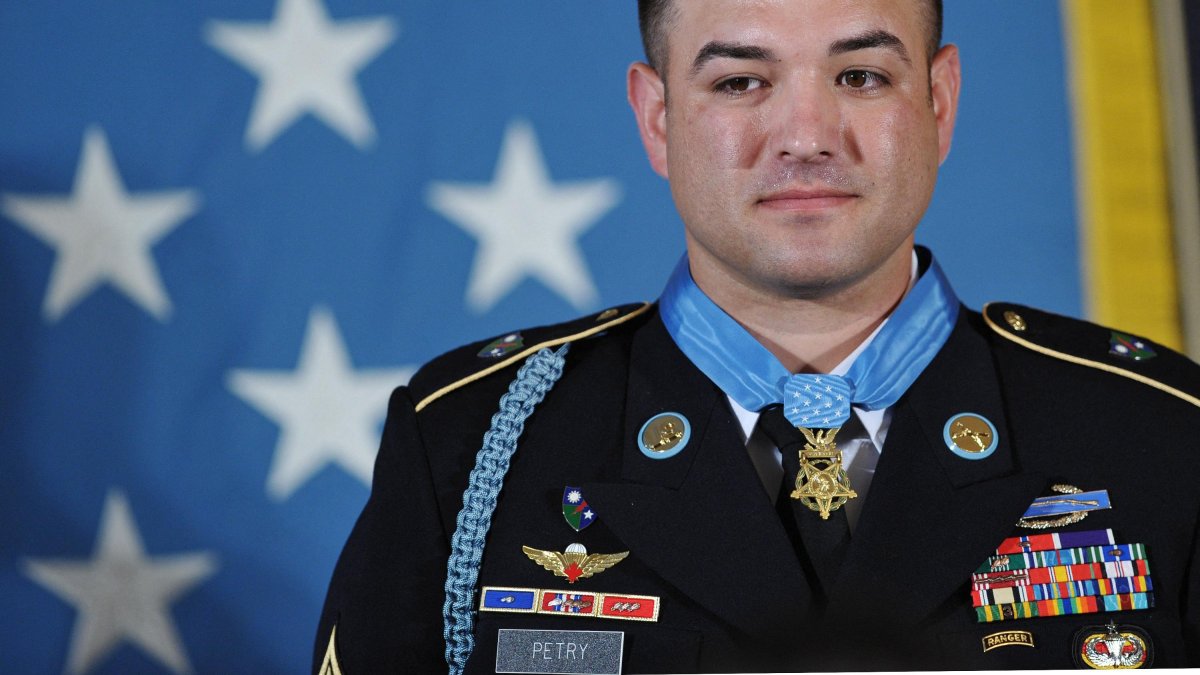
Leroy A. Petry, Medal of Honor in 2008

"At the instant a man broke through my line and thrust a rebel battle flag into my hands. He never said a word and darted back," General Alexander S. Webb wrote of the Battle of Gettysburg in 1863." "It was Corporal Joseph H. De Castro, one of my color bearers."
The first Hispanic Medal of Honor, the country's highest military award, carried no rifle, no saber. Just a flag in the colors of Massachusetts. A native of Boston, born to a Spanish father and an American mother, in his twenties Castro was a volunteer in the 19th Massachusetts Infantry Volunteer Corps. As standard bearer, his role was to signal pace and direction to his regiment, flaming his flag amid enemy blasts and bullets.
In the battle that earned him the distinction, Castro was leading his unit at Gettysburg, Pennsylvania. As a bearer of state colors, he was a helpless, easily spotted and coveted target. In a moment he was cut off from his men. With no unit to lead, he chose a new target: the standard bearer of the 19th Virginia Infantry Regiment.
Castro attacked using his own staff and scabbard, and fighting hand-to-hand, won the enemy insignia and offered it, without ceremony, to his superiors.
Since then, more than 60 Hispanics have received the country's highest military award. More than a century and a half of outstanding service to the country in all branches of the Armed Forces, from Vietnam to Afghanistan, from Europe (Belgium, Italy, France) to the Philippine Islands, Alaska to China.
What is the Medal of Honor?
The recommendation of a candidate goes up the chain of command, all the way to the president, commander-in-chief of the Armed Forces. It requires exhaustive reports on the feat to be awarded, along with the affidavit of two eyewitnesses.
The Hispanic medal stand harbors stories like that of Richard Edward Cavazos, who in Korea ordered his men evacuated but fell behind, rescuing first five wounded - leading one by one to the rear - then a whole group of lost soldiers and then one more.
"Not until he was personally satisfied that the battlefield was cleared on the morning of June 15, did he allow treatment of his own combat wounds sustained during the action," recounts about Cavazos the Congressional Medal of Honor Society, founded by Congress in 1958.
Or the feat of Eduardo Gomez, who, also in Korea but three years earlier, after volunteering, crawled thirty meters through a rice field, climbed into a tank, opened a hatch and threw a grenade. Or that of Leroy Arthur Petry, who in a courtyard in Afghanistan, with both legs wounded, in the midst of enemy fire, pulled a fellow Ranger to safety and then, shielding others, threw an enemy grenade back with his own hand.
"Despite the severity of his wounds, Staff Sergeant Petry continued to maintain the presence of mind to place a tourniquet on his right wrist before communicating the situation by radio in order to coordinate support for himself and his fellow wounded Rangers," says the Medal of Honor Society.
In VOZ, we compiled a list of with Hispanics featured in these stories from public data from the Congressional Medal of Honor Society and the Hispanic Veterans Leadership Alliance:
Vietnam, the war with the most Hispanic Medal of Honor awards.
About 80.000 Latinos served in that conflict, although the data are uncertain because they were categorized as "Caucasian" by authorities, according to the Department of Veterans Affairs. In the Day of Hispanic Heritage Day 2017, Congress noted that they accounted for 5.5% of casualties despite being 4.5% of the country's population.
World War II (1939-1945) ended with 17 Latin medals. The Korean War (1950-1953) with 15 and the Civil War (1861-1865)with 3.
LATEST