The New York Times issues a correction after publishing an image of a sick child as a symbol of hunger in Gaza
The media outlet's correction comes after it was revealed that the child pictured had pre-existing medical conditions, undermining the narrative about the food crisis.

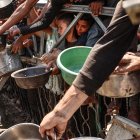
Palestinians crowd a lentil soup distribution point in Gaza City.

The New York Times admitted on Tuesday that it did not provide sufficient information about the health status of a Palestinian boy whose photograph was used on the front page to illustrate the alleged level of famine in Gaza. Following the publication of new medical records, the media outlet added an editorial acknowledging that the little boy, identified as Muhammad Zakariya al-Matouq, suffers from "pre-existing health problems," calling into question the use of his image as a direct representation of the food crisis.
The photo - also reproduced by other international media - showed the child, barely 18 months old, visibly emaciated and wearing a plastic bag as a diaper while being held by his mother. The publication generated a strong emotional charge and fueled new accusations against Israel in the context of the conflict with Hamas.
Mother and medical records contradict initial narrative
Shortly after the publication, reports began to circulate that called into question the cause of the child's condition. The mother herself stated that her son had been diagnosed with a "muscle disorder" and was receiving specialized nutrition and physical therapy. He further stated that Muhammad was a cheerful child and able to sit up unaided.
Although the New York Times included a clarifying note in its article, it did not detail the child's specific ailments. However, freelance journalist David Collier stated via X that the child was diagnosed with cerebral palsy, hypoxemia, and a severe genetic disorder.
JNS
Gaza ‘starvation’ poster child has genetic condition, left Strip with Israel’s help
JNS (Jewish News Syndicate)
Reactions: "This is a blood libel in 2025"
The correction did not go unnoticed. Former Israeli Prime Minister Naftali Bennett accused the media outlet of manipulating public opinion and acting in full awareness of the consequences of publishing such a sensitive image. "After generating a tsunami of hate towards Israel with that terrifying picture, the NYT now quietly admits that the boy has preexisting conditions (...) You knew exactly what this picture would cause. This is a blood libel in 2025. Have you no shame?" he wrote on X.
David Collier also lashed out at the use of the image, questioning that any "honest" journalist should have questioned the image after seeing that the boy's mother and older brother, who appear in other images, show no signs of malnutrition.
Collier recalled that this is not the first time that international media have amplified testimonies and images without proper context. He also noted that the BBC was recently forced to withdraw a documentary after it was discovered that its protagonist was the son of a senior Hamas official.

LATEST