Supreme Court hears arguments in two key cases for future of transgender athletes in women's sports
The Trump Administration is supporting the two Republican states involved, Idaho and West Virginia. Even Justice Department lawyers were involved in the arguments.
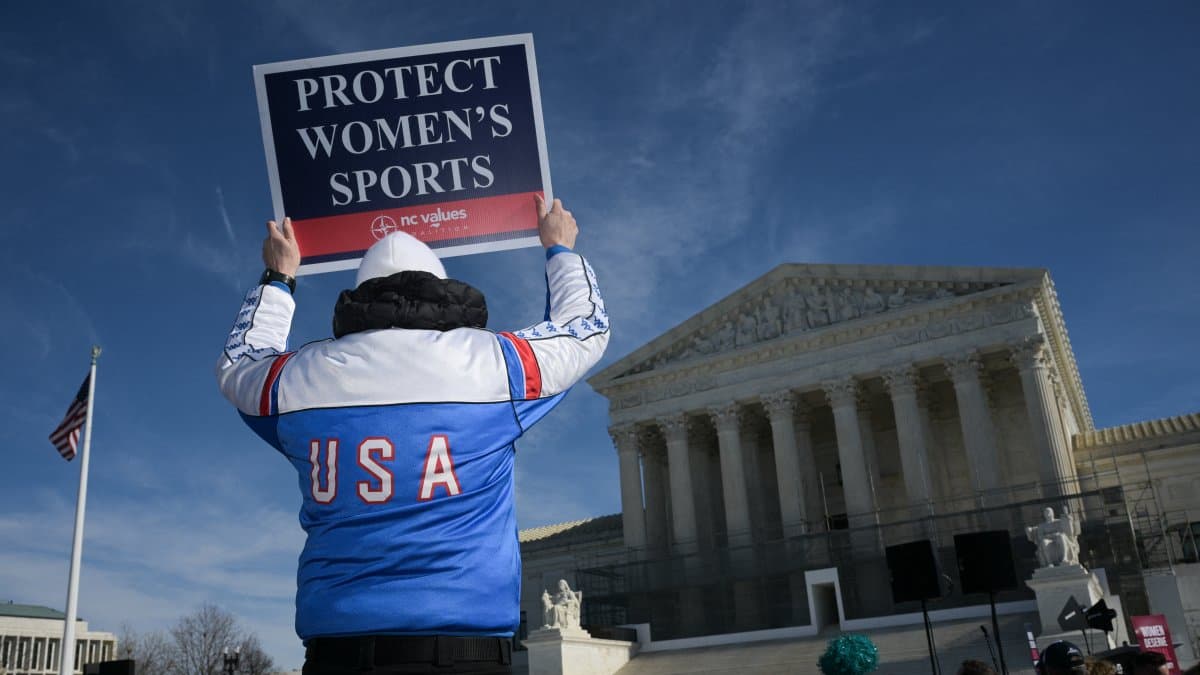

The Supreme Court heard oral arguments in two cases that could shape the future of transgender athletes in women's sports. For more than three hours, the justices examined whether the Idaho and West Virginia state bans violate Title IX and the Equal Protection Clause of the National Constitution. The Trump Administration is supporting the two Republican states, with even Justice Department lawyers participating in the arguments.
The cases, Hecox v. Little and West Virginia v. B.P.J., drew hundreds of protesters outside the courthouse. Even some members of Congress arrived, including Senators Steve Daines and Ed Markey. The Secretary of Education, Linda McMahon, was also present.
Currently, 30 states have sanctioned laws preventing biological males who identify as women from participating in women's sports sponsored by public schools and universities. Therefore, the court's ruling could have a nationwide impact.

How did the cases get to the Supreme Court?
Idaho and West Virginia enacted their respective laws in 2020 and 2021, mandating that school and college sports be organized solely on the basis of "biological sex," defined as the sex assigned at birth.
The Idaho legislation was challenged by a transgender student identified in court as 'BPG', with the support of the American Civil Liberties Union (ACLU), an organization that also supported the lawsuit against the West Virginia law.
Idaho has always led with common sense -- it’s why we were the first state in the nation to ban men from competing in women’s sports. I’m confident that same common sense will prevail as the Supreme Court reviews our law that set the precedent in defending girls and women.
Both were initially blocked for allegedly violating the Equal Protection Clause of the Constitution and Title IX.
Both cases reached the Supreme Court with the states asking to reverse lower court rulings that blocked their laws and declare that they have authority to define sports categories by biological sex without violating either the Constitution or Title IX.
The key issues in the case
The case revolves around whether these laws, which restrict sports participation based on biological sex, violate Title IX by excluding transgender athletes from women's teams, or whether they are instead in keeping with the original intent of the law to protect fairness in women's sports.
Plaintiffs' advocates argue that excluding a trans person from a team consistent with his or her gender identity is discrimination based on sex, thus violating Title IX.
On the other hand, the states argue that Title IX was created to protect biological women and girls, not to redefine sports categories based on gender identity. In 1972, when Title IX was passed, the word "sex" meant biological sex, not gender identity. The goal was to correct physical and structural disadvantages that prevented women from competing on an equal basis.
Today, my attorneys are arguing a crucial Supreme Court case pushing back against the trans agenda. Our position: states have the authority to ban men from participating in women’s sports.
This is common sense. We are fighting to protect girls and women in the locker room and… pic.twitter.com/xJEpPEZC9P
The day of oral arguments
Oral arguments took place on the morning of Tuesday, January 13. The audio showed a clear ideological divide between the more conservative and more progressive justices. For example, Samuel Alito, Clarence Thomas, Brett Kavanaugh, John Roberts and Amy Coney Barrett were closer to the states' position, while Elena Kagan, Sonia Sotomayor and Ketanji Brown Jackson appeared to be more sympathetic to the plaintiffs.
Neil Gorsuch, a judge confirmed by Donald Trump in 2017, showed hesitation with both arguments.
Kavanaugh, also confirmed by Trump but in 2018, coached his daughter's basketball team and showed his serious concerns in allowing transgender athletes to participate in women's sports: "There’s a harm there, and I think we can’t sweep that aside."
"Today, my attorneys are arguing a crucial Supreme Court case pushing back against the trans agenda. Our position: states have the authority to ban men from participating in women’s sports," the attorney general, Pam Bondi, said on her X account.
The ruling puts into play the interpretation of Title IX, which was created in 1972 to prohibit any discrimination based on sex in schools or programs receiving public money.
"No person in the United States shall, on the basis of sex, be excluded from participation in, be denied the benefits of, or be subjected to discrimination under any education program or activity receiving Federal financial assistance," read the original Title IX drafted by then-Senator Birch Bayh (D-IN).
🛠 Do you think there is an error in this article?
Recommendations





LATEST