'Avoid homes advertising Trump': DHS report compromising Biden's FEMA
Following the release of the report, DHS announced the cancellation of the door-to-door survey practice. It also referred the investigation to the Department of Justice for a possible prosecution.

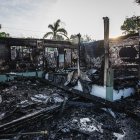
Hurricane Milton damage in Siesta Key, Fla.

"Avoid homes advertising Trump." The message appeared in a Microsoft Teams chat from the Federal Emergency Management Agency (FEMA), where they were in charge of touring areas affected by Hurricane Milton last year.
The controversy erupted in December 2024, FEMA suspended the supervisor who wrote the message - who reportedly defended it as being synonymous with "avoiding hostile homes" - and claimed it was an isolated case. An investigation by the Department of Homeland Security (DHS) published Tuesday contradicts that version:
"FEMA’s actions were not limited to the Hurricane Milton disaster relief efforts in 2024. In fact, the DHS Privacy Office found that FEMA impermissibly collected prohibited information at least dating back to the Hurricane Ida disaster in September 2021."
Discrimination on the ground?
After a catastrophe or disaster, as one of its first actions on the ground, the agency deploys teams of surveyors through the stricken areas to make contact with those affected, house by house. It is a first encounter in which information is left and people are allowed to sign up for its programs. That data is used to ascertain the severity of the damage and distribute resources.
The recent DHS investigation found that "in different disasters, states, and timeframes, canvassers’ records show that canvassers skipped homes and left no disaster assistance flyers, citing First Amendment-protected activity as the reason for not making contact."
That conduct violated, according to the same report, both laws and DHS practices. One of those was the Privacy Act of 1974, which, it said, the agency had been violating since at least Hurricane Ida in 2021.
Politics
Florida sues FEMA for discriminating against Trump supporters with Helene and Milton aid
Santiago Ospital
Five years of alleged violations of victims' privacy
"The information collected [by the surveyors] included obviously protected information about individuals’ freedom of expression," the investigation reads. Most frequently recorded was pro-gun signage (noted 72 times), followed by mentions of Trump (15).
The DHS report also collects some examples of reports written by employees or contractors over the years and catastrophes:
- November 2024 - Florida: "There was a political flyer so I didn’t leave a FEMA brochure."
- October 2024 - North Carolina: "[T]he survivor had a sign that read… NRS, we do our part."
- June 2024 - Texas: "[P]ro gun sign."
- October 2022 - Florida: "Survivor very anti govt anti Biden. Told me to tell Biden to go [f***] himself."
- September 2021 - Pennsylvania: "...a lot of explicit political flags, posters, etc. ‘F*** Joe Biden’ ‘MAGA 2024’ ‘Joe Biden Sucks’ ‘TRUMP 2024’ We do not recommend anyone visiting this location."
Those records "not only violated legal privacy protections," according to DHS, "but also raise concerns about potential discrimination based on political beliefs."
But not only that: according to the department, FEMA must make public the specific categories of information it will require from citizens to provide them with assistance. However, none of the publications reviewed by the researchers include a notice that protected expressions such as political preferences may be requested.
Recommendations and a possible court case
The DHS investigative team contends that it failed to find a "broader directive" from FEMA management to discriminate against certain households based on political affinities. However, it points to the lack of a specific direction to prevent such conduct as a serious problem:
"This lack of guidance leaves significant questions up to the individual canvasser’s judgment, which increases the likelihood of collecting impermissible information and unfair decision-making. From a privacy perspective, FEMA’s failure to address these issues directly in policy, guidance, or training increases the risk that FEMA personnel are susceptible to future violations of the Privacy Act of 1974 as FEMA canvassers will continue to be unaware of what personal information is relevant and necessary to disaster assistance."
Following the release of the report, DHS announced a series of measures such as canceling the practice of door-to-door surveys and requiring the agency to improve training and guidelines.
In addition, it referred the investigation to the Department of Justice for possible prosecution.
Access the full report
LATEST