Analysis
Trump, Musk, and a possible public rift: three threats to the Republican Party
Although White House sources insist that the personal relationship between the two has not changed, it would appear that the president's retort is closer than far away.
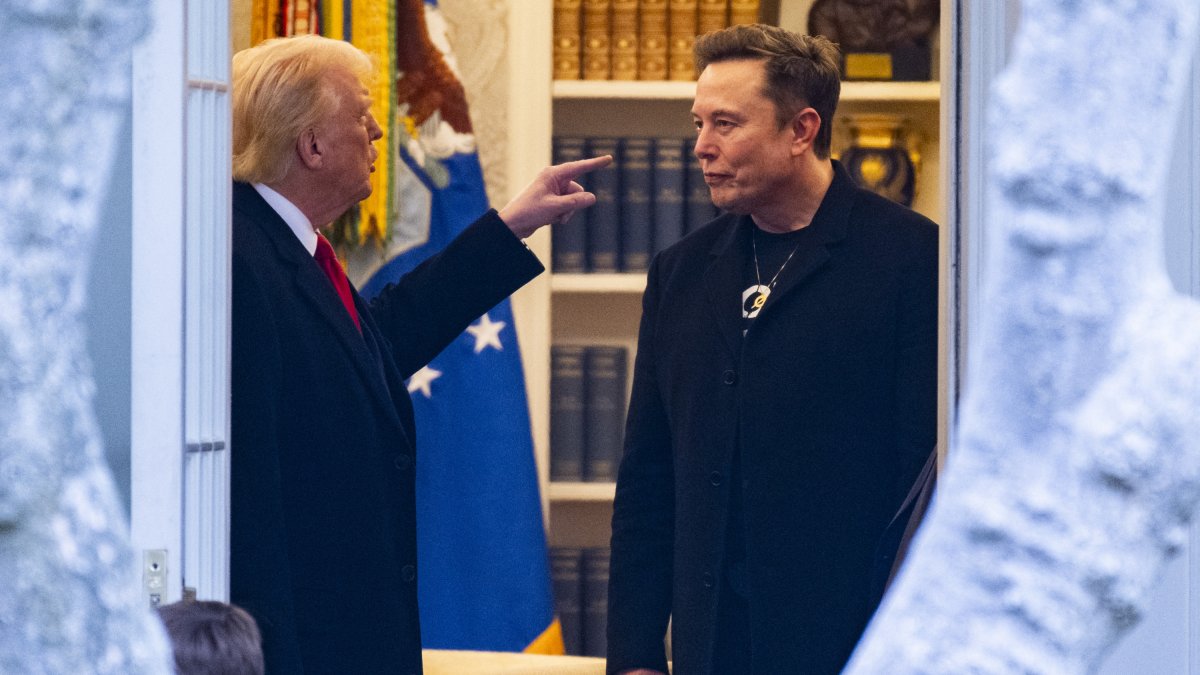
Trump and Musk in the Oval Office/ Roberto Schmidt.

Donald Trump is still unfazed by the attacks by Elon Musk on his megaproject bill. While the president usually and emphatically defends his agenda from those who question it, he is leaving it to others to respond to the mogul and, until recently, part of the administration. Although White House sources insist that the personal relationship between the two has not changed, it appears that a public response is closer than far away. In other words, how long before Trump writes a Truth Social something with a lot of capital letters about Musk?
In recent days, the X owner described the "One Big, Beautiful Bill" as a "disgusting abomination," asserting that Republicans should be ashamed to vote for language with its characteristics. While some members of Congress have responded to him, either publicly or on condition of anonymity in some media outlet, the president's response appears increasingly imminent.
According to the neuroscience principle of association, the brain has the ability to form connections and links between different ideas and images. For example, if one hears a bark, one is likely to associate it with a dog. In this case, criticizing the president's bedside legislation could very well be a way of criticizing Trump himself. Once he considers himself personally attacked, he will no doubt pick up his phone and start typing.
Assuming this happens, and doing a bit of futurology, there would be three key points to keep in mind.
Politics
¿La relación entre Trump y Musk a punto de desmoronarse? El presidente pierde la paciencia con el magnate por las críticas a su megaley
Emmanuel Alejandro Rondón
New rift between Trump and the big tech companies
Unlike the first Trump Administration, where there was some perceived hostility between the president and Silicon Valley, reaching a peak of tension with the Hunter Biden story, the situation is completely different.
In addition to Musk, Meta's Mark Zuckerberg, Google's Sundar Pichai, and Amazon's Jeff Bezos participated in Trump's inauguration, and many even donated to the event. The president is also investing heavily in artificial intelligence and other technologies where Musk has a lot of influence.
A public spat with the tycoon could damage or even reverse the progress made in this area. It could even, perhaps the most playful part of the discussion, reignite the platform "war" between X and Truth Social, potentially dividing the digital and conservative community.
Taking the idea of digital fracturing, it could cause a split between conservative or GOP-associated political commentators and influencers. Among them are Charlie Kirk, Patrick Bet David, Joe Rogan, Ben Shapiro, Dave Rubin, Vivek Ramaswamy, and Michael Knowles.
Losing the biggest Republican donor in 2024
While Musk wasn't Trump's biggest fan, everything changed after the assassination attempt he suffered in Pensylvania in mid-June 2024. That was the tipping point for the mogul, who, in addition to publicly endorsing him, jumped right into the presidential campaign.
Between events and millionaire raffles, Musk's biggest contribution was financial. Indeed, through his political action committee, America PAC, he contributed $239 million to elect Trump and other Republican candidates.
Politics
Trump llamó a eliminar el techo de la deuda: “Estoy de acuerdo con Elizabeth Warren”
Joaquín Núñez

Although the tycoon has already made it clear that he would seek to significantly reduce his political contributions, it would not be unreasonable to think that he could be reactivated as a major donor for the midterm elections, crucial for the Republicans and the balance of power.
A loud fight between Trump and Musk would flatly rule out the main Republican source of income and could even result in the owner of X supporting other types of Republicans or independent candidates.
Bringing the ideological battle forward
So far, Trump has listened to two more free-trade voices and two more protectionist ones to make economic and trade decisions. This is precisely the ideological tug-of-war in the current Republican Party. The first group was made up of Scott Bessent and Musk, while the second was made up of Howard Lutnick and Peter Navarro.
With Musk out of the government and away personally from Trump, the protectionist team could gain integers when it comes to advising to make decisions, to the detriment of the pro-market and technocratic wing represented by the founder of Tesla.
Deepening this rift at this point in Trump's term could advance a discussion that was already set for 2028: return to a more economically free party or continue to advance the strategic protectionism being pushed by the president in a post-Trump party.
Just as happened a few months ago with the MAGA movement's discussion of qualified immigration, that discussion is expected to be anything but friendly.
LATEST