Just another week: New York, Toronto, Berlin, Paris
Islamist attacks in these cities are not a series of isolated incidents that chance happened to bring together in the same week. This is the new normal the West has learned to live with, and much of the public discourse continues to treat it as a statistical anomaly rather than a pattern that repeats itself, day after day, month after month.
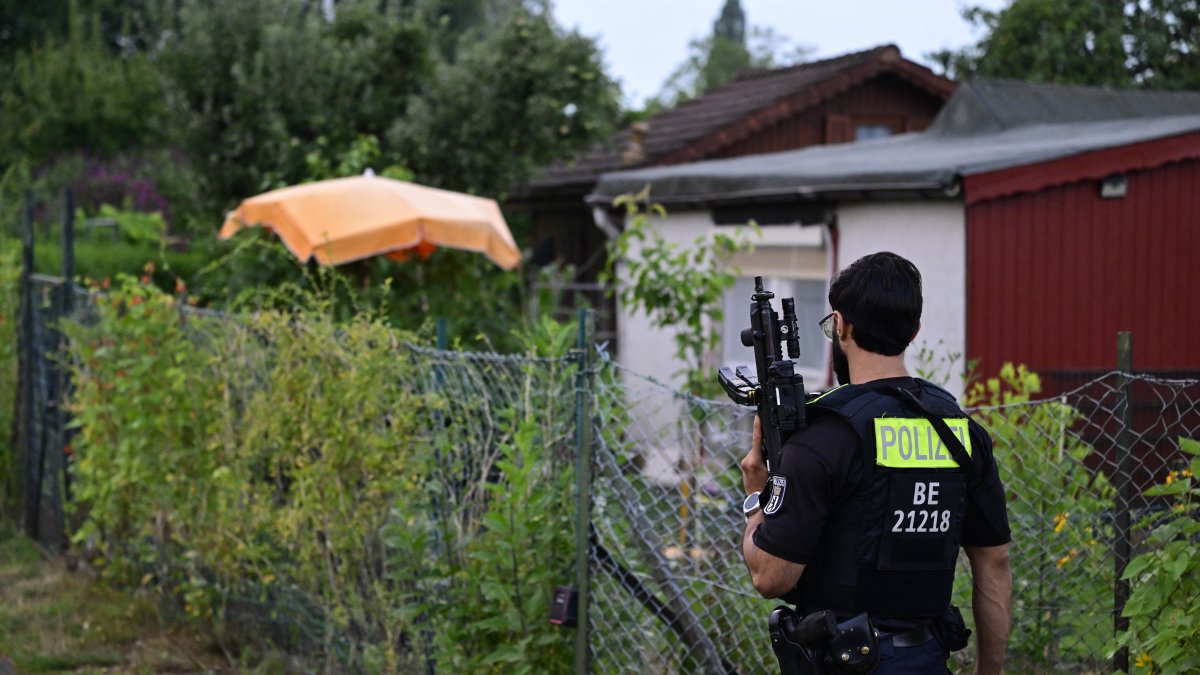
A police officer armed with an automatic weapon walks near the spot where Ballout was shot dead.
Let's just review the timeline. On Wednesday, July 23, on Manhattan's Upper West Side, a man stabbed two people while shouting "Allahu Akbar." That same weekend, in Toronto, shots were fired at two locations of a Jewish bakery chain. On Saturday, July 25, in Berlin, a van plowed into the crowd at the end of the Pride parade, killing one woman and injuring 29 others. On Monday, July 27, in Paris, a man stabbed three women—one of whom was pregnant—near Porte de Clichy, while repeating that "Allah ordered him to do it."
This is not a series of isolated incidents that chance happened to bring together in the same week. This is the new normal the West has learned to live with, and much of the public discourse continues to treat it as a statistical anomaly rather than a pattern that repeats itself, day after day, month after month.
Of the four cases, the one in Berlin best illustrates how the institutional apparatus that is supposed to prevent the explosive growth of Islamic terrorism actually operates (or rather, how it fails). The attacker, 21-year-old Abdul Ballout, was no stranger to the justice system. He had traveled in 2025 with the intention of joining the Islamic State in Syria and was arrested in Lebanon. Upon his return to Germany, a juvenile court sentenced him in May 2026 to one year and 10 months for planning a serious act of violence against the state and for spreading Islamic State propaganda. The prosecution had sought two years and 10 months; the court ruled that a shorter sentence was sufficient.
The sentence was suspended. Ballout was released that same month, on the sole condition that he attend a deradicalization program for offenders. The program was scheduled to include several sessions. He attended two. The program's organizers themselves, the Violence Prevention Network, acknowledged after the attack that they had already detected warning signs and were preparing to inform the authorities that Ballout's alleged cooperation appeared "insincere." No one acted in time. Days later, he killed a woman in the Tiergarten.

There's no need for a retrospective diagnosis by an outside analyst: German Chancellor Friedrich Merz himself publicly questioned why Ballout was still free, and Interior Minister Alexander Dobrindt was even more direct: given his history of support for the Islamic State, You can assume that it certainly would have made sense to put this person in custody." The German government itself acknowledged this: the system had a man convicted of planning an attack on behalf of the Islamic State in its grasp, and it decided that the correct response was a series of re-education sessions with civilian evaluators who did not even trust his sincerity.
As if that weren't enough, there was a second warning that was ignored: just three weeks before the attack, the police raided Ballout's home on suspicion of violating the firearms law, found nothing more than a toy gun and closed the case without further inquiry. A man convicted of jihadist terrorism, on probation, systematically skipping his own reintegration program, with the police knocking on his door weeks before the massacre—and not a single cog in the German state apparatus connected the dots.
Then there's the detail that borders on the absurd: the organizers of Christopher Street Day issued a statement on Sunday calling for the attack not to be "used for political ends" and for no group "to be placed under suspicion." The call to not "divide our society" is an automatic reflex, triggered by the mere fact that the suspect might be Muslim. Scenes like this—of attendees or progressive media outlets trying to tell the world that what their own eyes see is not reality—were repeated in the aftermath of the attack.
It's hard to describe these reactions without concluding that they stem from a pathological dogma. The demand to not use such incidents for "political ends" appears as a conditioned reflex whenever the perpetrator does not fit the "woke" framework of the oppressors and the oppressed.
If the driver of that van had been a member of the AfD, for example, the Islamo-leftist ecosystem would not have called for calm or restraint. It would have been on the front page of every newspaper in Europe for a week. This selective calm reflects a hidden moral hierarchy that decides, even before any investigation, which types of crimes deserve public outrage and which deserve a statement calling for restraint.
The weekend also left behind a snapshot that sums up the ideological confusion in which much of European progressive activism has become entangled. While the official Pride march was under attack by a radicalized Islamist, just a few miles away, in the Kreuzberg neighborhood, a parallel march was taking place—one that described itself as "queer," the Internationalist Queer Pride for Liberation, organized under "anti-colonial, anti-racist, and anti-capitalist" slogans. The police had to break it up due to repeated attacks on officers and antisemitic chants, resulting in 57 arrests and 17 injured police officers.
In other words: on the very same day, a sector of queer activism chose to demonstrate under a pro-Palestinian and antisemitic pretense, while the real danger to the LGBT+ community roamed freely. The inability of a significant portion of that activist movement to identify its enemies is not an anecdotal detail: it is proof that the ideological compass of the "intersectional" left automatically points toward Israel and the West—even on the very weekend when the real, lethal threat to the very people it claims to defend had a suspended sentence for supporting the Islamic State. Not even the bloodshed in the Tiergarten was enough to realign that compass.

World
Switzerland: Authorities call stabbing at train station near Zurich ‘terrorist attack'
Carlos Dominguez
This is not unique to Germany. It is the same pattern that we already saw in Winterthur, Switzerland, in May, when a Swiss citizen of Turkish origin stabbed three people at the train station while shouting "Allahu Akbar"; the same pattern we saw months earlier in London, when a man stabbed two Jewish people in Golders Green. The common denominator is not the attacker's nationality, nor the country where it occurs, but rather a society and an institutional system that, time and again, has identified, filed and even convicted the suspect, and decides that containing him isn't worth the political cost of keeping someone in custody to avoid accusations of Islamophobia.
While there is now debate in Germany over whether to reform the juvenile justice system for these cases, in France, regarding Monday's attack, the government is hesitating to classify the attack as Islamic terrorism, even though the attacker himself proclaimed it with his own mouth as he was being subdued on the floor. Bureaucratic caution in the face of the obvious is, in itself, part of the very same problem that left Ballout with two types of deradicalization and a suspended sentence: the gap between what the attacker says about himself in his own words, and what the system is willing to admit, so as not to acknowledge the suicidal nature of his agenda and at the risk of its citizens' lives.
LATEST