The mystery of Banksy: Contemporary art's most elusive identity finally uncovered?
An international investigation points to a specific name behind the iconic urban artist, but the enigma - and its meaning - remains more vivid than ever.
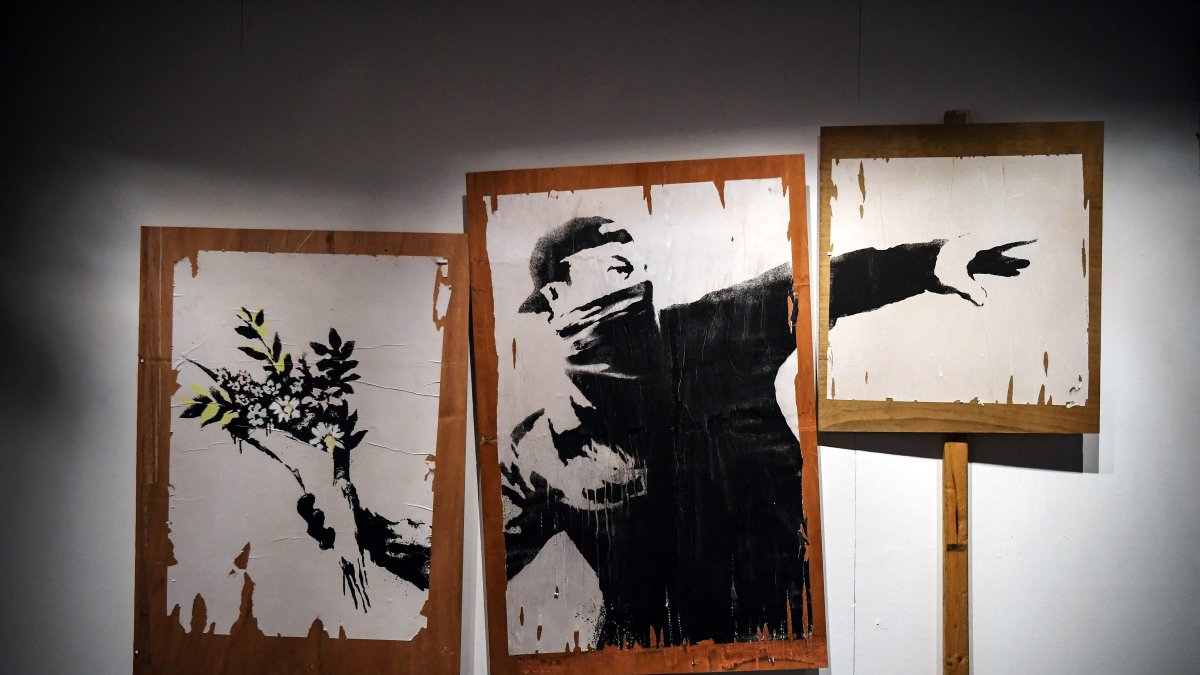
The artwork "Flower Thrower," or "Love is in the Air," by British artist Banksy.

For more than three decades, Banksy has been synonymous with anonymity, provocation and politically charged art. Their works have appeared unexpectedly on walls in cities around the world, always accompanied by an unanswered question: who is behind it?
Now, a Reuters investigation claims to have identified the artist as Robin Gunningham, a 51-year-old from Bristol. This is not the first time this name has come up, but the new report brings together court documents, public records and testimonies that reinforce the hypothesis.
One of the most striking findings is that Gunningham had reportedly legally changed his name to 'David Jones' in 2008, one of the most common combinations in the United Kingdom. A decision that, far from hiding him in the shadows, would have protected him in the full light: to be nobody in order to be anyone.
Culture
Klimt painting becomes the second most expensive work of art ever sold at auction
Diane Hernández
A trail between walls, wars and arrests
The research reconstructs the artist's journey through scattered but revealing episodes. Among them, an arrest in New York in 2000 after intervening in an advertisement in the middle of the city, where he reportedly even left a signed confession.
More recent moves are also tracked, such as his presence in Ukraine in 2022, where murals appeared in war-torn areas. Witnesses described a group working quickly and with their faces covered, in a scene that fits the artist's usual method.
For years, one of the names most associated with the mystery was that of Robert Del Naja. However, the report concludes that, although the two coincided in some places, their relationship would be more one of collaboration than of shared identity.
Art, the market and provocation
Beyond their identity, the Banksy phenomenon has redefined the boundaries between urban art and the global market. Works such as Girl with Balloon have become cultural icons, while others have reached million-dollar figures at auction.
In 2018, the artist surprised the world when one of his pieces self-destructed right after being sold, transforming into Love is in the Bin. The gesture was interpreted as a direct criticism of the system that commercializes street-born art.
The value of anonymity
In this sense, his invisibility would not be an eccentricity, but a tool: a way to be able to say what others cannot.
A mystery that may not need to be solved
Although the evidence points more clearly than ever toward a concrete identity, the figure of Banksy seems to resist being defined by a name.
Because perhaps the real impact of his work lies not in who signs it, but in what it provokes. In that image that suddenly appears on a wall and forces us to stop, to think, to make us uncomfortable.
If anything, this research leaves not only a possible answer, but a new question: does the myth lose strength when the person is revealed, or does it become, precisely for that reason, more human?
Perhaps Banksy was always that: someone common enough to disappear in the crowd... and brilliant enough for the whole world to be looking for him.
LATEST