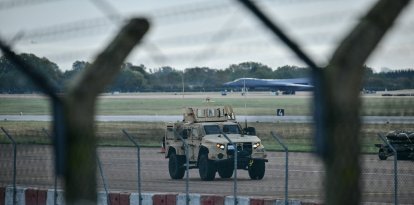
NATO fighter jets shoot down drone that entered Latvian airspace near Russian border
An Italian Eurofighter shot down the unmanned aircraft after it was detected over Latvian territory. NATO confirmed the operation, while Finland temporarily restricted air and maritime traffic in part of the Gulf of Finland as a precautionary measure.
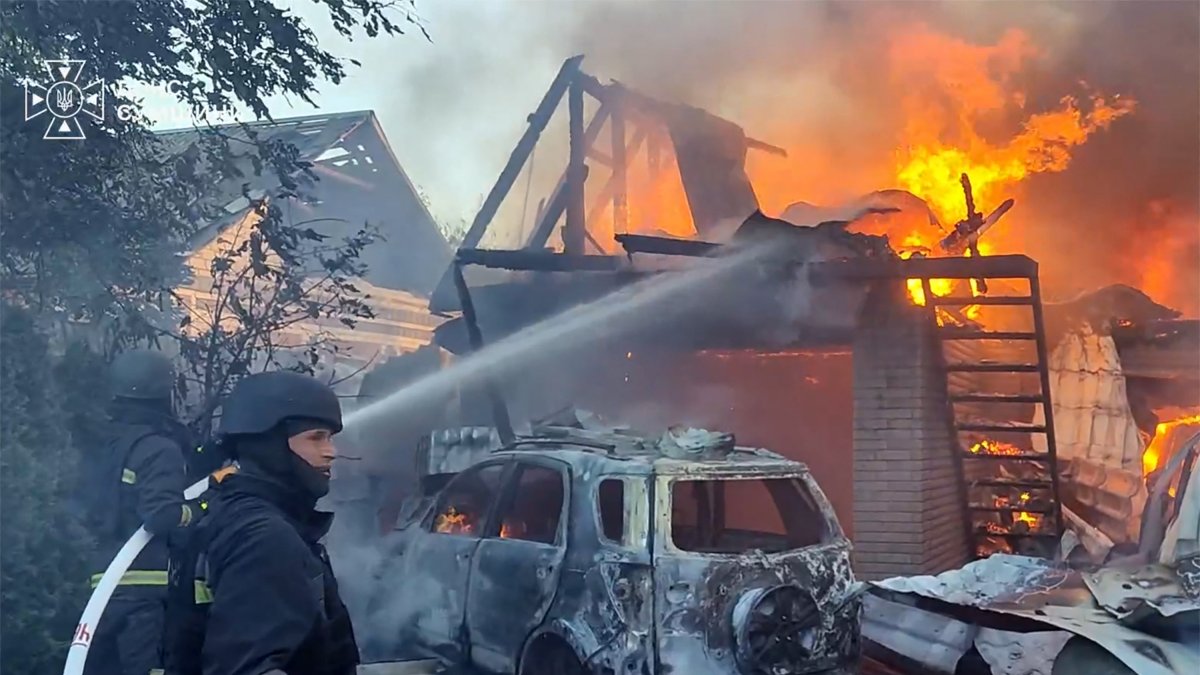
Ukrainian rescue workers battling a house fire following an airstrike

Fighters deployed under NATO command shot down a drone of as-yet-unknown origin on Friday that had entered Latvian airspace, in a new incident that heightens security concerns in the Baltic region amid the war between Russia and Ukraine.
The Latvian Ministry of Defense and Armed Forces initially reported the incursion, while NATO later confirmed that an Italian Eurofighter deployed on an air defense mission was responsible for shooting down the aircraft, according to AFP.
"All aircraft were operating under NATO command. An investigation is ongoing and NATO is in close contact with the Latvian authorities," explained NATO spokesperson Allison Hart, as reported by Reuters.
So far, authorities have not publicly determined the origin of the drone.
Italian Eurofighters and Turkish F-16s were deployed
NATO's response involved several aircraft deployed on the alliance's eastern flank.
According to information provided by Hart, two Italian Eurofighters took off from Lithuania and two Turkish F-16s were mobilized from a base in Estonia after the object was detected over Latvian territory.
One of the Italian Eurofighters finally identified the drone and proceeded to shoot it down.
NATO assured that it maintains a permanent capability to respond to potential threats in allied airspace. Its air defense and missile defense system specifically includes the Air Policing mission, through which allies continuously monitor the airspace of member countries.

World
Ukraine teaches the US a lesson in modern warfare: The Pentagon was outmatched by Ukrainian drones in a military exercise
Emmanuel Alejandro Rondón
Search underway for drone wreckage near Russian border
Latvian forces launched an operation to locate the wreckage of the aircraft in a wooded area near Rugāji, approximately 22 miles from the border with Russia.
A Latvian military spokesperson, Iveta Berzina, explained that definitive information on the drone's origin could not yet be provided because the area where it is believed to have crashed was still being searched.
The terrain—which consists of forests, marshy areas and few homes—has made the search for the wreckage difficult.
The drone's origin will be one of the key focuses of the investigation, particularly given the incident's proximity to Russian territory and the numerous incidents recorded in recent months in the Baltic states.
Finland temporarily restricts some air and sea traffic
The Finnish Defense Forces stated that the measure was taken as a precaution.
The region is particularly vulnerable to the effects of the drone war between Russia and Ukraine. In recent months, several unmanned aircraft linked to attacks on Russian territory have ended up straying into the airspace of neighboring countries.

World
Russia: Putin threatens to intercept Western ships in response to European actions
Carlos Dominguez
Baltic region has seen numerous drone incidents
Friday's shootdown is not an isolated incident.
In May, a Romanian F-16 deployed as part of a NATO mission shot down a Ukrainian drone that had entered Estonian airspace. Kiev later acknowledged the drone's origin and apologized to Estonian authorities.
In June, a French Rafale deployed on a NATO mission shot down another drone that entered Latvia from Russian territory. In that incident, Latvian authorities noted that the drone may have been diverted as a result of Russian electronic warfare activities.
Latvia maintains that some of these incursions may be related to the strong electromagnetic interference used by Russia in the region, which is capable of disrupting the navigation systems of certain drones. However, in Friday's incident, there is still no official attribution regarding the ownership or origin of the downed aircraft.
The series of incidents has made drone defense a growing concern for countries on NATO's eastern flank. In recent years, the alliance has strengthened its surveillance, air defense and critical infrastructure protection capabilities in that region against aerial threats and hybrid actions.
LATEST