ANALYSIS
‘The Price of Sustaining the Castro Regime’: Report accuses Spain and EU of playing key role in survival of Cuba’s communist dictatorship
For decades, Spain has treated the Cuban dictatorship as an inconvenient debtor, a historic partner and a strategic business destination. A new report from the Juan de Mariana Institute argues that this policy has ultimately served as a financial lifeline for Havana: debt forgiveness, debt-for-equity swaps, public cooperation and institutional support—all while the island continues to hold political prisoners, engage in systematic repression, face a mass exodus and maintain an economy in ruins.
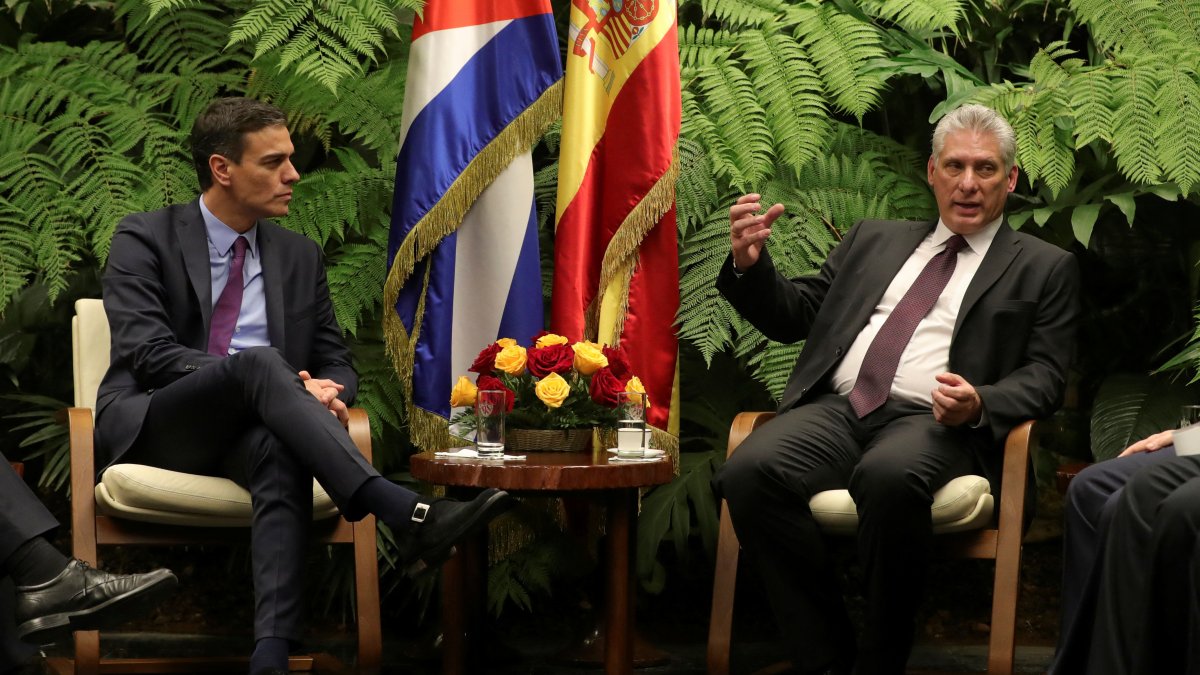
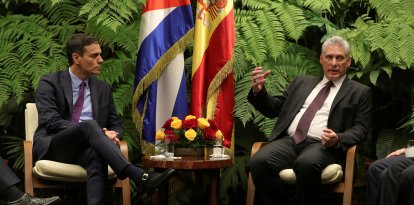
Cuban dictator Miguel Diaz-Canel (right) and Spanish Prime Minister Pedro Sánchez (File photo)

The figure that sums up the accusation is this: $2.7 billion (2.44 billion euros). That was, according to the report “The Price of Sustaining the Castro Regime,” the amount of Cuba’s debt to Spain that was restructured in 2016. Of that amount, Spain reportedly directly forgave nearly 1.5 billion euros, about 60% of the total. New relief measures followed: a debt conversion program of up to 375 million euros and a new operation valued at 291 million, which, according to calculations by the Juan de Mariana Institute, reportedly reduced Cuba’s obligations to Spain by nearly 90%.
In July 2025, the Spanish government presented the Debt Conversion Program with Cuba in July 2025 as a tool to channel up to 375 million euros toward sustainable development projects in energy, water, and food security. The Spanish government argued that the mechanism would transform debt into investments with a social impact.
The report, however, views the operation from the opposite angle: not as cooperation, but as financial lifeline for a regime that has offered no verifiable political reforms in return. Its central thesis is devastating: Spain has not supported a democratic transition in Cuba; it has helped lower the cost of the dictatorship’s survival.
"The most compelling evidence of the financial support Spain is providing to the Cuban regime is the series of debt relief, conversion and restructuring measures that Madrid has extended to Havana," stated Diego Sánchez de la Cruz, head of studies at the Juan de Mariana Institute, during an interview with VOZ.

A dictatorship subsidized in stages
The Castro regime was never self-sufficient. At first, it depended on the Soviet Union, which, according to the report, transferred more than $120 billion dollars to Cuba in aid, subsidies and loans. Later, Venezuela replaced Moscow as the main external supporter, with oil and transfers that, at the height of the Chavista alliance, accounted for up to 22% of Cuba’s GDP. More recently, Russia has once again taken on a central role through debt forgiveness, loans, payment deferrals and energy supplies. Mexico has also—albeit more discreetly—provided other forms of support to the island’s state apparatus.
Spain appears in this chain not as the largest financier, but as a “key player within the democratic world”: a member country of the European Union that, despite the repression on the island, has continued to normalize its financial and diplomatic relations with Havana.
The most sensitive issue is the debt. In 2016, Cuba owed Spain 2.44 million euros. According to the report, the initial debt forgiveness amounted to 1.5 billion euros. Subsequently, the 375 million euro Debt Conversion Program allowed outstanding obligations to be converted into projects on the island. In 2025, another debt relief operation of 291 million euros was added. The result, according to calculations by the Juan de Mariana Institute, is that the outstanding balance is around 286 million euros.
"In 2016, Spain recognized nearly 2.5 billion euros of Cuba’s outstanding debt, and today that figure is less than 300 million. That means that for every 100 euros of debt, barely 10 remain outstanding,” the economic analyst explained to VOZ.
The report goes further and calculates the effective financial cost: if Cuba had had to finance that debt under market conditions, with a compound interest rate of 8% per year, the balance would have reached about 5.28 billion euros ($6 billion) by 2026. Based on that scenario, Spain’s support would amount to a financial impact of nearly 5 billion euros. This is an estimate from the document itself, not an official figure from the Spanish government, which has kept these issues under wraps for decades.
The official argument: Cooperation and development
The Spanish government’s defense rests on one idea: converting unpaid debt into useful projects. According to Madrid, the program—worth up to 375 million euros—aims to fund initiatives in critical sectors such as energy, water and food security, and is linked to the multilateral agreement reached at the Paris Club.
But this raises the central question of this investigation: Can there be effective cooperation when the recipient is an opaque, one-party state with no free press, no independent parliamentary oversight and political prisoners?
The report by the Juan de Mariana Institute answers no. Anyone familiar with the reality in Cuba would also reach this conclusion. It argues that the funds, although formally labeled as development aid, ultimately serve to strengthen state capabilities in the hands of the very same political structure that represses Cuban society. It also mentions sales of police equipment, energy programs, administrative digitization, institutional cooperation, technical assistance and food aid.

The other cost: Prisoners, poverty and exodus
The financial dimension cannot be separated from the political context. In 2026, Cuba held more than 1,200 political prisoners, according to Prisoners Defenders, and hundreds of people linked to the July 2021 protests remained imprisoned or subject to restrictions.
Amnesty International warned in April 2026 that the releases announced by the regime continued to be marked by arbitrariness, a lack of transparency and the absence of guarantees of full release for those who were imprisoned for exercising their fundamental rights.
The Juan de Mariana Institute’s own report cites even higher figures from human rights organizations: thousands of prisoners held for political reasons, more than 20,000 political prisoners since 1959, and nearly 300 prisons or detention centers.
Added to the repression is economic collapse. The report states that the average real wage is equivalent to about $4 per month, that 89% of Cubans live in extreme poverty, and that seven out of 10 people are forced to skip at least one meal a day due to a lack of resources, according to studies by organizations such as the Food Monitor Program, which closely monitor the issue of food insecurity and the precarious conditions currently facing the island.
The exodus completes the picture. Between 2021 and 2024, more than 1 million Cubans left the island, an exodus equivalent to nearly a quarter of the population.
"There have been decades of cooperation with a one-party dictatorship that continues to maintain more than 300 prisons, hold more than 1,000 political prisoners, and repress any form of dissent. There has been no verifiable improvement in human rights nor any economic or political opening that would justify all these concessions," stated Sánchez de la Cruz.
Spanish companies: The partner that doesn’t get paid
This data shifts the political context. It is not merely a relationship between two states. There are also Spanish private companies trapped in a market where the regime controls payments, foreign currency, authorizations and the repatriation of profits. Spanish policy toward Cuba has combined public debt forgiveness with an inability to ensure that its own businesspeople get paid.
The moral problem
For years, Spain has justified its policy toward Cuba with a familiar formula: dialogue, presence, cooperation and influence. But the picture painted by the report is quite different. After decades of relations, Cuba remains a one-party dictatorship; civil liberties continue to be suppressed; the 2021 protests were punished with long prison sentences; the economy is collapsing and the population is fleeing en masse.
The question is no longer whether Spain should maintain relations with Cuba. All states maintain relations, in one way or another, with authoritarian governments. The question is what Cuban society gets in exchange for every financial concession granted to its government.
If the answer is greater transparency, more freedom, the release of prisoners and genuine openness, then such cooperation could be justified. But if the answer is opacity, default, repression and propaganda, then the Juan de Mariana Institute’s assessment gains traction: Spain would not be financing a transition, but rather ensuring the survival of a regime.

The price of looking the other way
The final figure—nearly 5 billion euros in actual financial cost, according to the Juan de Mariana Institute’s estimate—may be debatable as an economic calculation, but it is powerful as a political symbol. Because behind it lies a reality that is hard to ignore: while Spain forgives, converts and restructures debt, Cuba imprisons, impoverishes and expels its people.
“There can be no cordial relationship with Havana as long as Havana remains what it is—one of the pillars of evil in the West, a country that actively cooperates with all the authoritarian regimes that make life difficult for citizens of the free world, but which also oppresses its entire population with a totalitarian model that has been in place for decades and decades since 1959,” concluded Diego Sánchez de la Cruz.
That is the price of propping up the Castro regime. And also the price of looking the other way.
LATEST