The Canal of Death: The mass grave that reflects Ecuador’s violence crisis
The conflict between criminal organizations, the rise in disappearances and reports of abuses during the government’s crackdown on drug trafficking have turned a section of Guayaquil into the most harrowing illustration of the crisis facing this South American country.
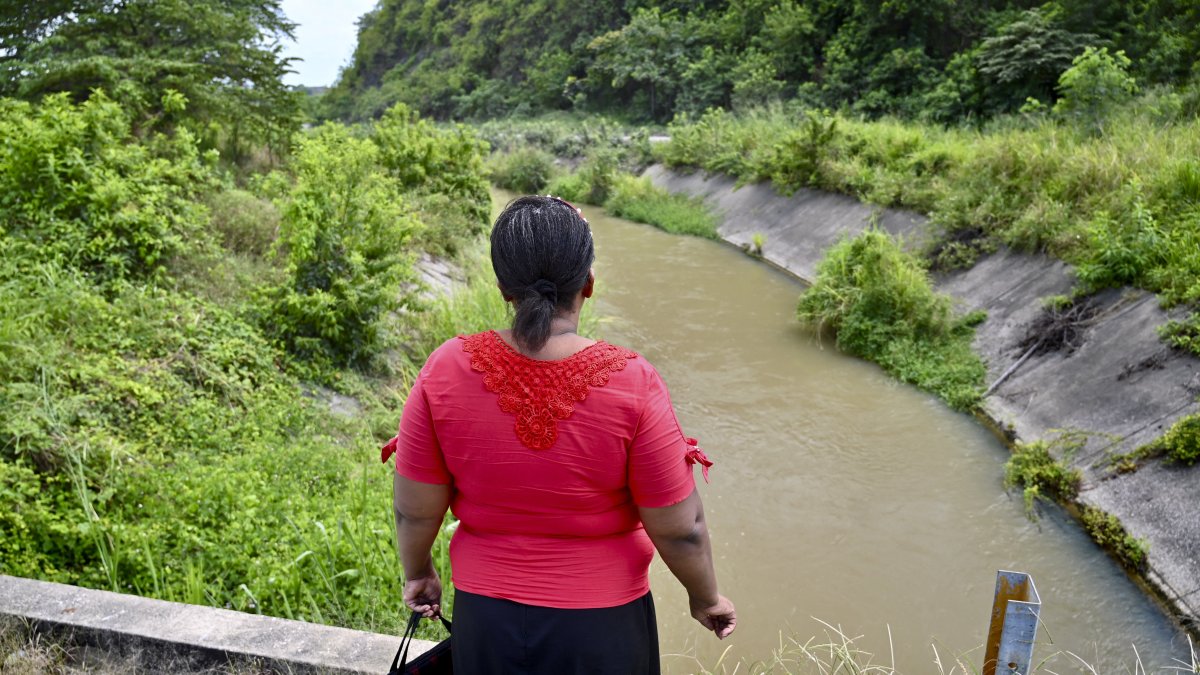
A woman living in Nueva Prosperina, where the Canal of Death is located
When a loved one goes missing, the search usually begins at hospitals, police stations or the morgue. But in a corner of Guayaquil, the most populous city in Ecuador, family members have learned that there is another place to look first: an irrigation canal turned into a clandestine open-air graveyard.
Locals call it the Canal of Death (Canal de la Muerte).
Stretching over 28 miles, this canal that runs through the Nueva Prosperina district—considered one of the most violent areas in the country—has become a symbol of the rise of organized crime and the collapse of public safety in this South American nation. There, bodies are found floating, human remains trapped between the floodgates and victims who, in many cases, were never officially searched for.
More than just a scene of horror, the canal epitomizes the profound transformation of a country that, just a decade ago, was considered one of the safest in Latin America and that today faces one of the highest homicide rates in the region, driven by the conflict between criminal organizations linked to drug trafficking.
A canal turned into a mass grave
In May, relatives found the body of 38-year-old Georgina Bermeo face down among the weeds and polluted water of the canal. Her husband, 43-year-old José Cedeño, was also murdered and dumped in the same spot.
According to their loved ones, both were victims of a robbery before being executed.
“Our only sin is being black,” Georgina’s sister told AFP, asking to remain anonymous for fear of reprisals from the criminal groups operating in the area.
The woman says she decided not to report the crime because, as she claims, “the police are in the pockets of criminals.”
Originally built to irrigate crops, the canal began to take on a different character after the COVID-19 pandemic, neighbors say. Since then, they say, bodies have begun to appear with increasing frequency.
Today, the dirt road that runs alongside the canal is surrounded by trash, stagnant water, starving dogs and vultures. There are no surveillance cameras or streetlights. Residents say that armed men on motorcycles control access to the area.

"Death comes to visit us"
Juan Ordóñez has lived in Nueva Prosperina for four decades. He has watched as the neighborhood went from being a peripheral area to becoming a territory contested by criminal gangs.
“We live in fear, with our doors locked, and there’s no way to open them because death comes to visit us,” he says.
He says he has seen bodies caught in the floodgates where the canal ends.
Since 2023, the National Police have recovered more than 100 bodies from this canal, some naked, others inside jute sacks. In November of that year, authorities also located a clandestine grave containing nine human heads, arms and torsos.
“They leave bodies—three to five—and they turn up floating here in the canal,” says Miguel Ángel Tenemaza, a 45-year-old taxi driver.
Lieutenant Christian Echeverría, a member of the unit specializing in violent deaths, agrees with that description. “It’s a place to dump bodies. They’re executed there or further upstream and are carried away by the current,” he explains.
During the three years he worked in Guayaquil, he admits he lost count of the bodies recovered.

The epicenter of the criminal war
Nueva Prosperina accounts for a large part of the deterioration in security in Ecuador.
The district is located in the northwest of Guayaquil, a city that is home to the country’s main seaport and one of the primary points of departure for cocaine bound for the United States and Europe.
Its strategic location has made the area a coveted territory for criminal organizations such as Los Tiguerones, Los Lobos and Los Choneros, which are locked in a struggle for control over drug trafficking routes, extortion and illegal economies.
Violence has been steadily escalating.
According to humanitarian analyses by ACAPS based on official Ecuadorian figures, between January and August 2025, Nueva Prosperina recorded 474 homicides, a 112% increase compared to the same period the previous year, making it the most violent district in Guayaquil.
The presence of the state is limited, and according to international organizations, gangs exercise territorial control through murders, extortion, kidnappings, the recruitment of minors and forced displacements.
Ecuador: From an oasis of safety to an epicenter of violence
For much of the 2010s, Ecuador ranked among the countries with the lowest homicide rates in Latin America.
That situation changed dramatically.
The rise of international drug trafficking, the fragmentation of criminal gangs following the capture or death of their leaders, and disputes over control of ports led to an explosive increase in violence.
Data from the Ministry of the Interior cited by Reuters shows that Ecuador ended 2025 with 9,216 homicides, an increase of nearly 30% compared to 2024, equivalent to an average of nearly one murder per hour.
Although authorities report a decrease in violent deaths during the first half of 2026, experts warn that violence continues to be concentrated in specific areas such as Guayaquil and its outskirts.

World
Ecuador launches nationwide offensive against drug trafficking with U.S. support
Sabrina Martin
Disappearances and complaints against security forces
Violence does not come solely from gangs.
Jonathan Villón disappeared in 2024 after being detained during a military operation, shortly after serving breakfast to his three children. He has not been seen since.
In March, the United Nations Committee on Enforced Disappearances reported receiving complaints regarding at least 51 disappearances allegedly committed by state agents since 2024, amid the security strategy promoted by President Daniel Noboa.
The driver of the military truck transporting the soldiers stated that Villón was left alive in the Canal of Death. His sister visited the site twice. After going public with the case, she claims she was forbidden from returning. “The last time, they chased me away at gunpoint,” she says.
Her partner was murdered last year, and after receiving threats, she fled Guayaquil with her mother. “The gangs work with the military,” she asserts.
Living under the control of gangs
Daily life in Nueva Prosperina is marked by a lack of basic services, constant fear and the dominance of criminal groups.
Taxi drivers avoid entering the neighborhood. Many homes remain abandoned. From a nearby hill, a police officer accompanying AFP points out several houses without windows. “They aim their rifles at us from there,” he says on condition of anonymity.
“Nothing is done here without their permission.”
For Eva Sevillano, a resident for three decades, the canal epitomizes the tragedy of a neighborhood that has become synonymous with violence. “They kill people elsewhere and dump the bodies here, and we’re the ones who suffer,” she laments as she clutches a Bible.
The Canal of Death doesn’t just receive bodies.
It also carries fear, impunity and the institutional decay of a country that is still seeking to regain control of territories dominated by organized crime.
LATEST