The three faces of guerrilla infiltration in Colombia's socialist government
Two unusual profiles of the security forces and a guerrilla chief are behind the alleged collaborations that have cast a shadow over Gustavo Petro's administration.

Colombian President Gustavo Petro

Colombia's president, Gustavo Petro, faces one of the worst scandals nine months from leaving power. Two unusual profiles of the public force and a guerrilla chief are behind the alleged collaborations that are casting a shadow over the government.
Who are they and what is behind this scheme?
General Miguel Huertas and intelligence director Wilmar Mejía were removed from their posts for allegedly exchanging sensitive information with alias Calarcá, the leader of a FARC dissident faction.
The guerrilla leader, in peace negotiations with the government without concrete progress, was searched at a checkpoint in 2024 where phones and computers were seized.
A journalistic investigation revealed dozens of chats found that show alleged information leaks so that the guerrillas could evade military controls in troubled territories. Also about the creation of a security company that would allow them to carry legal weapons even if the peace negotiations failed.
Petro accuses the CIA
The president asked the justice system to make a "forensic examination" of the evidence, in the hands of the prosecution.
The implicated are three: a sports graduate who quickly rose to become director of intelligence; a retired general reinstated in the Army, accused of links to criminal groups; and a rebel who rejected the historic 2016 peace agreement.

The sports graduate
With no military experience, Mejia went from being a physical education graduate and university representative to director of the National Intelligence Directorate in less than a year.
He joined the institution in May 2024 after providing “sensitive information” to the government as an informant, and from there his rise was meteoric.
In the documents he is nicknamed El Chulo, as the illegal groups call people close to the army who could be a "threat," as he himself explained in the media.
Mejia says he meets the two essential qualities to enter Colombia's intelligence: "generating trust" to "go unnoticed" and having "access" to “privileged information from the actors in that territory.”
"Being an intelligence agent does not demand a professional career per se," he assured.
Mejia is also Petro's appointee to the public University of Antioquia, an unusual combination.
He met the president in the early 2000s when he was a student leader.
Media and sources consulted by AFP point to Mejía as being in charge of the purge of high ranking military officials during Petro's term.
For Juana Cabezas, researcher at Indepaz, his "closeness with the armed groups and the government" is "evident." Mejía meanwhile denies it.
The retired general
General Huertas was suspended in 2021 by the previous government following a CIA warning about his alleged links to the ELN guerrillas, according to then Interior Minister Daniel Palacios.
Very active in Petro's presidential campaign, Huertas was reinstated in the army in August as head of the Personnel Command, the division that decides hiring and firing.
In the seized files, Huertas is linked to the creation of a security company with a legal appearance so that the dissidents could move around in armored vehicles and carry weapons.
Mejia is a "friend" of Huertas and supported his reintegration, an unusual decision in the army.
"I dared to advocate for him," he said.
Huertas denies "any links" with illegal groups.
The guerrilla
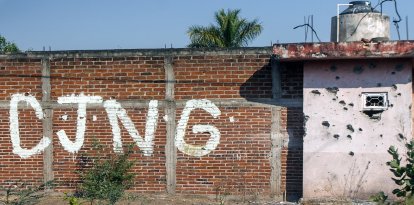
The guerrilla Alexander Díaz, alias Calarcá, was an associate of the most wanted man in Colombia, Iván Mordisco, who has since become his fiercest enemy.
An adversary that he shares with President Petro, who compares Mordisco to Pablo Escobar and is targeting him with deadly airstrikes.
Calarcá and the government maintain talks, but their attacks against the security forces continue and dissidence has strengthened in recent years.
LATEST