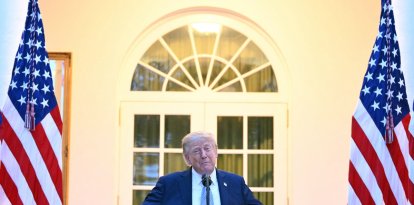
Trump and Netanyahu agree and move towards a new plan to achieve peace in Gaza
The summit between the two leaders seeks to establish a roadmap to end the conflict amid growing international pressure and a recent diplomatic shift toward recognition of Palestine as a state by several countries.

President Donald Trump welcomes Israeli Prime Minister Benjamin Netanyahu.

U.S. President Donald Trump met today at the White House with the Israeli Prime Minister Benjamin Netanyahu with the aim of consolidating a peace plan for Gaza.
The summit seeks to establish a road map to end the conflict amid growing international pressure and a recent diplomatic shift toward recognition of Palestine as a state by several countries.

The meeting, which included a three-way phone call with Qatari Prime Minister Mohammed bin Abdulrahman bin Jassim Al Thani, represents a key effort by the Trump Administration to mediate in the region.
President Donald J. Trump hosts a trilateral phone call with Prime Minister Benjamin Netanyahu of Israel and Prime Minister Mohammed bin Abdulrahman bin Jassim Al Thani of Qatar in the Oval Office. pic.twitter.com/ekbKg3WDZQ
— The White House (@WhiteHouse) September 29, 2025
According to White House statements, the leaders discussed a detailed proposal to end the war in Gaza, improve security in the Middle East and foster greater understanding between the parties involved. In addition, Trump praised Netanyahu and Al Thani's willingness to cooperate in pursuit of regional peace and security.
International pressure and the 21-point plan
The meeting comes at a critical time, just days before the second anniversary of the Hamas attack on Israel on October 7, 2023.

JNS
Israeli attack on Iran nuke program ‘will go down in annals of military history,’ Netanyahu tells UN
JNS (Jewish News Syndicate)
Highlights of the plan, as detailed by the White House on its X account, include:
President Donald J. Trump’s Comprehensive Plan to End the Gaza Conflict:
— Rapid Response 47 (@RapidResponse47) September 29, 2025
1. Gaza will be a deradicalized terror-free zone that does not pose a threat to its neighbors.
2. Gaza will be redeveloped for the benefit of the people of Gaza, who have suffered more than enough.
3. If… pic.twitter.com/veqhr9MW28
- Immediate cease-fire: once the agreement is signed, all military operations, including aerial and artillery bombardment, would be suspended, freezing battle lines until conditions for a full and phased withdrawal of Israeli forces are met.
- Release of hostages and prisoners: Within 72 hours of public acceptance by Israel, all hostages - dead and alive - held by Hamas would be returned. In return, Israel would release 250 life-sentenced prisoners and 1,700 Gazans held after October 7, 2023, including all women and children. For each remaining Israeli hostage released, Israel would release the remains of 15 deceased Gazans.
- Gradual withdrawal and disarmament: Israeli forces would withdraw from Gaza in a manner supervised by international mechanisms, while Hamas would disarm. A transitional international Arab-Palestinian transitional authority would be established to administer Gaza temporarily, with guarantees that Israel would not annex the West Bank, an essential condition for maintaining Arab support.
- Governance and reconstruction: Gaza would be governed by a technocratic, apolitical Palestinian committee, overseen by a new Trump-led "Peace Board," with participation by figures such as former British Prime Minister Tony Blair and other leaders to be announced. This body would manage funding for redevelopment, including the rehabilitation of infrastructure such as water, electricity, hospitals and bakeries, as well as rubble removal.
- Humanitarian aid and economic development: immediate aid would be sent consistent with previous agreements, distributed by the UN, Red Crescent and other neutral institutions. An economic development plan would be created to revitalize Gaza, with a special economic zone, attracting investment to generate jobs and opportunities. No one would be forced to leave Gaza, and the population would be encouraged to stay in order to build a better future.
- Security and demilitarization: Hamas and other factions would commit to opt out of governance, destroying all military infrastructure, including tunnels and weapons. A temporary International Stabilization Force (ISF) would be deployed, in collaboration with Arab partners, to train Palestinian forces and secure borders, with the U.S. facilitating the flow of goods and preventing the entry of munitions.
- Dialogue and political horizon: a process of interfaith dialogue would be advanced to promote tolerance and coexistence. As redevelopment and reforms in the Palestinian Authority progress, conditions would be created for a Palestinian state, recognizing this aspiration of the Palestinian people. The United States would facilitate a dialogue between Israelis and Palestinians for peaceful coexistence.
The White House emphasized that Gaza would be transformed into a “deradicalized terror-free zone” redeveloped for the benefit of its people, who have suffered unspeakably. “If both sides agree to this proposal, the war will immediately end,” read the official statement.
In a press conference following the meeting, President Trump thanked Netanyahu for accepting the plan, stressing that, working together, it is possible to “bring an end to the death and destruction that we’ve seen for so many years, decades, even centuries, and begin a new chapter of security, peace and prosperity for the entire region.”
🚨 BREAKING | President Trump on Middle East peace:
— VOZ (@Voz_US) September 29, 2025
"If Hamas rejects the deal, which is always possible... as you know, Bibi, you'd have our full backing to do what you would have to do."
pic.twitter.com/ZzZvpvnIn5
In that regard, the Republican leader noted that Israel would have his “full backing to do what you would have to do” should Hamas not agree to the proposal.
Toward a hopeful future
LATEST