France: Massive opposition to budget cuts puts Macron's government on the hot seat
Both the left and the right have announced their vote against the budget, going so far as to call for Macron's ouster if the government falls.


French politics is living days of vertigo. The instability that has been shaking the country for months could lead to the fall of the government of Prime Minister François Bayrou and, with it, a new crisis that would put the leadership of President Emmanuel Macron in jeopardy.
The French government faces a critical scenario: in the coming weeks, Bayrou will present an economic plan with budget cutting measures that promises to generate rejection from both the left and the right. The result? A possible dissolution of the government and a new headache for Macron.
A "matter of survival"
Bayrou's plan, which will undergo a vote on Sept. 8 in Parliament, seeks to address France's severe fiscal deficit, which stands at 5.8% of GDP, far exceeding the 3% limit allowed by the European Union (E.U.). The proposed measures include a budget cut of 44 billion euros, a decision that the prime minister called a "matter of survival" for the nation. However, the lack of a solid majority in Parliament puts the approval of these measures at risk. If the plan fails to win the necessary backing, Bayrou has warned that his government will collapse, which would force Macron to form a new coalition in an increasingly polarized political context.
Opposition united against Macron
The opposition has not been long in coming. From the right, Jordan Bardella, leader of the party Rassemblement Nationale (RN), has made it clear that he will not support a government whose policies, according to him, "make the French suffer." The radical left, led by Jean-Luc Mélenchon, has also announced its vote against the budget, going so far as to call for the impeachment of Macron if the government falls. Mélenchon, known for his combative rhetoric, accused the president of generating "chaos" and demanded an end to his leadership. Even the environmentalists of the Greens have joined the rejection, making the survival of the current government look increasingly unlikely.
This panorama of uncertainty is not new. Since Macron dissolved the National Assembly in June 2024, following the advance of the right wing in the European elections, France has failed to find a political balance. The legislative elections that followed strengthened both the right and the left, weakening the political center that Macron represents. Without a clear alliance between the center and any of the extremes, forming a stable coalition has become an almost impossible task. This scenario, which has been going on for more than a year, has generated significant wear and tear for the president, whose term of office ends in 2027.
Recognition of a Palestinian state as a "death knell"?
The crisis does not only have domestic implications. According to an analysis by journalist Nissan Shtrauchler, of the Israeli newspaper Israel Hayom, a new political setback could lead Macron to focus more on foreign policy to compensate for his domestic difficulties. In particular, it highlights his interest in leading international initiatives, such as the recognition of a Palestinian state at the next U.N. General Assembly in September. This move, which seeks to consolidate his legacy in the global arena, could generate tensions with countries such as Israel, especially at a time when bilateral relations are already under scrutiny.
Mass demonstrations against the plan
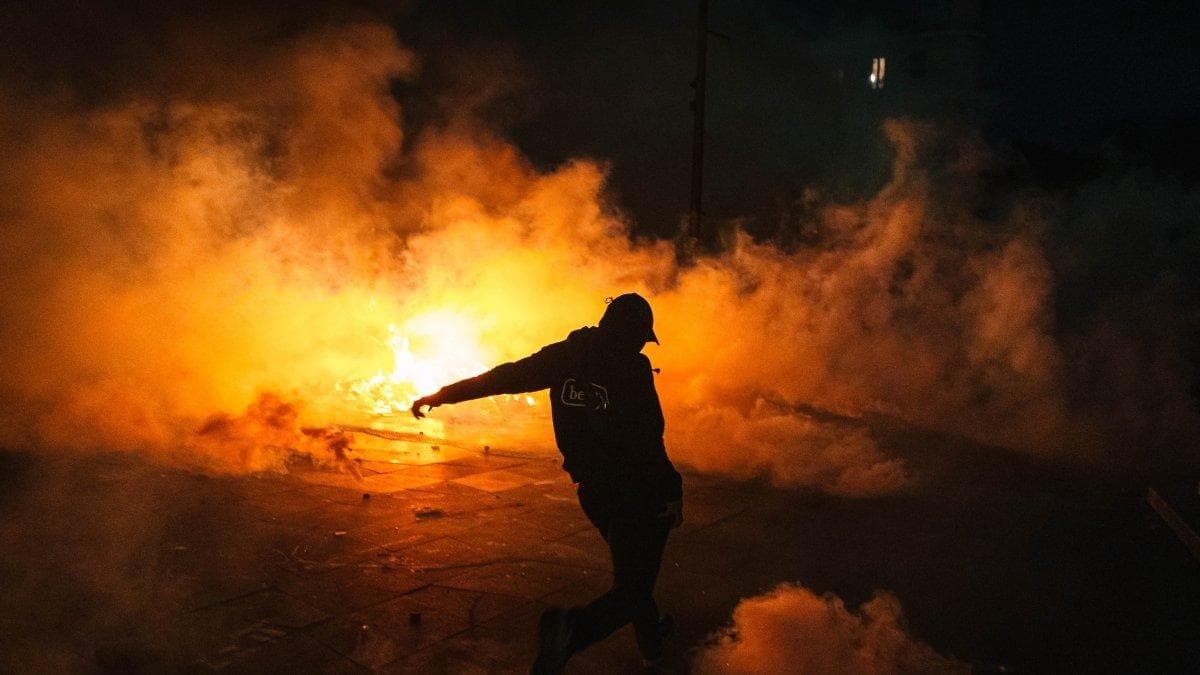
Meanwhile, French society is also reacting. Unions have called for mass demonstrations for Sept. 10 in rejection of the proposed cuts, adding pressure to a government already walking a tightrope.
Turning points for France
In conclusion, France is facing a definitive moment. The vote on Sept. 8 will not only determine the future of Bayrou's government, but could also set the country's course in a context of growing polarization. Will Macron be able to weather this political storm or will it be the beginning of a new chapter of instability? Only time will tell.
U.S. envoy accuses France of failing to act on antisemitism
In an open letter to French President Emmanuel Macron published in The Wall Street Journal, Charles Kushner expressed his "deep concern over the dramatic rise of antisemitism in France and the lack of sufficient action by your government to confront it." The letter goes on to state that "not a day passes without Jews assaulted in the street, synagogues or schools defaced, or Jewish-owned businesses vandalized."
The letter is dated Aug. 25, despite being published a day earlier, a date Kushner notes is "the 81st anniversary of the Allied Liberation of Paris, which ended the deportation of Jews from French soil" under Nazi German occupation.
Antisemitism has "long scarred French life," Kushner wrote, but has "exploded" since the Oct. 7 massacre and amid the subsequent war in Gaza.
🛠 Do you think there is an error in this article?
Recommendations





LATEST