ANALYSIS: The Kremlin on the Ropes — Russia’s Economy Collapses After Three Years of War
The Ukrainian resistance has been so heroic that the war has been extended for three long years in which Vladimir Putin's regime seems to be getting closer to the Soviet decline in Afghanistan than to the red incursion in Berlin, leading Russia to an unthinkable economic attrition.
A year after invading Ukraine, the international community was perplexed at how the Russian economy had improved compared to 2022, representing clear evidence that the Kremlin was strong enough to resist both Western sanctions and the pariah status it had fallen into after initiating a war that began as a countdown to the total annexation of a country, and today may end up signifying a historic mistake.
Although the state of the Russian economy was also solid enough to withstand the expense of the war, this seemed to be an irrelevant detail in the face of what was seen as the inevitable Russian crushing, being the second most powerful army in the world and a country that - a priori - did not have enough capacity to face it for even a couple of months. However, the Ukrainian resistance has been so heroic that the war has been extended for three long years in which Vladimir Putin's regime seems to be getting closer to the Soviet decline in Afghanistan than to the red incursion in Berlin, leading Russia to an economic attrition so unthinkable that the Kremlin has been forced to take three paths as uncomfortable as humiliating: having to publicly acknowledge the economic debacle, considerably reduce its expansionist ambitions with Ukraine, and having to hurry up its war operations in the invasion before the White House decides to impose a new package of sanctions that could already be devastating.
Unexpected admission
The public acknowledgment of the economic abyss Russia is heading for came shortly before the St. Petersburg Forum, an event at which Putin has been known to combine real data and propaganda in recent years. The one who took it upon himself to state in the starkest way the current reality was none other than the economic advisor to the Presidential Administration, Maxim Oreshkin, who not only assured in a blunt manner that "this growth model has been exhausted", but also stressed that it was "necessary to move, not forward, but upward: towards the next technological and organizational level."
Already during the event, Economic Development Minister Maxim Reshetnikov warned that "we are on the brink of recession", with Russian central bank governor Elvira Nabiullina detailing that the reserves that kept the accounts finally "have been depleted". In this way, two of the most important figures of the Russian regime recognized that the plan executed by the Kremlin to shield itself from Western sanctions and continue with the invasion without seeing its economy affected has failed, thus laying bare the miseries of a confused and erratic Moscow, pointing to a destiny for which there only seem to be painful paths.
An almost empty war chest
Since the Russian Armed Forces penetrated the Ukrainian borders in 2022, Russia has experienced economic growth driven by both its war industry and its money from the Russian National Wealth Fund, also known as the 'war chest', which has enabled it to withstand sanctions and the inevitable increase in military spending in times of armed conflict. According to what has been publicly stated by the Kremlin, this fund seems to have been squeezed to the point where this pillar of its strategy has ceased to be sustainable and will not be able to withstand the demands of an increasingly bogged-down war.
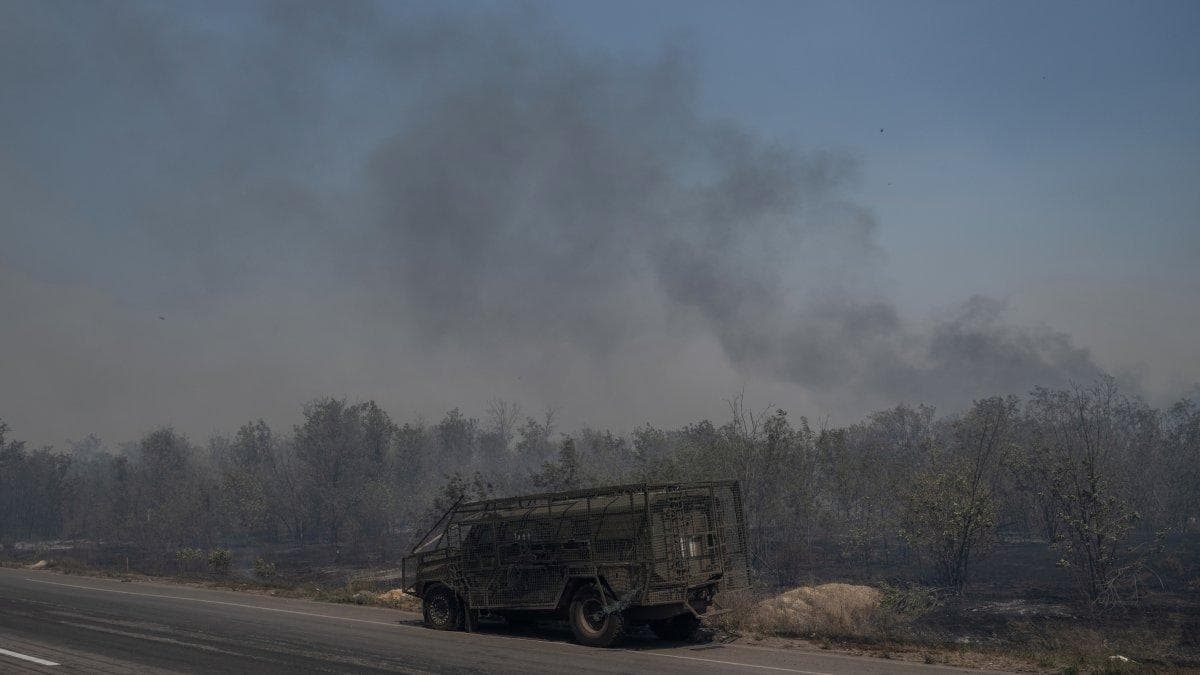
Military vehicle in the middle of a Ukrainian road.AFP
In May, the national wealth fund recorded a historic decline as it saw its liquid assets reduced to just $35.7 billion. To make the picture bigger, Putin's war chest has shrunk by no less than 71% since the Russian leader decided to invade Ukraine in 2022, a year in which the fund's liquid assets stood at $135 billion and represented 10% of the country's GDP.
While today one can think of the hundreds of projects that could have been developed with this money, the fact is that the Kremlin was not so far-fetched back then: in the face of the drastic aggrandizement of the Russian military-industrial complex and all that would have to be spent on defense, the fund would be used to keep the whole thing running smoothlyin the face of the sanctions package triggered by the West, which would not represent any risk in the case of a war that, in the worst case scenario, could last a year, because it would be almost impossible for a country like Ukraine to resist against the second largest army in the world. After all, exacerbated wartime defense spending requires a fund to keep the country from crumbling in the face of the elephantine expenditures that the military industry will inevitably pour out at a steady pace to materialize victory.
The problem with this whole scenario is when victory is not only slow in coming, but becomes increasingly difficult to materialize, considering that in such a circumstance the only options are to either abandon the war or further increase spending to stay in it. The latter is exactly the point at which the Kremlin finds itself, with a Ukrainian resistance that proved to be more solid than a Russian economy that has finally started to show itself vulnerable to sanctions, after being absorbed for more than three years in a war whose goal of erecting a puppet government or annexing an entire country seem already impossible to materialize.
Sanctions today directly affect Putin's war chest, the heart of his economic plan since the invasion, since the Russian economy is largely based on natural resources such as oil or gas, which generate an income that goes into the fund when their prices are high. Detecting this weakness, part of the sanctions have consisted in imposing restrictions on both resources, which has made the Kremlin spend much more than it takes in and has made it impossible for it to continue to replenish its fund, which has been severely weakened by having to disbursealmost $20 billion this year alone.
A monster that devours itself.
The perfect storm materializes in the face of the fact that military spending has been so disproportionate that today it represents a 7.2% of Russian GDP, this being twice what it represented shortly before the invasion in 2022. We are talking about a juncture in which the invasion of Ukraine may end up representing an economic suicide with unpredictable consequencesfor Russia. And the fact is that, without realizing it, Putin enlarged a military industry that has ended up becoming addicted to war and has permeated almost all layers of the country, by hiring millions of people and offering salaries that are more than succulent by Russian standards. While defense spending ended up strengthening the economy during the early years, today it is a drag that has been severely affected also by the casualties Russia has suffered, which may have already exceeded one million.
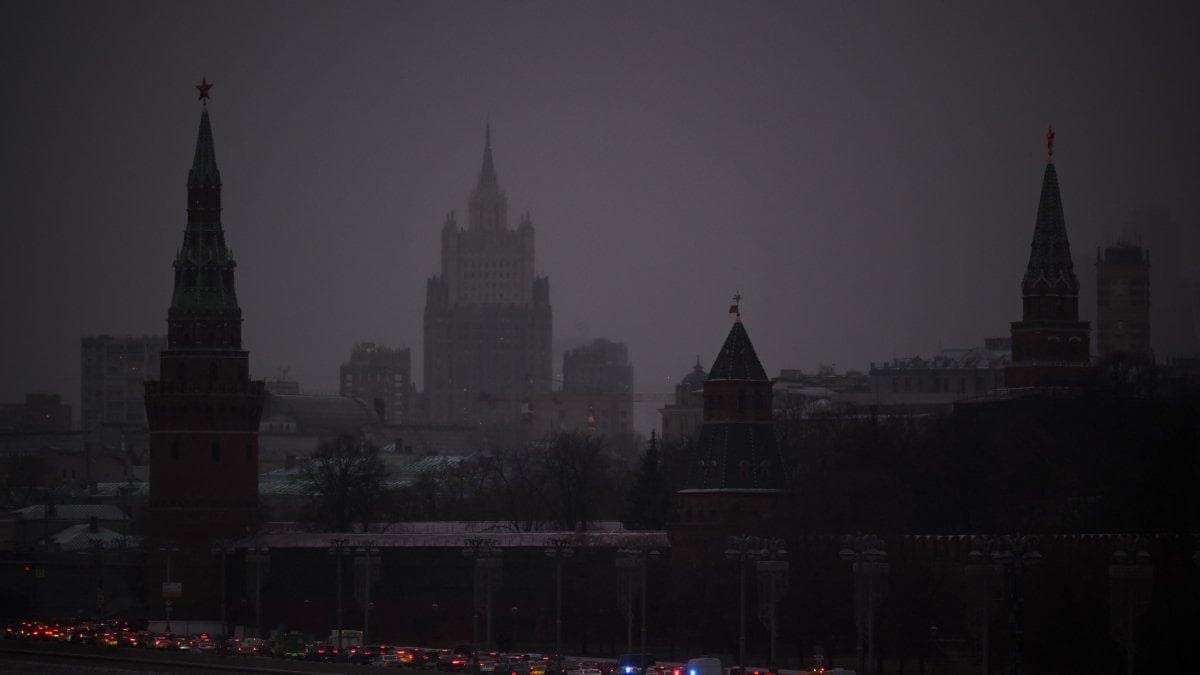
Vehicular traffic near the Kremlin.AFP
Faced with such a reality, recruitments by the Russian Army have multiplied, generating a considerable reduction in manpower that has forced the Kremlin to have to hire North Koreans and Afghans, not only to swell the invading troops, but also to get into construction-related jobs. Of course, such an act clearly violates a 2017 United Nations Security Council law prohibiting any kind of employment of North Korean workers abroad, which was no impediment to the Kremlin bringing in a total of 13,221 North Koreans over the past year. At this point, the Russian government is expected to bring in six thousand more from the Asian country and a thousand from Afghanistan, a figure that could rise as the weeks pass and casualties on the front line increase.
Putin has entered a context in which maintaining military spending has become an operation as unsustainable as it is self-destructive. And, despite the fact that the Russian leader has publicly hinted that he will reduce spending, the paths left to the Kremlin in the face of this situation are as complex as they are delicate.
Labyrinths and outcomes
It is no secret that the solution the Kremlin could count on to escape the current economic crisis and an even more Dantesque near future would be to restitute its status as the top exporter of gas and oil to Europe and drastically cut military spending. However, such a solution seems uphill considering not only the time it would take the Russian government to rebuild its commercial relationship with Europe as the main destination of its energy exports, but also the enormous amount of concessions it would have to offer for this part of the world to see the Kremlin as a sufficiently reliable actor to depend on it again at the energy level.
Likewise, cutting military spending could have as its main obstacle the Russian military, as these are the most benefited from a gear in which they count not only with more power but also with better economic benefits, to the point that today a Russian soldier earns more than 2.000 euros per month, a more than acceptable amount in a country like Russia, where the minimum wage does not reach 300. Thus, the strategy created by the Kremlin has been so broken down and spoiled by Ukrainian resistance and Western sanctions that at this point a peace agreement would imply a return to a near past in which the Russian military had lower economic benefits and earned a quarter of the current salary. And, given the precedent of Yevgeny Prigozhin and his Wagner group, the Kremlin is fully aware that the military establishment can become an unimaginably dangerous actorif decisions detrimental to it are made.
In the case of wanting to continue the invasion no matter what, the only tangible path for the Kremlin would be to further tighten its relationship with China and have Beijing as its great military and financial ally. To materialize a major economic restructuring in which the Chinese regime would be deeply involved, thus creating an unprecedented dependence on the Asian giant in which Russia would inevitably directly or indirectly cede part of its sovereignty, opening the possibility of becoming the cog in another geopolitical power. Of course, Beijing's clarity on this reality has been unquestionable enough to see Foreign Minister Wang Yi commenting (according to several media reports) to European Union foreign affairs chief Kaja Kallas that the communist regime prefers Russia to win the warbecause of the way such a scenario would keep U.S. attention away from China.
The Kremlin has entered a complex labyrinth as a result of a decision based on erroneous premises, anachronistic thinking and the underestimation of a country that has been willing to the unspeakable to avoid being absorbed by Moscow. At this point, victorious outcomes are almost non-existent, and almost inevitable those that mark the turning point that divides not only periods, but also the destinies of leaders and regimes that were perceived as indestructible.
🛠 Do you think there is an error in this article?
Recommendations

LATEST