Ukraine denounces the use of Indian parts in Russian drones and further strains the relationship between Trump and Modi
The Ukrainian complaint comes at a time of friction between U.S. President Donald Trump and Indian Prime Minister Narendra Modi due to strengthening trade ties between New Delhi and Moscow.

Ukrainian defense repels Russian drones in the sky.

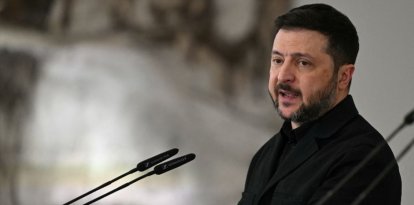
Ukraine has denounced the presence of parts made in India in Russian drones used to attack both military and civilian positions on its territory as part of the invasion ordered by Vladimir Putin.
The revelation, made public on Tuesday by Andri Yermak, head of the Ukrainian presidential office, has stoked geopolitical tensions, especially between the United States and India, against a backdrop of growing trade and diplomatic pressure.
"Unfortunately, Indian components appear on Russian attack drones. These are drones that are used on the front lines and against civilians, in particular the Shahed-Geran," Yermak wrote on his Telegram channel, according to reports from Reuters. Yermak urged depriving Russia of access to foreign components that enable the manufacture of these weapons, noting that their use facilitates "the murder of Ukrainians."
The Ukrainian complaint comes at a time of friction between U.S. President Donald Trump and Indian Prime Minister Narendra Modi due to strengthening trade ties between New Delhi and Moscow.
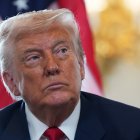
Trump accused India of financing the Russian war machine by “buying massive amounts of Russian Oil,” and reselling it “for big profits” on the international market.
In a post on his Truth Social platform, the Republican announced that he will impose tariffs on Indian exports in retaliation, although he did not specify the percentage. "They don’t care how many people in Ukraine are being killed by the Russian War Machine,” he wrote.
Indian government responds
For its part, the Indian government responded strongly, calling the accusations by Washington and the European Union (EU) "unjustified" and "unreasonable." In a communication, India's Foreign Ministry defended its right to protect its energy security and strategic interests, stressing that its trade policy should not be questioned.
The Russian oil trade has allowed Moscow to partially circumvent sanctions imposed by the United States, the EU and other allies, securing revenues that, according to Ukraine and its partners, finance the military offensive in the east of the country. Russian shelling, which includes the use of drones such as the Shahed-Geran, has caused thousands of civilian casualties, according to a report by the United Nations.

In response to the diplomatic impasse, Trump has redoubled international pressure. Last week, he issued a ten-day ultimatum to the Kremlin to negotiate a peace deal, threatening secondary sanctions on countries such as India and China, the largest buyers of Russian oil. In addition, the U.S. president sent his special emissary, Steve Witkoff, on a tour of Middle East and Russia.

Witkoff to meet with Putin soon
Steve Witkoff, who already met with Putin in April, will arrive in Moscow between August 6 and 7 for talks with Kremlin officials. Spokesman Dmitry Peskov confirmed Russia's readiness to meet with Witkoff, calling the talks "important and very useful," according to reports from The Guardian.
Zelensky thanks Trump for peace efforts
In that regard, the Ukrainian expressed his gratitude: “we are grateful to @POTUS for all efforts toward a just and lasting peace” and noted that the war could have ended earlier if Russia had not prolonged it.
According to Zelensky, during the talk, the two leaders coordinated positions between Ukraine and the United States, exchanging assessments on the escalation of Russian attacks. “President Trump is fully informed about Russian strikes on Kyiv and other cities and communities,” he said. They also discussed sanctions against Russia, whose economy "continues to decline," making Moscow a "sensitive prospect" to President Trump’s "resolve."
In addition, he thanked NATO countries for military support, including commitments from The Netherlands, Sweden, Norway and Denmark for more than $1 billion in U.S. arms. He then ended with a general thank you: “Thank you to every American heart that supports our defense of life. Thank you, President Trump!”
LATEST